

26
H. Bichsel and H. Schindler
of an electron in an ionising collision is limited to half of its kinetic energy,
E max =
1
2
mc
2 (γ − 1) ,
(2.29)
as primary and secondary electron are indistinguishable. Stopping power tables for
electrons are available in ICRU report 37 [67] and in the ESTAR database [61].
The other main mechanism by which fast electrons and positrons lose energy
when traversing matter is the emission of radiation (bremsstrahlung) due to
deflections in the electric field of the nucleus and the atomic electrons.
2.4.1 Bremsstrahlung
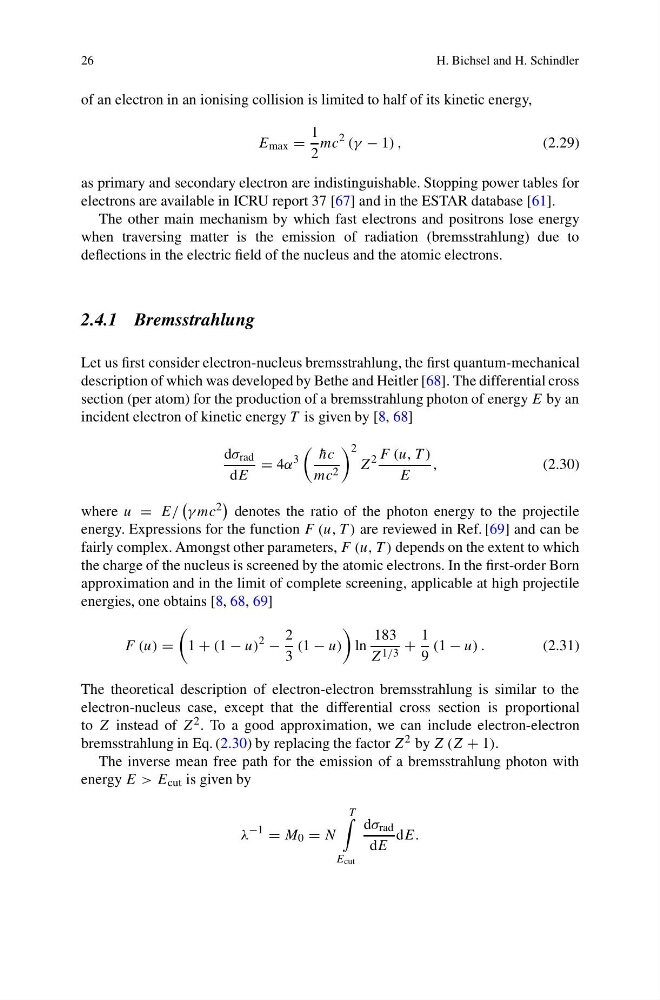
Let us first consider electron-nucleus bremsstrahlung, the first quantum-mechanical
description of which was developed by Bethe and Heitler [68]. The differential cross
section (per atom) for the production of a bremsstrahlung photon of energy E by an
incident electron of kinetic energy T is given by [8, 68]
dσ rad
dE
= 4α
3
¯
hc
mc 2
2
Z
2 F (u, T )
E
,
(2.30)
where u = E/
γ mc 2
denotes the ratio of the photon energy to the projectile
energy. Expressions for the function F (u, T ) are reviewed in Ref. [69] and can be
fairly complex. Amongst other parameters, F (u, T ) depends on the extent to which
the charge of the nucleus is screened by the atomic electrons. In the first-order Born
approximation and in the limit of complete screening, applicable at high projectile
energies, one obtains [8, 68, 69]
F (u) =
1 + (1 − u)
2
−
2
3
(1 − u)
ln
183
Z 1/3 +
1
9
(1 − u) .
(2.31)
The theoretical description of electron-electron bremsstrahlung is similar to the
electron-nucleus case, except that the differential cross section is proportional
to Z instead of Z 2 . To a good approximation, we can include electron-electron
bremsstrahlung in Eq. (2.30) by replacing the factor Z 2 by Z (Z + 1).
The inverse mean free path for the emission of a bremsstrahlung photon with
energy E > E cut is given by
λ
−1
= M 0 = N
T
E cut
dσ rad
dE
dE.
H. Bichsel and H. Schindler
of an electron in an ionising collision is limited to half of its kinetic energy,
E max =
1
2
mc
2 (γ − 1) ,
(2.29)
as primary and secondary electron are indistinguishable. Stopping power tables for
electrons are available in ICRU report 37 [67] and in the ESTAR database [61].
The other main mechanism by which fast electrons and positrons lose energy
when traversing matter is the emission of radiation (bremsstrahlung) due to
deflections in the electric field of the nucleus and the atomic electrons.
2.4.1 Bremsstrahlung
Let us first consider electron-nucleus bremsstrahlung, the first quantum-mechanical
description of which was developed by Bethe and Heitler [68]. The differential cross
section (per atom) for the production of a bremsstrahlung photon of energy E by an
incident electron of kinetic energy T is given by [8, 68]
dσ rad
dE
= 4α
3
¯
hc
mc 2
2
Z
2 F (u, T )
E
,
(2.30)
where u = E/
γ mc 2
denotes the ratio of the photon energy to the projectile
energy. Expressions for the function F (u, T ) are reviewed in Ref. [69] and can be
fairly complex. Amongst other parameters, F (u, T ) depends on the extent to which
the charge of the nucleus is screened by the atomic electrons. In the first-order Born
approximation and in the limit of complete screening, applicable at high projectile
energies, one obtains [8, 68, 69]
F (u) =
1 + (1 − u)
2
−
2
3
(1 − u)
ln
183
Z 1/3 +
1
9
(1 − u) .
(2.31)
The theoretical description of electron-electron bremsstrahlung is similar to the
electron-nucleus case, except that the differential cross section is proportional
to Z instead of Z 2 . To a good approximation, we can include electron-electron
bremsstrahlung in Eq. (2.30) by replacing the factor Z 2 by Z (Z + 1).
The inverse mean free path for the emission of a bremsstrahlung photon with
energy E > E cut is given by
λ
−1
= M 0 = N
T
E cut
dσ rad
dE
dE.