

8 Neutrino Detectors
347
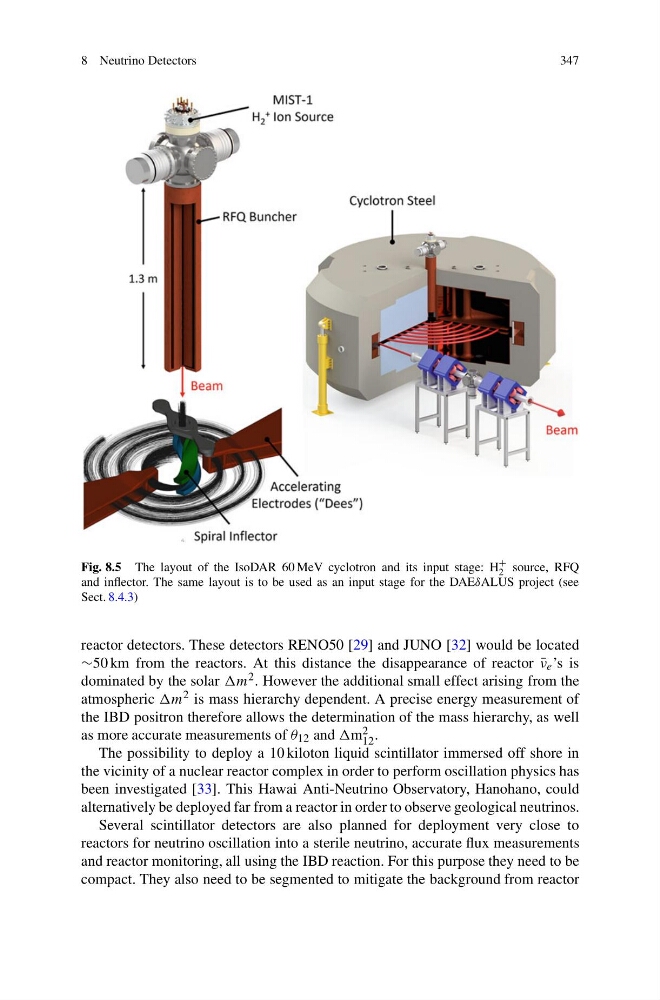
Fig. 8.5 The layout of the IsoDAR 60 MeV cyclotron and its input stage: H
+
2 source, RFQ
and inflector. The same layout is to be used as an input stage for the DAEδALUS project (see
Sect. 8.4.3)
reactor detectors. These detectors RENO50 [29] and JUNO [32] would be located
∼50 km from the reactors. At this distance the disappearance of reactor ¯
ν e ’s is
dominated by the solar m 2 . However the additional small effect arising from the
atmospheric m 2 is mass hierarchy dependent. A precise energy measurement of
the IBD positron therefore allows the determination of the mass hierarchy, as well
as more accurate measurements of θ 12 and m 2
12 .
The possibility to deploy a 10 kiloton liquid scintillator immersed off shore in
the vicinity of a nuclear reactor complex in order to perform oscillation physics has
been investigated [33]. This Hawai Anti-Neutrino Observatory, Hanohano, could
alternatively be deployed far from a reactor in order to observe geological neutrinos.
Several scintillator detectors are also planned for deployment very close to
reactors for neutrino oscillation into a sterile neutrino, accurate flux measurements
and reactor monitoring, all using the IBD reaction. For this purpose they need to be
compact. They also need to be segmented to mitigate the background from reactor
347
Fig. 8.5 The layout of the IsoDAR 60 MeV cyclotron and its input stage: H
+
2 source, RFQ
and inflector. The same layout is to be used as an input stage for the DAEδALUS project (see
Sect. 8.4.3)
reactor detectors. These detectors RENO50 [29] and JUNO [32] would be located
∼50 km from the reactors. At this distance the disappearance of reactor ¯
ν e ’s is
dominated by the solar m 2 . However the additional small effect arising from the
atmospheric m 2 is mass hierarchy dependent. A precise energy measurement of
the IBD positron therefore allows the determination of the mass hierarchy, as well
as more accurate measurements of θ 12 and m 2
12 .
The possibility to deploy a 10 kiloton liquid scintillator immersed off shore in
the vicinity of a nuclear reactor complex in order to perform oscillation physics has
been investigated [33]. This Hawai Anti-Neutrino Observatory, Hanohano, could
alternatively be deployed far from a reactor in order to observe geological neutrinos.
Several scintillator detectors are also planned for deployment very close to
reactors for neutrino oscillation into a sterile neutrino, accurate flux measurements
and reactor monitoring, all using the IBD reaction. For this purpose they need to be
compact. They also need to be segmented to mitigate the background from reactor