

348
L. Camilleri
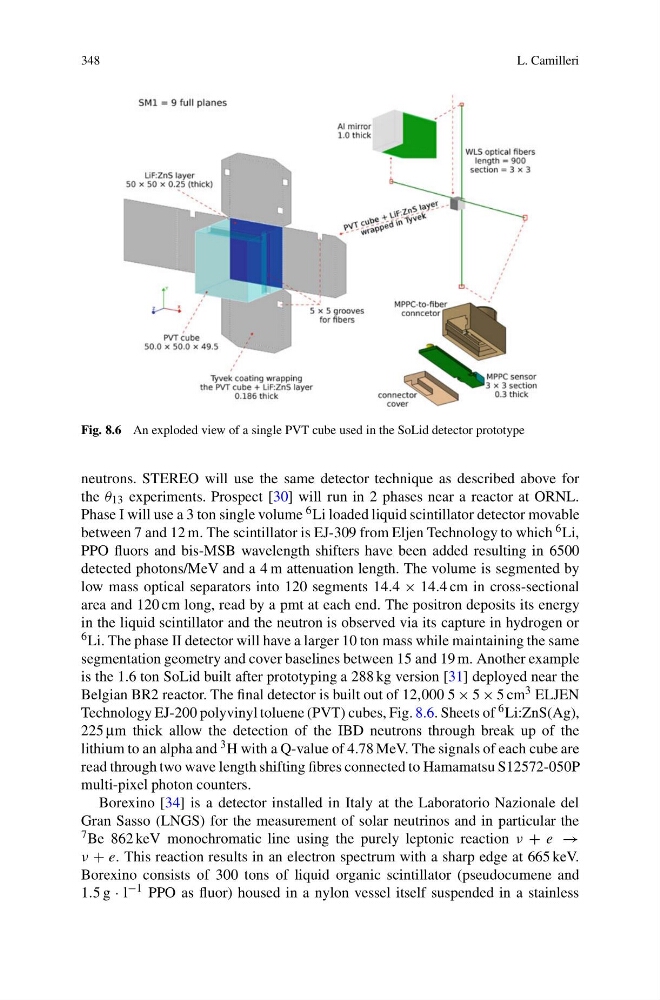
Fig. 8.6 An exploded view of a single PVT cube used in the SoLid detector prototype
neutrons. STEREO will use the same detector technique as described above for
the θ 13 experiments. Prospect [30] will run in 2 phases near a reactor at ORNL.
Phase I will use a 3 ton single volume 6 Li loaded liquid scintillator detector movable
between 7 and 12 m. The scintillator is EJ-309 from Eljen Technology to which 6 Li,
PPO fluors and bis-MSB wavelength shifters have been added resulting in 6500
detected photons/MeV and a 4 m attenuation length. The volume is segmented by
low mass optical separators into 120 segments 14.4 × 14.4 cm in cross-sectional
area and 120 cm long, read by a pmt at each end. The positron deposits its energy
in the liquid scintillator and the neutron is observed via its capture in hydrogen or
6 Li. The phase II detector will have a larger 10 ton mass while maintaining the same
segmentation geometry and cover baselines between 15 and 19 m. Another example
is the 1.6 ton SoLid built after prototyping a 288 kg version [31] deployed near the
Belgian BR2 reactor. The final detector is built out of 12,000 5 × 5 × 5 cm 3 ELJEN
Technology EJ-200 polyvinyl toluene (PVT) cubes, Fig. 8.6. Sheets of 6 Li:ZnS(Ag),
225 μm thick allow the detection of the IBD neutrons through break up of the
lithium to an alpha and 3 H with a Q-value of 4.78 MeV. The signals of each cube are
read through two wave length shifting fibres connected to Hamamatsu S12572-050P
multi-pixel photon counters.
Borexino [34] is a detector installed in Italy at the Laboratorio Nazionale del
Gran Sasso (LNGS) for the measurement of solar neutrinos and in particular the
7 Be 862 keV monochromatic line using the purely leptonic reaction ν + e →
ν + e. This reaction results in an electron spectrum with a sharp edge at 665 keV.
Borexino consists of 300 tons of liquid organic scintillator (pseudocumene and
1.5 g · l
−1 PPO as fluor) housed in a nylon vessel itself suspended in a stainless
L. Camilleri
Fig. 8.6 An exploded view of a single PVT cube used in the SoLid detector prototype
neutrons. STEREO will use the same detector technique as described above for
the θ 13 experiments. Prospect [30] will run in 2 phases near a reactor at ORNL.
Phase I will use a 3 ton single volume 6 Li loaded liquid scintillator detector movable
between 7 and 12 m. The scintillator is EJ-309 from Eljen Technology to which 6 Li,
PPO fluors and bis-MSB wavelength shifters have been added resulting in 6500
detected photons/MeV and a 4 m attenuation length. The volume is segmented by
low mass optical separators into 120 segments 14.4 × 14.4 cm in cross-sectional
area and 120 cm long, read by a pmt at each end. The positron deposits its energy
in the liquid scintillator and the neutron is observed via its capture in hydrogen or
6 Li. The phase II detector will have a larger 10 ton mass while maintaining the same
segmentation geometry and cover baselines between 15 and 19 m. Another example
is the 1.6 ton SoLid built after prototyping a 288 kg version [31] deployed near the
Belgian BR2 reactor. The final detector is built out of 12,000 5 × 5 × 5 cm 3 ELJEN
Technology EJ-200 polyvinyl toluene (PVT) cubes, Fig. 8.6. Sheets of 6 Li:ZnS(Ag),
225 μm thick allow the detection of the IBD neutrons through break up of the
lithium to an alpha and 3 H with a Q-value of 4.78 MeV. The signals of each cube are
read through two wave length shifting fibres connected to Hamamatsu S12572-050P
multi-pixel photon counters.
Borexino [34] is a detector installed in Italy at the Laboratorio Nazionale del
Gran Sasso (LNGS) for the measurement of solar neutrinos and in particular the
7 Be 862 keV monochromatic line using the purely leptonic reaction ν + e →
ν + e. This reaction results in an electron spectrum with a sharp edge at 665 keV.
Borexino consists of 300 tons of liquid organic scintillator (pseudocumene and
1.5 g · l
−1 PPO as fluor) housed in a nylon vessel itself suspended in a stainless