

346
L. Camilleri
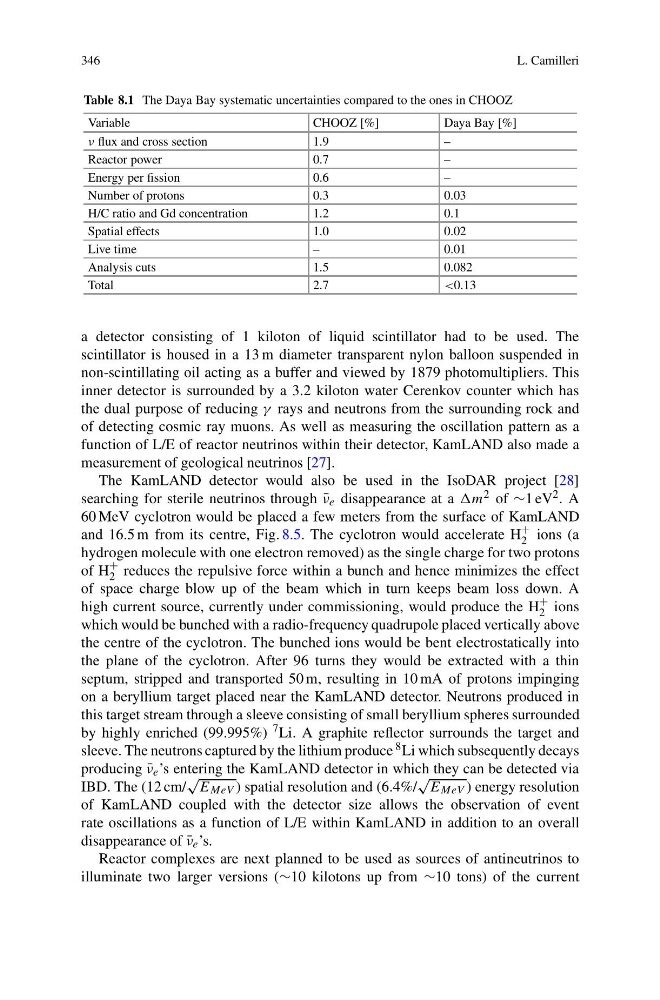
Table 8.1 The Daya Bay systematic uncertainties compared to the ones in CHOOZ
Variable
CHOOZ [%]
Daya Bay [%]
ν flux and cross section
1.9
–
Reactor power
0.7
–
Energy per fission
0.6
–
Number of protons
0.3
0.03
H/C ratio and Gd concentration
1.2
0.1
Spatial effects
1.0
0.02
Live time
–
0.01
Analysis cuts
1.5
0.082
Total
2.7
<0.13
a detector consisting of 1 kiloton of liquid scintillator had to be used. The
scintillator is housed in a 13 m diameter transparent nylon balloon suspended in
non-scintillating oil acting as a buffer and viewed by 1879 photomultipliers. This
inner detector is surrounded by a 3.2 kiloton water Cerenkov counter which has
the dual purpose of reducing γ rays and neutrons from the surrounding rock and
of detecting cosmic ray muons. As well as measuring the oscillation pattern as a
function of L/E of reactor neutrinos within their detector, KamLAND also made a
measurement of geological neutrinos [27].
The KamLAND detector would also be used in the IsoDAR project [28]
searching for sterile neutrinos through ¯
ν e disappearance at a 2 of ∼1 eV 2 . A
60 MeV cyclotron would be placed a few meters from the surface of KamLAND
and 16.5 m from its centre, Fig. 8.5. The cyclotron would accelerate H
+
2 ions (a
hydrogen molecule with one electron removed) as the single charge for two protons
of H
+
2 reduces the repulsive force within a bunch and hence minimizes the effect
of space charge blow up of the beam which in turn keeps beam loss down. A
high current source, currently under commissioning, would produce the H
+
2 ions
which would be bunched with a radio-frequency quadrupole placed vertically above
the centre of the cyclotron. The bunched ions would be bent electrostatically into
the plane of the cyclotron. After 96 turns they would be extracted with a thin
septum, stripped and transported 50 m, resulting in 10 mA of protons impinging
on a beryllium target placed near the KamLAND detector. Neutrons produced in
this target stream through a sleeve consisting of small beryllium spheres surrounded
by highly enriched (99.995%) 7 Li. A graphite reflector surrounds the target and
sleeve. The neutrons captured by the lithium produce 8 Li which subsequently decays
producing ¯
ν e ’s entering the KamLAND detector in which they can be detected via
IBD. The (12 cm/
√
E MeV ) spatial resolution and (6.4%/
√
E MeV ) energy resolution
of KamLAND coupled with the detector size allows the observation of event
rate oscillations as a function of L/E within KamLAND in addition to an overall
disappearance of ¯
ν e ’s.
Reactor complexes are next planned to be used as sources of antineutrinos to
illuminate two larger versions (∼10 kilotons up from ∼10 tons) of the current
L. Camilleri
Table 8.1 The Daya Bay systematic uncertainties compared to the ones in CHOOZ
Variable
CHOOZ [%]
Daya Bay [%]
ν flux and cross section
1.9
–
Reactor power
0.7
–
Energy per fission
0.6
–
Number of protons
0.3
0.03
H/C ratio and Gd concentration
1.2
0.1
Spatial effects
1.0
0.02
Live time
–
0.01
Analysis cuts
1.5
0.082
Total
2.7
<0.13
a detector consisting of 1 kiloton of liquid scintillator had to be used. The
scintillator is housed in a 13 m diameter transparent nylon balloon suspended in
non-scintillating oil acting as a buffer and viewed by 1879 photomultipliers. This
inner detector is surrounded by a 3.2 kiloton water Cerenkov counter which has
the dual purpose of reducing γ rays and neutrons from the surrounding rock and
of detecting cosmic ray muons. As well as measuring the oscillation pattern as a
function of L/E of reactor neutrinos within their detector, KamLAND also made a
measurement of geological neutrinos [27].
The KamLAND detector would also be used in the IsoDAR project [28]
searching for sterile neutrinos through ¯
ν e disappearance at a 2 of ∼1 eV 2 . A
60 MeV cyclotron would be placed a few meters from the surface of KamLAND
and 16.5 m from its centre, Fig. 8.5. The cyclotron would accelerate H
+
2 ions (a
hydrogen molecule with one electron removed) as the single charge for two protons
of H
+
2 reduces the repulsive force within a bunch and hence minimizes the effect
of space charge blow up of the beam which in turn keeps beam loss down. A
high current source, currently under commissioning, would produce the H
+
2 ions
which would be bunched with a radio-frequency quadrupole placed vertically above
the centre of the cyclotron. The bunched ions would be bent electrostatically into
the plane of the cyclotron. After 96 turns they would be extracted with a thin
septum, stripped and transported 50 m, resulting in 10 mA of protons impinging
on a beryllium target placed near the KamLAND detector. Neutrons produced in
this target stream through a sleeve consisting of small beryllium spheres surrounded
by highly enriched (99.995%) 7 Li. A graphite reflector surrounds the target and
sleeve. The neutrons captured by the lithium produce 8 Li which subsequently decays
producing ¯
ν e ’s entering the KamLAND detector in which they can be detected via
IBD. The (12 cm/
√
E MeV ) spatial resolution and (6.4%/
√
E MeV ) energy resolution
of KamLAND coupled with the detector size allows the observation of event
rate oscillations as a function of L/E within KamLAND in addition to an overall
disappearance of ¯
ν e ’s.
Reactor complexes are next planned to be used as sources of antineutrinos to
illuminate two larger versions (∼10 kilotons up from ∼10 tons) of the current