

340
L. Camilleri
Target
Horn
Reflector
50 GeV
20 GeV
100 GeV
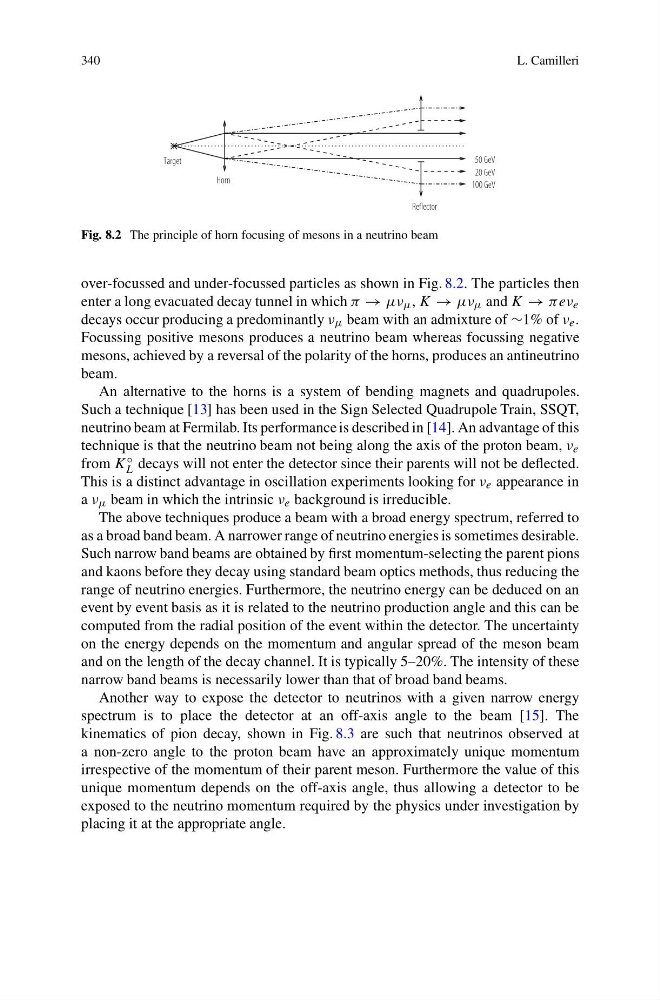
Fig. 8.2 The principle of horn focusing of mesons in a neutrino beam
over-focussed and under-focussed particles as shown in Fig. 8.2. The particles then
enter a long evacuated decay tunnel in which π → μν μ , K → μν μ and K → πeν e
decays occur producing a predominantly ν μ beam with an admixture of ∼1% of ν e .
Focussing positive mesons produces a neutrino beam whereas focussing negative
mesons, achieved by a reversal of the polarity of the horns, produces an antineutrino
beam.
An alternative to the horns is a system of bending magnets and quadrupoles.
Such a technique [13] has been used in the Sign Selected Quadrupole Train, SSQT,
neutrino beam at Fermilab. Its performance is described in [14]. An advantage of this
technique is that the neutrino beam not being along the axis of the proton beam, ν e
from K ◦
L decays will not enter the detector since their parents will not be deflected.
This is a distinct advantage in oscillation experiments looking for ν e appearance in
a ν μ beam in which the intrinsic ν e background is irreducible.
The above techniques produce a beam with a broad energy spectrum, referred to
as a broad band beam. A narrower range of neutrino energies is sometimes desirable.
Such narrow band beams are obtained by first momentum-selecting the parent pions
and kaons before they decay using standard beam optics methods, thus reducing the
range of neutrino energies. Furthermore, the neutrino energy can be deduced on an
event by event basis as it is related to the neutrino production angle and this can be
computed from the radial position of the event within the detector. The uncertainty
on the energy depends on the momentum and angular spread of the meson beam
and on the length of the decay channel. It is typically 5–20%. The intensity of these
narrow band beams is necessarily lower than that of broad band beams.
Another way to expose the detector to neutrinos with a given narrow energy
spectrum is to place the detector at an off-axis angle to the beam [15]. The
kinematics of pion decay, shown in Fig. 8.3 are such that neutrinos observed at
a non-zero angle to the proton beam have an approximately unique momentum
irrespective of the momentum of their parent meson. Furthermore the value of this
unique momentum depends on the off-axis angle, thus allowing a detector to be
exposed to the neutrino momentum required by the physics under investigation by
placing it at the appropriate angle.
L. Camilleri
Target
Horn
Reflector
50 GeV
20 GeV
100 GeV
Fig. 8.2 The principle of horn focusing of mesons in a neutrino beam
over-focussed and under-focussed particles as shown in Fig. 8.2. The particles then
enter a long evacuated decay tunnel in which π → μν μ , K → μν μ and K → πeν e
decays occur producing a predominantly ν μ beam with an admixture of ∼1% of ν e .
Focussing positive mesons produces a neutrino beam whereas focussing negative
mesons, achieved by a reversal of the polarity of the horns, produces an antineutrino
beam.
An alternative to the horns is a system of bending magnets and quadrupoles.
Such a technique [13] has been used in the Sign Selected Quadrupole Train, SSQT,
neutrino beam at Fermilab. Its performance is described in [14]. An advantage of this
technique is that the neutrino beam not being along the axis of the proton beam, ν e
from K ◦
L decays will not enter the detector since their parents will not be deflected.
This is a distinct advantage in oscillation experiments looking for ν e appearance in
a ν μ beam in which the intrinsic ν e background is irreducible.
The above techniques produce a beam with a broad energy spectrum, referred to
as a broad band beam. A narrower range of neutrino energies is sometimes desirable.
Such narrow band beams are obtained by first momentum-selecting the parent pions
and kaons before they decay using standard beam optics methods, thus reducing the
range of neutrino energies. Furthermore, the neutrino energy can be deduced on an
event by event basis as it is related to the neutrino production angle and this can be
computed from the radial position of the event within the detector. The uncertainty
on the energy depends on the momentum and angular spread of the meson beam
and on the length of the decay channel. It is typically 5–20%. The intensity of these
narrow band beams is necessarily lower than that of broad band beams.
Another way to expose the detector to neutrinos with a given narrow energy
spectrum is to place the detector at an off-axis angle to the beam [15]. The
kinematics of pion decay, shown in Fig. 8.3 are such that neutrinos observed at
a non-zero angle to the proton beam have an approximately unique momentum
irrespective of the momentum of their parent meson. Furthermore the value of this
unique momentum depends on the off-axis angle, thus allowing a detector to be
exposed to the neutrino momentum required by the physics under investigation by
placing it at the appropriate angle.