

8 Neutrino Detectors
339
8.2.3 Cosmological Neutrinos
The study of cosmological neutrinos [9] at the TeV scale is in its infancy. Their very
low rate necessitates extremely large detectors. This has led to the use of naturally
occurring detection media such as lake or sea water and Antarctic ice. The Cerenkov
light or radio waves emitted by charged particles produced in their interactions in the
medium are recorded, respectively, in strings of photomultiplier tubes or antennas.
8.2.4 Reactor Neutrinos
Nuclear reactors are an abundant source of antineutrinos, 6 ¯
ν e per nuclear fission
on average, resulting in a flux of 1.8 × 10 20 per GW thermal energy, emitted
isotropically. The standard method to study them [10] is to observe the Inverse Beta
Decay (IBD) reaction ¯
ν e + p → e + + n in a hydrogen-rich liquid scintillator
detector. In addition to observing photons emitted as a result of the positron
annihilation, the neutron can be detected by recording photons emitted by the
neutron capture in the scintillator.
8.2.5 Accelerator Neutrinos
Accelerator neutrinos are produced [11] by the decay of π and K mesons themselves
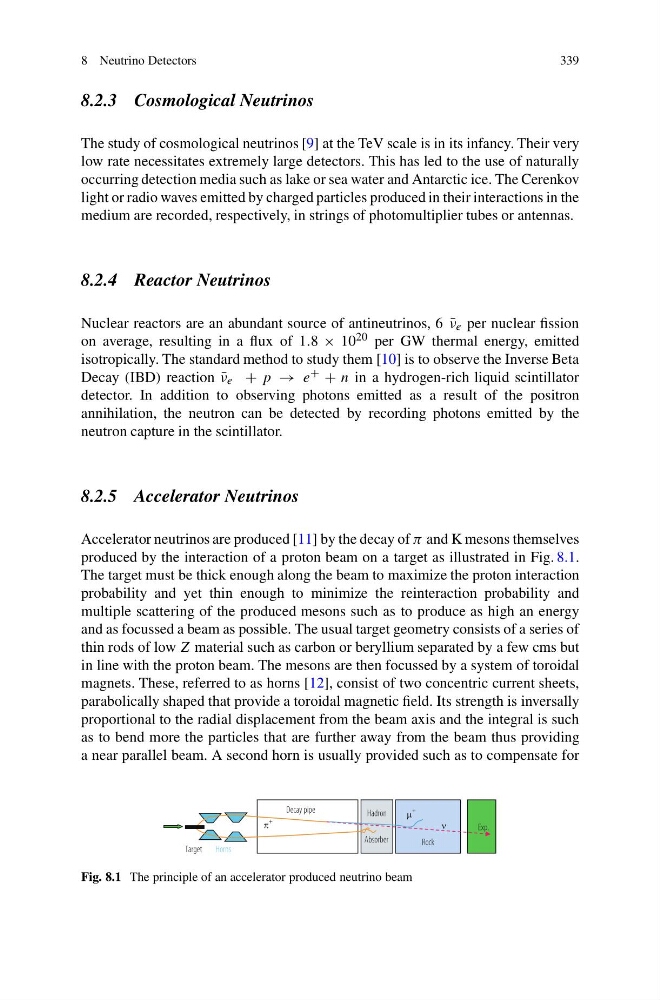
produced by the interaction of a proton beam on a target as illustrated in Fig. 8.1.
The target must be thick enough along the beam to maximize the proton interaction
probability and yet thin enough to minimize the reinteraction probability and
multiple scattering of the produced mesons such as to produce as high an energy
and as focussed a beam as possible. The usual target geometry consists of a series of
thin rods of low Z material such as carbon or beryllium separated by a few cms but
in line with the proton beam. The mesons are then focussed by a system of toroidal
magnets. These, referred to as horns [12], consist of two concentric current sheets,
parabolically shaped that provide a toroidal magnetic field. Its strength is inversally
proportional to the radial displacement from the beam axis and the integral is such
as to bend more the particles that are further away from the beam thus providing
a near parallel beam. A second horn is usually provided such as to compensate for
Decay pipe
Target Horns
Hadron
Absorber
Rock
Exp.
π
+
μ
+
ν
Fig. 8.1 The principle of an accelerator produced neutrino beam
339
8.2.3 Cosmological Neutrinos
The study of cosmological neutrinos [9] at the TeV scale is in its infancy. Their very
low rate necessitates extremely large detectors. This has led to the use of naturally
occurring detection media such as lake or sea water and Antarctic ice. The Cerenkov
light or radio waves emitted by charged particles produced in their interactions in the
medium are recorded, respectively, in strings of photomultiplier tubes or antennas.
8.2.4 Reactor Neutrinos
Nuclear reactors are an abundant source of antineutrinos, 6 ¯
ν e per nuclear fission
on average, resulting in a flux of 1.8 × 10 20 per GW thermal energy, emitted
isotropically. The standard method to study them [10] is to observe the Inverse Beta
Decay (IBD) reaction ¯
ν e + p → e + + n in a hydrogen-rich liquid scintillator
detector. In addition to observing photons emitted as a result of the positron
annihilation, the neutron can be detected by recording photons emitted by the
neutron capture in the scintillator.
8.2.5 Accelerator Neutrinos
Accelerator neutrinos are produced [11] by the decay of π and K mesons themselves
produced by the interaction of a proton beam on a target as illustrated in Fig. 8.1.
The target must be thick enough along the beam to maximize the proton interaction
probability and yet thin enough to minimize the reinteraction probability and
multiple scattering of the produced mesons such as to produce as high an energy
and as focussed a beam as possible. The usual target geometry consists of a series of
thin rods of low Z material such as carbon or beryllium separated by a few cms but
in line with the proton beam. The mesons are then focussed by a system of toroidal
magnets. These, referred to as horns [12], consist of two concentric current sheets,
parabolically shaped that provide a toroidal magnetic field. Its strength is inversally
proportional to the radial displacement from the beam axis and the integral is such
as to bend more the particles that are further away from the beam thus providing
a near parallel beam. A second horn is usually provided such as to compensate for
Decay pipe
Target Horns
Hadron
Absorber
Rock
Exp.
π
+
μ
+
ν
Fig. 8.1 The principle of an accelerator produced neutrino beam