

8 Neutrino Detectors
341
0
5
10
15
E [GeV]
E [GeV]
θ = 0 mrad
θ = 7 mrad
θ = 14 mrad
θ = 27 mrad
0
10
20
30
40
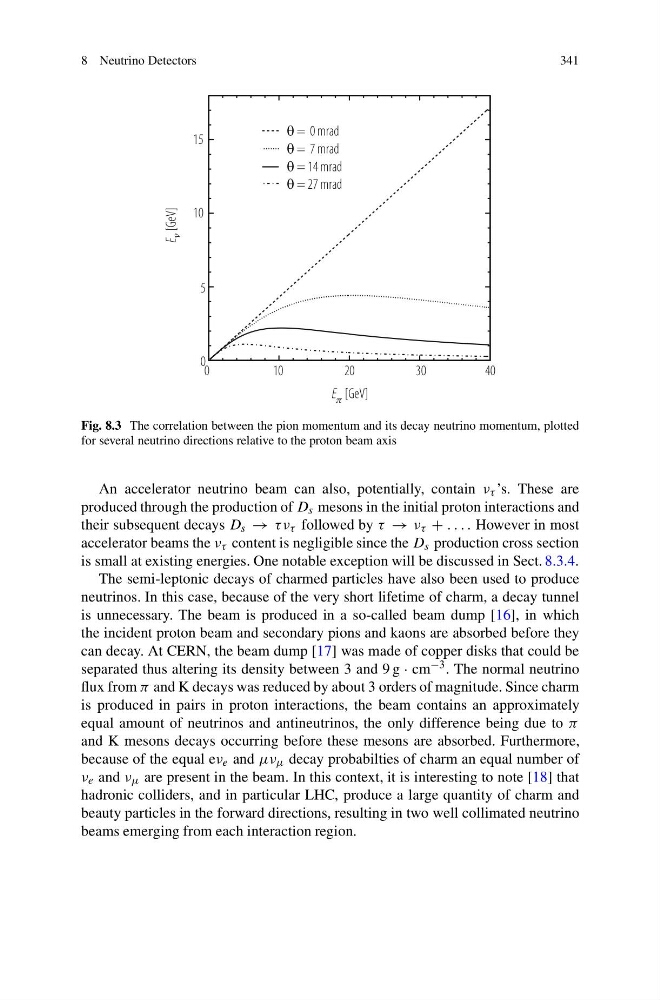
Fig. 8.3 The correlation between the pion momentum and its decay neutrino momentum, plotted
for several neutrino directions relative to the proton beam axis
An accelerator neutrino beam can also, potentially, contain ν τ ’s. These are
produced through the production of D s mesons in the initial proton interactions and
their subsequent decays D s → τ ν τ followed by τ → ν τ + . . . . However in most
accelerator beams the ν τ content is negligible since the D s production cross section
is small at existing energies. One notable exception will be discussed in Sect. 8.3.4.
The semi-leptonic decays of charmed particles have also been used to produce
neutrinos. In this case, because of the very short lifetime of charm, a decay tunnel
is unnecessary. The beam is produced in a so-called beam dump [16], in which
the incident proton beam and secondary pions and kaons are absorbed before they
can decay. At CERN, the beam dump [17] was made of copper disks that could be
separated thus altering its density between 3 and 9 g · cm −3 . The normal neutrino
flux from π and K decays was reduced by about 3 orders of magnitude. Since charm
is produced in pairs in proton interactions, the beam contains an approximately
equal amount of neutrinos and antineutrinos, the only difference being due to π
and K mesons decays occurring before these mesons are absorbed. Furthermore,
because of the equal eν e and μν μ decay probabilties of charm an equal number of
ν e and ν μ are present in the beam. In this context, it is interesting to note [18] that
hadronic colliders, and in particular LHC, produce a large quantity of charm and
beauty particles in the forward directions, resulting in two well collimated neutrino
beams emerging from each interaction region.
341
0
5
10
15
E [GeV]
E [GeV]
θ = 0 mrad
θ = 7 mrad
θ = 14 mrad
θ = 27 mrad
0
10
20
30
40
Fig. 8.3 The correlation between the pion momentum and its decay neutrino momentum, plotted
for several neutrino directions relative to the proton beam axis
An accelerator neutrino beam can also, potentially, contain ν τ ’s. These are
produced through the production of D s mesons in the initial proton interactions and
their subsequent decays D s → τ ν τ followed by τ → ν τ + . . . . However in most
accelerator beams the ν τ content is negligible since the D s production cross section
is small at existing energies. One notable exception will be discussed in Sect. 8.3.4.
The semi-leptonic decays of charmed particles have also been used to produce
neutrinos. In this case, because of the very short lifetime of charm, a decay tunnel
is unnecessary. The beam is produced in a so-called beam dump [16], in which
the incident proton beam and secondary pions and kaons are absorbed before they
can decay. At CERN, the beam dump [17] was made of copper disks that could be
separated thus altering its density between 3 and 9 g · cm −3 . The normal neutrino
flux from π and K decays was reduced by about 3 orders of magnitude. Since charm
is produced in pairs in proton interactions, the beam contains an approximately
equal amount of neutrinos and antineutrinos, the only difference being due to π
and K mesons decays occurring before these mesons are absorbed. Furthermore,
because of the equal eν e and μν μ decay probabilties of charm an equal number of
ν e and ν μ are present in the beam. In this context, it is interesting to note [18] that
hadronic colliders, and in particular LHC, produce a large quantity of charm and
beauty particles in the forward directions, resulting in two well collimated neutrino
beams emerging from each interaction region.