

7 Particle Detectors and Detector Systems
327
TRD supermodule
TRD stack
TRD chamber
TPC heat shield
TOF
(a)
(b)
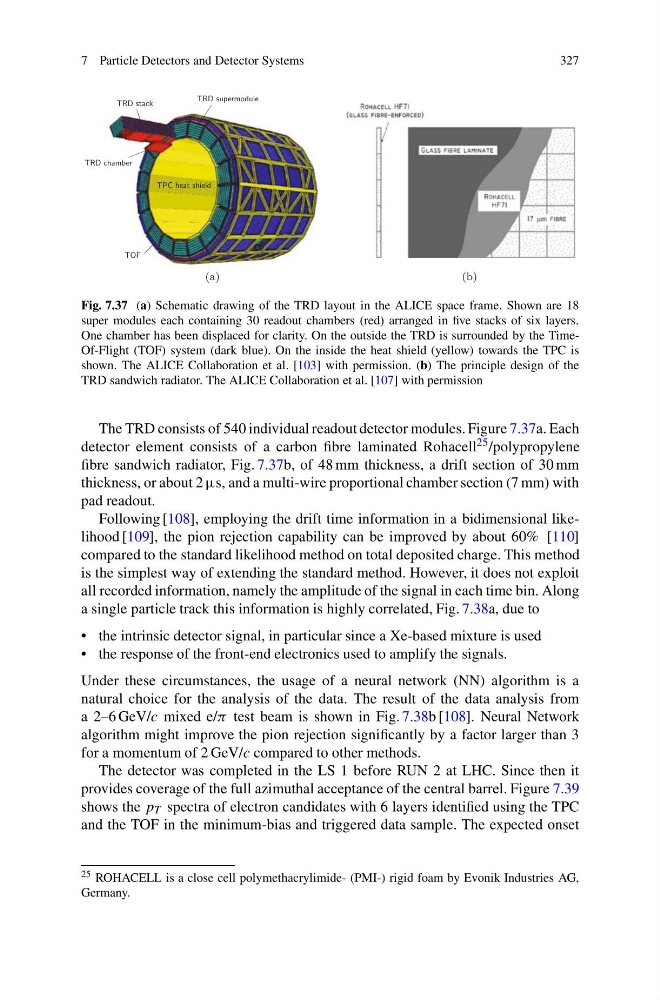
Fig. 7.37 (a) Schematic drawing of the TRD layout in the ALICE space frame. Shown are 18
super modules each containing 30 readout chambers (red) arranged in five stacks of six layers.
One chamber has been displaced for clarity. On the outside the TRD is surrounded by the TimeOf-Flight (TOF) system (dark blue). On the inside the heat shield (yellow) towards the TPC is
shown. The ALICE Collaboration et al. [103] with permission. (b) The principle design of the
TRD sandwich radiator. The ALICE Collaboration et al. [107] with permission
The TRD consists of 540 individual readout detector modules. Figure 7.37a. Each
detector element consists of a carbon fibre laminated Rohacell 25 /polypropylene
fibre sandwich radiator, Fig. 7.37b, of 48 mm thickness, a drift section of 30 mm
thickness, or about 2 μs, and a multi-wire proportional chamber section (7 mm) with
pad readout.
Following [108], employing the drift time information in a bidimensional likelihood [109], the pion rejection capability can be improved by about 60% [110]
compared to the standard likelihood method on total deposited charge. This method
is the simplest way of extending the standard method. However, it does not exploit
all recorded information, namely the amplitude of the signal in each time bin. Along
a single particle track this information is highly correlated, Fig. 7.38a, due to
• the intrinsic detector signal, in particular since a Xe-based mixture is used
• the response of the front-end electronics used to amplify the signals.
Under these circumstances, the usage of a neural network (NN) algorithm is a
natural choice for the analysis of the data. The result of the data analysis from
a 2–6 GeV/c mixed e/π test beam is shown in Fig. 7.38b [108]. Neural Network
algorithm might improve the pion rejection significantly by a factor larger than 3
for a momentum of 2 GeV/c compared to other methods.
The detector was completed in the LS 1 before RUN 2 at LHC. Since then it
provides coverage of the full azimuthal acceptance of the central barrel. Figure 7.39
shows the p T spectra of electron candidates with 6 layers identified using the TPC
and the TOF in the minimum-bias and triggered data sample. The expected onset
25 ROHACELL is a close cell polymethacrylimide- (PMI-) rigid foam by Evonik Industries AG,
Germany.
327
TRD supermodule
TRD stack
TRD chamber
TPC heat shield
TOF
(a)
(b)
Fig. 7.37 (a) Schematic drawing of the TRD layout in the ALICE space frame. Shown are 18
super modules each containing 30 readout chambers (red) arranged in five stacks of six layers.
One chamber has been displaced for clarity. On the outside the TRD is surrounded by the TimeOf-Flight (TOF) system (dark blue). On the inside the heat shield (yellow) towards the TPC is
shown. The ALICE Collaboration et al. [103] with permission. (b) The principle design of the
TRD sandwich radiator. The ALICE Collaboration et al. [107] with permission
The TRD consists of 540 individual readout detector modules. Figure 7.37a. Each
detector element consists of a carbon fibre laminated Rohacell 25 /polypropylene
fibre sandwich radiator, Fig. 7.37b, of 48 mm thickness, a drift section of 30 mm
thickness, or about 2 μs, and a multi-wire proportional chamber section (7 mm) with
pad readout.
Following [108], employing the drift time information in a bidimensional likelihood [109], the pion rejection capability can be improved by about 60% [110]
compared to the standard likelihood method on total deposited charge. This method
is the simplest way of extending the standard method. However, it does not exploit
all recorded information, namely the amplitude of the signal in each time bin. Along
a single particle track this information is highly correlated, Fig. 7.38a, due to
• the intrinsic detector signal, in particular since a Xe-based mixture is used
• the response of the front-end electronics used to amplify the signals.
Under these circumstances, the usage of a neural network (NN) algorithm is a
natural choice for the analysis of the data. The result of the data analysis from
a 2–6 GeV/c mixed e/π test beam is shown in Fig. 7.38b [108]. Neural Network
algorithm might improve the pion rejection significantly by a factor larger than 3
for a momentum of 2 GeV/c compared to other methods.
The detector was completed in the LS 1 before RUN 2 at LHC. Since then it
provides coverage of the full azimuthal acceptance of the central barrel. Figure 7.39
shows the p T spectra of electron candidates with 6 layers identified using the TPC
and the TOF in the minimum-bias and triggered data sample. The expected onset
25 ROHACELL is a close cell polymethacrylimide- (PMI-) rigid foam by Evonik Industries AG,
Germany.