

328
R. Forty and O. Ullaland
TR photon electron
pion
cathode
wires
cathode pads
primary
clusters
anode
wires
region
drift
pion
electron
Chamber
Drift
Radiator
entrance
window
z
x
region
2
4
6
8
10
12
14
1
2
3
4
5
6
7
8
0
25
50
75
100
Pad numb er
Tim
e
bin
Signal
cathode pads
region
drift
Radiator
Drift
Chamber
5
4
electron
3
anode
wires
cathode
wires
electron
x
y
region
(a)
0
1
2
3
4
5
0
2
4
6
8
1 0
Momentum (GeV/c)
Data, L-Q
small DCs
big stack
Simulation
L-Q
L-Q1,Q2
NNs
(b)
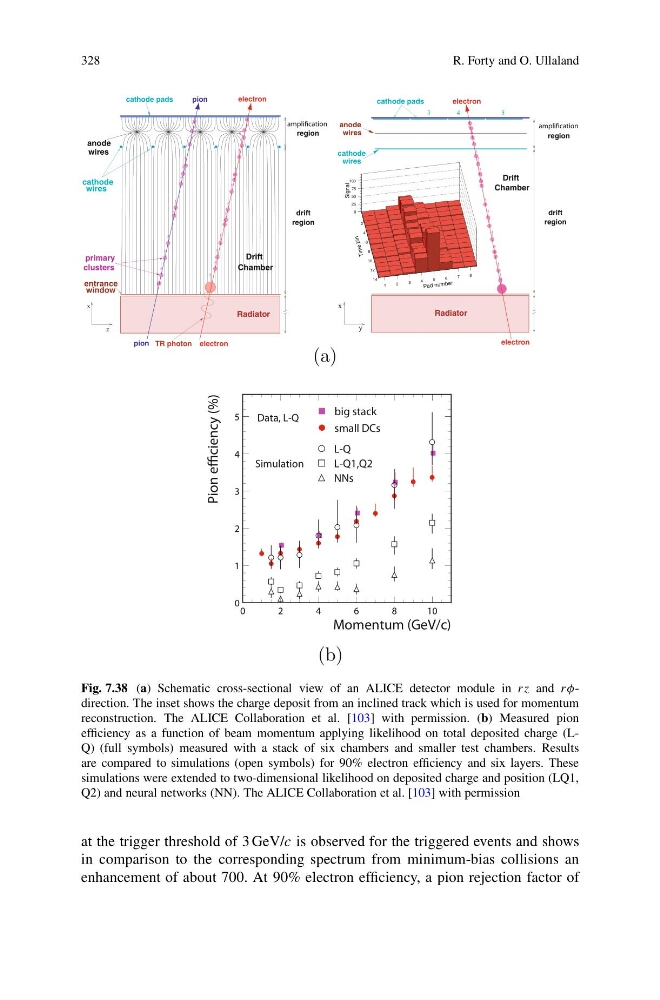
Fig. 7.38 (a) Schematic cross-sectional view of an ALICE detector module in rz and rφdirection. The inset shows the charge deposit from an inclined track which is used for momentum
reconstruction. The ALICE Collaboration et al. [103] with permission. (b) Measured pion
efficiency as a function of beam momentum applying likelihood on total deposited charge (LQ) (full symbols) measured with a stack of six chambers and smaller test chambers. Results
are compared to simulations (open symbols) for 90% electron efficiency and six layers. These
simulations were extended to two-dimensional likelihood on deposited charge and position (LQ1,
Q2) and neural networks (NN). The ALICE Collaboration et al. [103] with permission
at the trigger threshold of 3 GeV/c is observed for the triggered events and shows
in comparison to the corresponding spectrum from minimum-bias collisions an
enhancement of about 700. At 90% electron efficiency, a pion rejection factor of
R. Forty and O. Ullaland
TR photon electron
pion
cathode
wires
cathode pads
primary
clusters
anode
wires
region
drift
pion
electron
Chamber
Drift
Radiator
entrance
window
z
x
region
2
4
6
8
10
12
14
1
2
3
4
5
6
7
8
0
25
50
75
100
Pad numb er
Tim
e
bin
Signal
cathode pads
region
drift
Radiator
Drift
Chamber
5
4
electron
3
anode
wires
cathode
wires
electron
x
y
region
(a)
0
1
2
3
4
5
0
2
4
6
8
1 0
Momentum (GeV/c)
Data, L-Q
small DCs
big stack
Simulation
L-Q
L-Q1,Q2
NNs
(b)
Fig. 7.38 (a) Schematic cross-sectional view of an ALICE detector module in rz and rφdirection. The inset shows the charge deposit from an inclined track which is used for momentum
reconstruction. The ALICE Collaboration et al. [103] with permission. (b) Measured pion
efficiency as a function of beam momentum applying likelihood on total deposited charge (LQ) (full symbols) measured with a stack of six chambers and smaller test chambers. Results
are compared to simulations (open symbols) for 90% electron efficiency and six layers. These
simulations were extended to two-dimensional likelihood on deposited charge and position (LQ1,
Q2) and neural networks (NN). The ALICE Collaboration et al. [103] with permission
at the trigger threshold of 3 GeV/c is observed for the triggered events and shows
in comparison to the corresponding spectrum from minimum-bias collisions an
enhancement of about 700. At 90% electron efficiency, a pion rejection factor of