

326
R. Forty and O. Ullaland
0.001
0.01
0.1
1
0.6
0.7
0.8
0.9
1
Electron efficiency
Pion efficiency
Test beam
Monte Carlo
(a)
20 GeV, barrel position 9
0
2
4
6
8
10
3
4
5
6
7
8
9
10
High threshold (keV)
Pion efficiency (%) at 90 % of electron
short barrel
full barrel
(b)
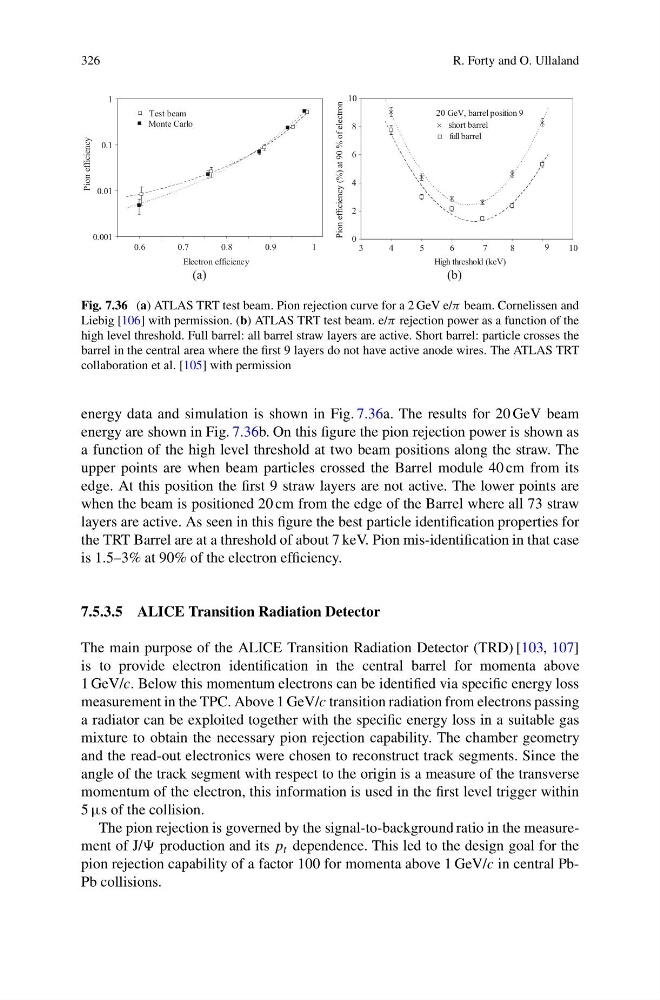
Fig. 7.36 (a) ATLAS TRT test beam. Pion rejection curve for a 2 GeV e/π beam. Cornelissen and
Liebig [106] with permission. (b) ATLAS TRT test beam. e/π rejection power as a function of the
high level threshold. Full barrel: all barrel straw layers are active. Short barrel: particle crosses the
barrel in the central area where the first 9 layers do not have active anode wires. The ATLAS TRT
collaboration et al. [105] with permission
energy data and simulation is shown in Fig. 7.36a. The results for 20 GeV beam
energy are shown in Fig. 7.36b. On this figure the pion rejection power is shown as
a function of the high level threshold at two beam positions along the straw. The
upper points are when beam particles crossed the Barrel module 40 cm from its
edge. At this position the first 9 straw layers are not active. The lower points are
when the beam is positioned 20 cm from the edge of the Barrel where all 73 straw
layers are active. As seen in this figure the best particle identification properties for
the TRT Barrel are at a threshold of about 7 keV. Pion mis-identification in that case
is 1.5–3% at 90% of the electron efficiency.
7.5.3.5 ALICE Transition Radiation Detector
The main purpose of the ALICE Transition Radiation Detector (TRD) [103, 107]
is to provide electron identification in the central barrel for momenta above
1 GeV/c. Below this momentum electrons can be identified via specific energy loss
measurement in the TPC. Above 1 GeV/c transition radiation from electrons passing
a radiator can be exploited together with the specific energy loss in a suitable gas
mixture to obtain the necessary pion rejection capability. The chamber geometry
and the read-out electronics were chosen to reconstruct track segments. Since the
angle of the track segment with respect to the origin is a measure of the transverse
momentum of the electron, this information is used in the first level trigger within
5 μs of the collision.
The pion rejection is governed by the signal-to-background ratio in the measurement of J/ production and its p t dependence. This led to the design goal for the
pion rejection capability of a factor 100 for momenta above 1 GeV/c in central PbPb collisions.
R. Forty and O. Ullaland
0.001
0.01
0.1
1
0.6
0.7
0.8
0.9
1
Electron efficiency
Pion efficiency
Test beam
Monte Carlo
(a)
20 GeV, barrel position 9
0
2
4
6
8
10
3
4
5
6
7
8
9
10
High threshold (keV)
Pion efficiency (%) at 90 % of electron
short barrel
full barrel
(b)
Fig. 7.36 (a) ATLAS TRT test beam. Pion rejection curve for a 2 GeV e/π beam. Cornelissen and
Liebig [106] with permission. (b) ATLAS TRT test beam. e/π rejection power as a function of the
high level threshold. Full barrel: all barrel straw layers are active. Short barrel: particle crosses the
barrel in the central area where the first 9 layers do not have active anode wires. The ATLAS TRT
collaboration et al. [105] with permission
energy data and simulation is shown in Fig. 7.36a. The results for 20 GeV beam
energy are shown in Fig. 7.36b. On this figure the pion rejection power is shown as
a function of the high level threshold at two beam positions along the straw. The
upper points are when beam particles crossed the Barrel module 40 cm from its
edge. At this position the first 9 straw layers are not active. The lower points are
when the beam is positioned 20 cm from the edge of the Barrel where all 73 straw
layers are active. As seen in this figure the best particle identification properties for
the TRT Barrel are at a threshold of about 7 keV. Pion mis-identification in that case
is 1.5–3% at 90% of the electron efficiency.
7.5.3.5 ALICE Transition Radiation Detector
The main purpose of the ALICE Transition Radiation Detector (TRD) [103, 107]
is to provide electron identification in the central barrel for momenta above
1 GeV/c. Below this momentum electrons can be identified via specific energy loss
measurement in the TPC. Above 1 GeV/c transition radiation from electrons passing
a radiator can be exploited together with the specific energy loss in a suitable gas
mixture to obtain the necessary pion rejection capability. The chamber geometry
and the read-out electronics were chosen to reconstruct track segments. Since the
angle of the track segment with respect to the origin is a measure of the transverse
momentum of the electron, this information is used in the first level trigger within
5 μs of the collision.
The pion rejection is governed by the signal-to-background ratio in the measurement of J/ production and its p t dependence. This led to the design goal for the
pion rejection capability of a factor 100 for momenta above 1 GeV/c in central PbPb collisions.