

7 Particle Detectors and Detector Systems
325
(a)
Straws
Divider
Carbon-Fiber Shell
Tension Plate
High Voltage Plate
Straw Endplug
Wire Support
Capacitor Barrel
Capacitor Assembly
Electronics
Protection
Board
Eyelet
Taper Pin
Radiator Sheets
(b)
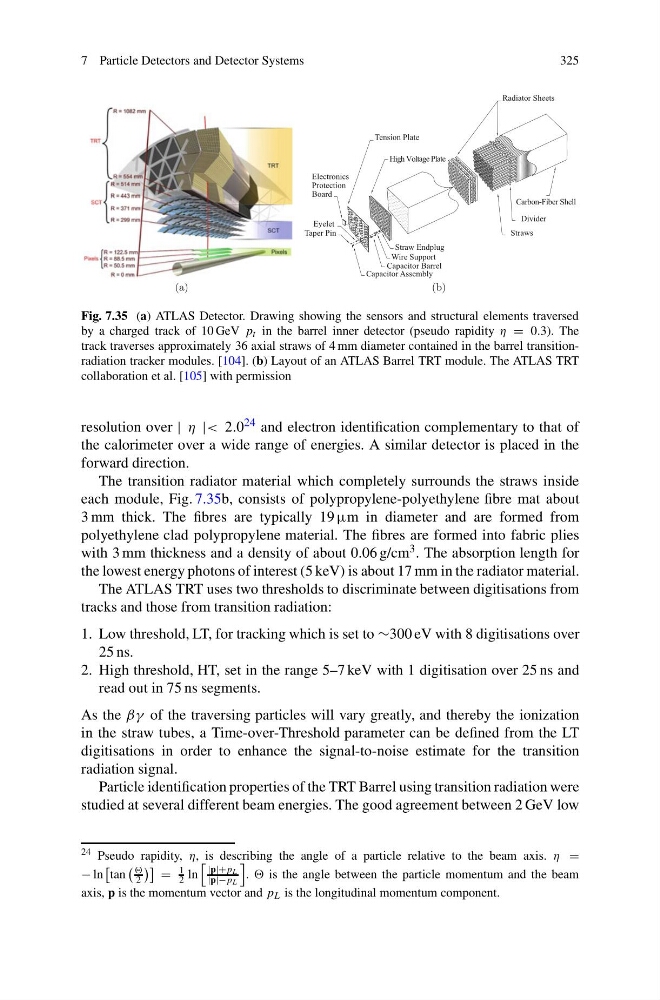
Fig. 7.35 (a) ATLAS Detector. Drawing showing the sensors and structural elements traversed
by a charged track of 10 GeV p t in the barrel inner detector (pseudo rapidity η = 0.3). The
track traverses approximately 36 axial straws of 4 mm diameter contained in the barrel transitionradiation tracker modules. [104]. (b) Layout of an ATLAS Barrel TRT module. The ATLAS TRT
collaboration et al. [105] with permission
resolution over | η |< 2.0 24 and electron identification complementary to that of
the calorimeter over a wide range of energies. A similar detector is placed in the
forward direction.
The transition radiator material which completely surrounds the straws inside
each module, Fig. 7.35b, consists of polypropylene-polyethylene fibre mat about
3 mm thick. The fibres are typically 19 μm in diameter and are formed from
polyethylene clad polypropylene material. The fibres are formed into fabric plies
with 3 mm thickness and a density of about 0.06 g/cm 3 . The absorption length for
the lowest energy photons of interest (5 keV) is about 17 mm in the radiator material.
The ATLAS TRT uses two thresholds to discriminate between digitisations from
tracks and those from transition radiation:
1. Low threshold, LT, for tracking which is set to ∼300 eV with 8 digitisations over
25 ns.
2. High threshold, HT, set in the range 5–7 keV with 1 digitisation over 25 ns and
read out in 75 ns segments.
As the βγ of the traversing particles will vary greatly, and thereby the ionization
in the straw tubes, a Time-over-Threshold parameter can be defined from the LT
digitisations in order to enhance the signal-to-noise estimate for the transition
radiation signal.
Particle identification properties of the TRT Barrel using transition radiation were
studied at several different beam energies. The good agreement between 2 GeV low
24 Pseudo rapidity, η, is describing the angle of a particle relative to the beam axis. η =
− ln
tan
2
=
1
2 ln
|p|+p L
|p|−p L
. is the angle between the particle momentum and the beam
axis, p is the momentum vector and p L is the longitudinal momentum component.
325
(a)
Straws
Divider
Carbon-Fiber Shell
Tension Plate
High Voltage Plate
Straw Endplug
Wire Support
Capacitor Barrel
Capacitor Assembly
Electronics
Protection
Board
Eyelet
Taper Pin
Radiator Sheets
(b)
Fig. 7.35 (a) ATLAS Detector. Drawing showing the sensors and structural elements traversed
by a charged track of 10 GeV p t in the barrel inner detector (pseudo rapidity η = 0.3). The
track traverses approximately 36 axial straws of 4 mm diameter contained in the barrel transitionradiation tracker modules. [104]. (b) Layout of an ATLAS Barrel TRT module. The ATLAS TRT
collaboration et al. [105] with permission
resolution over | η |< 2.0 24 and electron identification complementary to that of
the calorimeter over a wide range of energies. A similar detector is placed in the
forward direction.
The transition radiator material which completely surrounds the straws inside
each module, Fig. 7.35b, consists of polypropylene-polyethylene fibre mat about
3 mm thick. The fibres are typically 19 μm in diameter and are formed from
polyethylene clad polypropylene material. The fibres are formed into fabric plies
with 3 mm thickness and a density of about 0.06 g/cm 3 . The absorption length for
the lowest energy photons of interest (5 keV) is about 17 mm in the radiator material.
The ATLAS TRT uses two thresholds to discriminate between digitisations from
tracks and those from transition radiation:
1. Low threshold, LT, for tracking which is set to ∼300 eV with 8 digitisations over
25 ns.
2. High threshold, HT, set in the range 5–7 keV with 1 digitisation over 25 ns and
read out in 75 ns segments.
As the βγ of the traversing particles will vary greatly, and thereby the ionization
in the straw tubes, a Time-over-Threshold parameter can be defined from the LT
digitisations in order to enhance the signal-to-noise estimate for the transition
radiation signal.
Particle identification properties of the TRT Barrel using transition radiation were
studied at several different beam energies. The good agreement between 2 GeV low
24 Pseudo rapidity, η, is describing the angle of a particle relative to the beam axis. η =
− ln
tan
2
=
1
2 ln
|p|+p L
|p|−p L
. is the angle between the particle momentum and the beam
axis, p is the momentum vector and p L is the longitudinal momentum component.