

324
R. Forty and O. Ullaland
0.1
1
10
100
1000
10000
1
1 0
1 0 0
Photon energy ω (keV)
Mass attenuation coefficient (cm 2
/g)
Argon
Krypton
Xenon
Neon
Helium
(a)
0
100
200
300
100
50
0
A
Ion pairs/cm at NTP
H 2
He
N2
O 2
Ne
Ar
Kr
Xe
CO 2
CH
4
C 4 H 10
(b)
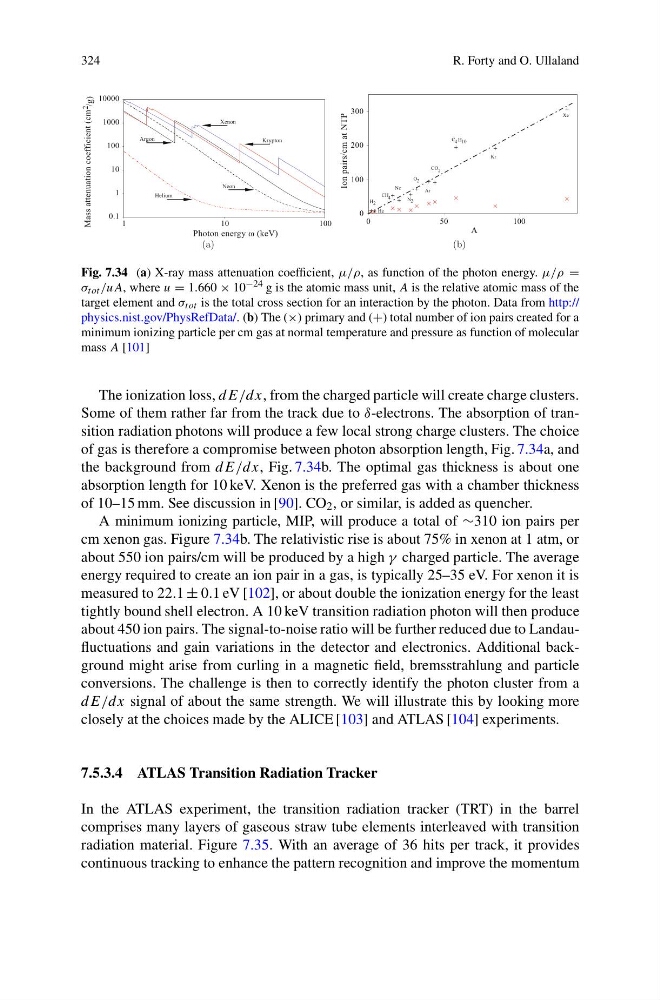
Fig. 7.34 (a) X-ray mass attenuation coefficient, μ/ρ, as function of the photon energy. μ/ρ =
σ tot /uA, where u = 1.660 × 10 −24 g is the atomic mass unit, A is the relative atomic mass of the
target element and σ tot is the total cross section for an interaction by the photon. Data from http://
physics.nist.gov/PhysRefData/. (b) The (×) primary and (+) total number of ion pairs created for a
minimum ionizing particle per cm gas at normal temperature and pressure as function of molecular
mass A [101]
The ionization loss, dE/dx, from the charged particle will create charge clusters.
Some of them rather far from the track due to δ-electrons. The absorption of transition radiation photons will produce a few local strong charge clusters. The choice
of gas is therefore a compromise between photon absorption length, Fig. 7.34a, and
the background from dE/dx, Fig. 7.34b. The optimal gas thickness is about one
absorption length for 10 keV. Xenon is the preferred gas with a chamber thickness
of 10–15 mm. See discussion in [90]. CO 2 , or similar, is added as quencher.
A minimum ionizing particle, MIP, will produce a total of ∼310 ion pairs per
cm xenon gas. Figure 7.34b. The relativistic rise is about 75% in xenon at 1 atm, or
about 550 ion pairs/cm will be produced by a high γ charged particle. The average
energy required to create an ion pair in a gas, is typically 25–35 eV. For xenon it is
measured to 22.1 ± 0.1 eV [102], or about double the ionization energy for the least
tightly bound shell electron. A 10 keV transition radiation photon will then produce
about 450 ion pairs. The signal-to-noise ratio will be further reduced due to Landaufluctuations and gain variations in the detector and electronics. Additional background might arise from curling in a magnetic field, bremsstrahlung and particle
conversions. The challenge is then to correctly identify the photon cluster from a
dE/dx signal of about the same strength. We will illustrate this by looking more
closely at the choices made by the ALICE [103] and ATLAS [104] experiments.
7.5.3.4 ATLAS Transition Radiation Tracker
In the ATLAS experiment, the transition radiation tracker (TRT) in the barrel
comprises many layers of gaseous straw tube elements interleaved with transition
radiation material. Figure 7.35. With an average of 36 hits per track, it provides
continuous tracking to enhance the pattern recognition and improve the momentum
R. Forty and O. Ullaland
0.1
1
10
100
1000
10000
1
1 0
1 0 0
Photon energy ω (keV)
Mass attenuation coefficient (cm 2
/g)
Argon
Krypton
Xenon
Neon
Helium
(a)
0
100
200
300
100
50
0
A
Ion pairs/cm at NTP
H 2
He
N2
O 2
Ne
Ar
Kr
Xe
CO 2
CH
4
C 4 H 10
(b)
Fig. 7.34 (a) X-ray mass attenuation coefficient, μ/ρ, as function of the photon energy. μ/ρ =
σ tot /uA, where u = 1.660 × 10 −24 g is the atomic mass unit, A is the relative atomic mass of the
target element and σ tot is the total cross section for an interaction by the photon. Data from http://
physics.nist.gov/PhysRefData/. (b) The (×) primary and (+) total number of ion pairs created for a
minimum ionizing particle per cm gas at normal temperature and pressure as function of molecular
mass A [101]
The ionization loss, dE/dx, from the charged particle will create charge clusters.
Some of them rather far from the track due to δ-electrons. The absorption of transition radiation photons will produce a few local strong charge clusters. The choice
of gas is therefore a compromise between photon absorption length, Fig. 7.34a, and
the background from dE/dx, Fig. 7.34b. The optimal gas thickness is about one
absorption length for 10 keV. Xenon is the preferred gas with a chamber thickness
of 10–15 mm. See discussion in [90]. CO 2 , or similar, is added as quencher.
A minimum ionizing particle, MIP, will produce a total of ∼310 ion pairs per
cm xenon gas. Figure 7.34b. The relativistic rise is about 75% in xenon at 1 atm, or
about 550 ion pairs/cm will be produced by a high γ charged particle. The average
energy required to create an ion pair in a gas, is typically 25–35 eV. For xenon it is
measured to 22.1 ± 0.1 eV [102], or about double the ionization energy for the least
tightly bound shell electron. A 10 keV transition radiation photon will then produce
about 450 ion pairs. The signal-to-noise ratio will be further reduced due to Landaufluctuations and gain variations in the detector and electronics. Additional background might arise from curling in a magnetic field, bremsstrahlung and particle
conversions. The challenge is then to correctly identify the photon cluster from a
dE/dx signal of about the same strength. We will illustrate this by looking more
closely at the choices made by the ALICE [103] and ATLAS [104] experiments.
7.5.3.4 ATLAS Transition Radiation Tracker
In the ATLAS experiment, the transition radiation tracker (TRT) in the barrel
comprises many layers of gaseous straw tube elements interleaved with transition
radiation material. Figure 7.35. With an average of 36 hits per track, it provides
continuous tracking to enhance the pattern recognition and improve the momentum