

320
R. Forty and O. Ullaland
Goniometer
Intensity
monitor
SEM Grid
OTR
radiator
Beam
L1
L2
CCD
camera
30 o
30 o
(a)
0.1
0.2
0.3
0.4
0.5
0.6
0.7
0.8
0
500 1000 1500 2000 2500 3000 3500
Intensity (A.U.)
σ rms (mm)
450 nm
650 nm
(b)
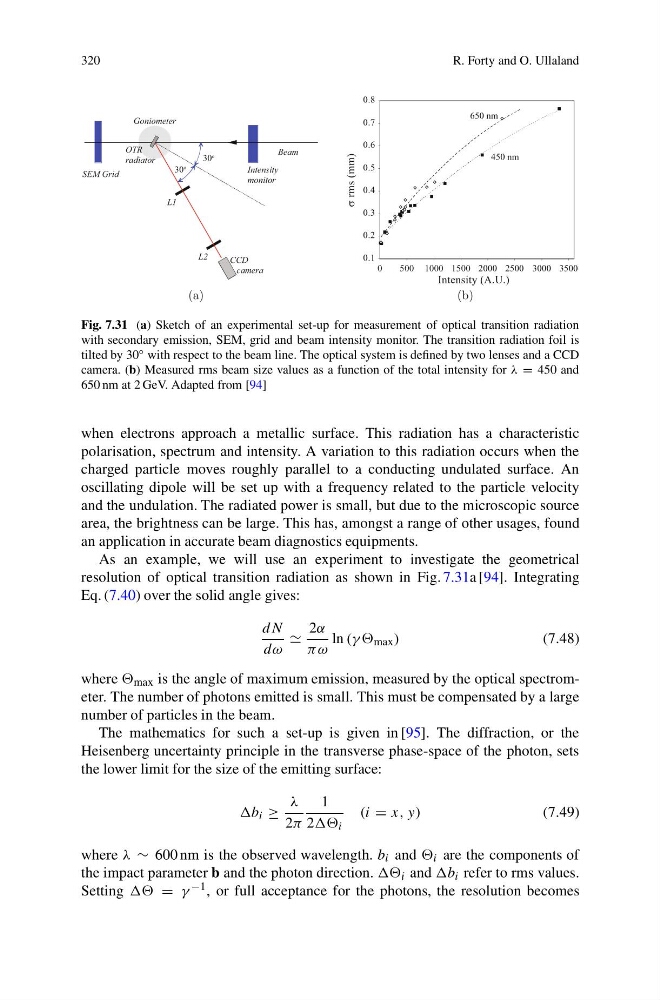
Fig. 7.31 (a) Sketch of an experimental set-up for measurement of optical transition radiation
with secondary emission, SEM, grid and beam intensity monitor. The transition radiation foil is
tilted by 30 ◦ with respect to the beam line. The optical system is defined by two lenses and a CCD
camera. (b) Measured rms beam size values as a function of the total intensity for λ = 450 and
650 nm at 2 GeV. Adapted from [94]
when electrons approach a metallic surface. This radiation has a characteristic
polarisation, spectrum and intensity. A variation to this radiation occurs when the
charged particle moves roughly parallel to a conducting undulated surface. An
oscillating dipole will be set up with a frequency related to the particle velocity
and the undulation. The radiated power is small, but due to the microscopic source
area, the brightness can be large. This has, amongst a range of other usages, found
an application in accurate beam diagnostics equipments.
As an example, we will use an experiment to investigate the geometrical
resolution of optical transition radiation as shown in Fig. 7.31a [94]. Integrating
Eq. (7.40) over the solid angle gives:
dN
dω
2α
πω
ln (γ γ max )
(7.48)
where max is the angle of maximum emission, measured by the optical spectrometer. The number of photons emitted is small. This must be compensated by a large
number of particles in the beam.
The mathematics for such a set-up is given in [95]. The diffraction, or the
Heisenberg uncertainty principle in the transverse phase-space of the photon, sets
the lower limit for the size of the emitting surface:
i ≥
λ
2π
1
2 i
(i = x, y)
(7.49)
where λ ∼ 600 nm is the observed wavelength. b i and i are the components of
the impact parameter b and the photon direction. i and i refer to rms values.
Setting = γ −1 , or full acceptance for the photons, the resolution becomes
R. Forty and O. Ullaland
Goniometer
Intensity
monitor
SEM Grid
OTR
radiator
Beam
L1
L2
CCD
camera
30 o
30 o
(a)
0.1
0.2
0.3
0.4
0.5
0.6
0.7
0.8
0
500 1000 1500 2000 2500 3000 3500
Intensity (A.U.)
σ rms (mm)
450 nm
650 nm
(b)
Fig. 7.31 (a) Sketch of an experimental set-up for measurement of optical transition radiation
with secondary emission, SEM, grid and beam intensity monitor. The transition radiation foil is
tilted by 30 ◦ with respect to the beam line. The optical system is defined by two lenses and a CCD
camera. (b) Measured rms beam size values as a function of the total intensity for λ = 450 and
650 nm at 2 GeV. Adapted from [94]
when electrons approach a metallic surface. This radiation has a characteristic
polarisation, spectrum and intensity. A variation to this radiation occurs when the
charged particle moves roughly parallel to a conducting undulated surface. An
oscillating dipole will be set up with a frequency related to the particle velocity
and the undulation. The radiated power is small, but due to the microscopic source
area, the brightness can be large. This has, amongst a range of other usages, found
an application in accurate beam diagnostics equipments.
As an example, we will use an experiment to investigate the geometrical
resolution of optical transition radiation as shown in Fig. 7.31a [94]. Integrating
Eq. (7.40) over the solid angle gives:
dN
dω
2α
πω
ln (γ γ max )
(7.48)
where max is the angle of maximum emission, measured by the optical spectrometer. The number of photons emitted is small. This must be compensated by a large
number of particles in the beam.
The mathematics for such a set-up is given in [95]. The diffraction, or the
Heisenberg uncertainty principle in the transverse phase-space of the photon, sets
the lower limit for the size of the emitting surface:
i ≥
λ
2π
1
2 i
(i = x, y)
(7.49)
where λ ∼ 600 nm is the observed wavelength. b i and i are the components of
the impact parameter b and the photon direction. i and i refer to rms values.
Setting = γ −1 , or full acceptance for the photons, the resolution becomes