

7 Particle Detectors and Detector Systems
315
5
0
200
400
600
800
1000
1200
1400
1600
Events / (9 MeV/c 2
)
1800
2000
2200
Events / (0.02 GeV/c 2
)
5.1 5.2 5.3 5.4 5.5
π + π – invariant mass (GeV/c 2 )
5.6
LHCb
(a)
(b)
LHCb
5.7 5.8
5
0
100
200
300
400
500
600
700
5.1 5.2 5.3 5.4 5.5
π + π – invariant mass (GeV/c 2 )
5.6 5.7 5.8
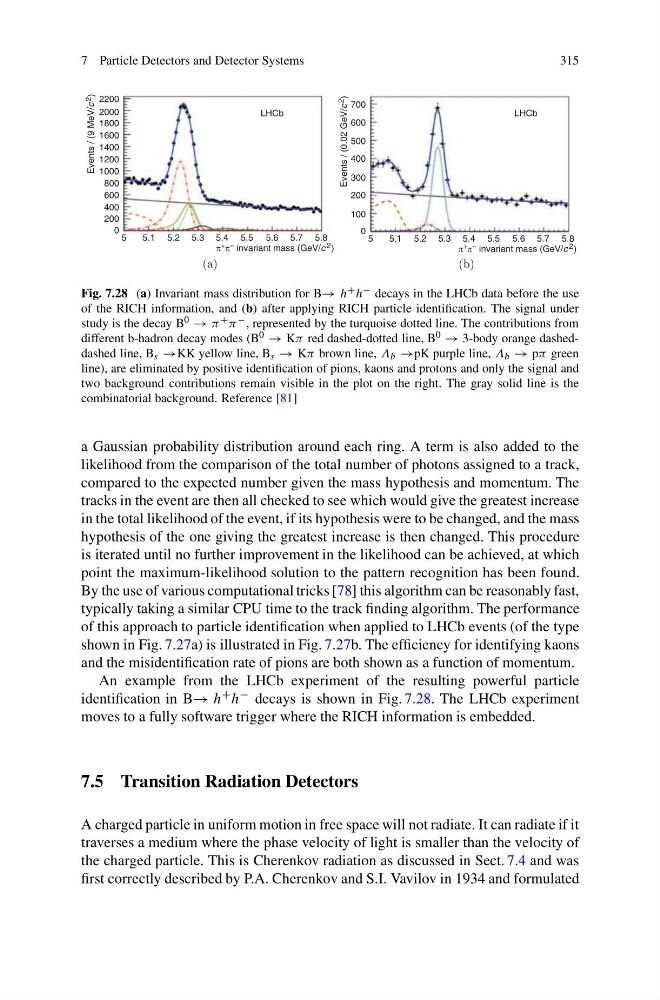
Fig. 7.28 (a) Invariant mass distribution for B→ h + h − decays in the LHCb data before the use
of the RICH information, and (b) after applying RICH particle identification. The signal under
study is the decay B 0 → π + π − , represented by the turquoise dotted line. The contributions from
different b-hadron decay modes (B 0 → Kπ red dashed-dotted line, B 0 → 3-body orange dasheddashed line, B s →KK yellow line, B s → Kπ brown line, Λ b →pK purple line, Λ b → pπ green
line), are eliminated by positive identification of pions, kaons and protons and only the signal and
two background contributions remain visible in the plot on the right. The gray solid line is the
combinatorial background. Reference [81]
a Gaussian probability distribution around each ring. A term is also added to the
likelihood from the comparison of the total number of photons assigned to a track,
compared to the expected number given the mass hypothesis and momentum. The
tracks in the event are then all checked to see which would give the greatest increase
in the total likelihood of the event, if its hypothesis were to be changed, and the mass
hypothesis of the one giving the greatest increase is then changed. This procedure
is iterated until no further improvement in the likelihood can be achieved, at which
point the maximum-likelihood solution to the pattern recognition has been found.
By the use of various computational tricks [78] this algorithm can be reasonably fast,
typically taking a similar CPU time to the track finding algorithm. The performance
of this approach to particle identification when applied to LHCb events (of the type
shown in Fig. 7.27a) is illustrated in Fig. 7.27b. The efficiency for identifying kaons
and the misidentification rate of pions are both shown as a function of momentum.
An example from the LHCb experiment of the resulting powerful particle
identification in B→ h + h − decays is shown in Fig. 7.28. The LHCb experiment
moves to a fully software trigger where the RICH information is embedded.
7.5 Transition Radiation Detectors
A charged particle in uniform motion in free space will not radiate. It can radiate if it
traverses a medium where the phase velocity of light is smaller than the velocity of
the charged particle. This is Cherenkov radiation as discussed in Sect. 7.4 and was
first correctly described by P.A. Cherenkov and S.I. Vavilov in 1934 and formulated
315
5
0
200
400
600
800
1000
1200
1400
1600
Events / (9 MeV/c 2
)
1800
2000
2200
Events / (0.02 GeV/c 2
)
5.1 5.2 5.3 5.4 5.5
π + π – invariant mass (GeV/c 2 )
5.6
LHCb
(a)
(b)
LHCb
5.7 5.8
5
0
100
200
300
400
500
600
700
5.1 5.2 5.3 5.4 5.5
π + π – invariant mass (GeV/c 2 )
5.6 5.7 5.8
Fig. 7.28 (a) Invariant mass distribution for B→ h + h − decays in the LHCb data before the use
of the RICH information, and (b) after applying RICH particle identification. The signal under
study is the decay B 0 → π + π − , represented by the turquoise dotted line. The contributions from
different b-hadron decay modes (B 0 → Kπ red dashed-dotted line, B 0 → 3-body orange dasheddashed line, B s →KK yellow line, B s → Kπ brown line, Λ b →pK purple line, Λ b → pπ green
line), are eliminated by positive identification of pions, kaons and protons and only the signal and
two background contributions remain visible in the plot on the right. The gray solid line is the
combinatorial background. Reference [81]
a Gaussian probability distribution around each ring. A term is also added to the
likelihood from the comparison of the total number of photons assigned to a track,
compared to the expected number given the mass hypothesis and momentum. The
tracks in the event are then all checked to see which would give the greatest increase
in the total likelihood of the event, if its hypothesis were to be changed, and the mass
hypothesis of the one giving the greatest increase is then changed. This procedure
is iterated until no further improvement in the likelihood can be achieved, at which
point the maximum-likelihood solution to the pattern recognition has been found.
By the use of various computational tricks [78] this algorithm can be reasonably fast,
typically taking a similar CPU time to the track finding algorithm. The performance
of this approach to particle identification when applied to LHCb events (of the type
shown in Fig. 7.27a) is illustrated in Fig. 7.27b. The efficiency for identifying kaons
and the misidentification rate of pions are both shown as a function of momentum.
An example from the LHCb experiment of the resulting powerful particle
identification in B→ h + h − decays is shown in Fig. 7.28. The LHCb experiment
moves to a fully software trigger where the RICH information is embedded.
7.5 Transition Radiation Detectors
A charged particle in uniform motion in free space will not radiate. It can radiate if it
traverses a medium where the phase velocity of light is smaller than the velocity of
the charged particle. This is Cherenkov radiation as discussed in Sect. 7.4 and was
first correctly described by P.A. Cherenkov and S.I. Vavilov in 1934 and formulated