

314
R. Forty and O. Ullaland
(cm)
(cm)
1.4
1.2
1
0.8
0.6
0.4
0.2
0
20
40
60
80
100
Momentum (GeV/c)
Efficiency
LHCb Data
(a)
(b)
ΔLogL(K -π) >0
ΔLogL(K -π) >5
π
K
K
K
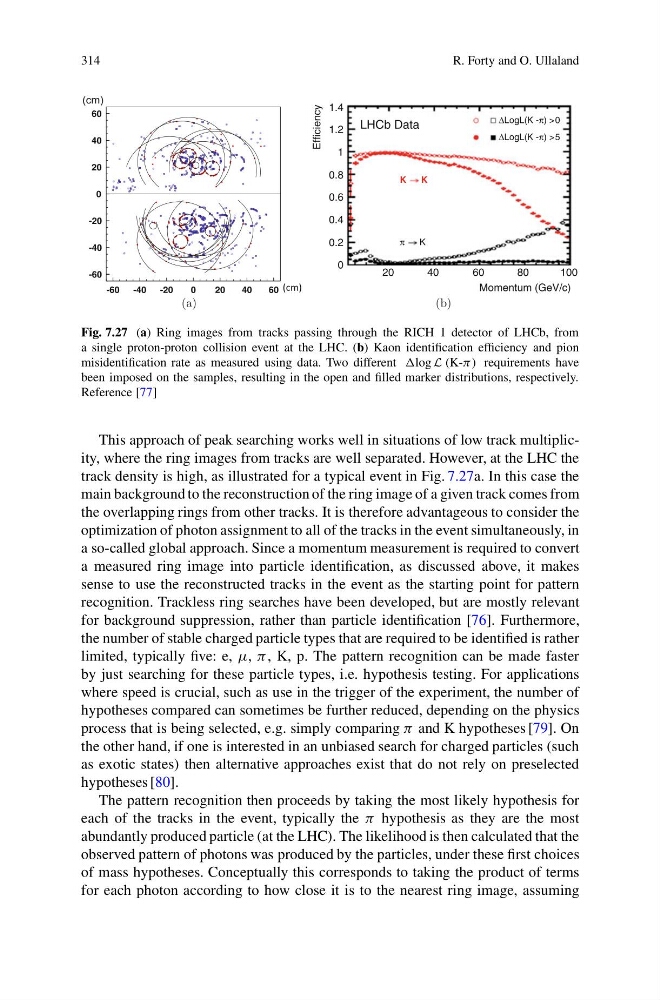
Fig. 7.27 (a) Ring images from tracks passing through the RICH 1 detector of LHCb, from
a single proton-proton collision event at the LHC. (b) Kaon identification efficiency and pion
misidentification rate as measured using data. Two different log L (K-π) requirements have
been imposed on the samples, resulting in the open and filled marker distributions, respectively.
Reference [77]
This approach of peak searching works well in situations of low track multiplicity, where the ring images from tracks are well separated. However, at the LHC the
track density is high, as illustrated for a typical event in Fig. 7.27a. In this case the
main background to the reconstruction of the ring image of a given track comes from
the overlapping rings from other tracks. It is therefore advantageous to consider the
optimization of photon assignment to all of the tracks in the event simultaneously, in
a so-called global approach. Since a momentum measurement is required to convert
a measured ring image into particle identification, as discussed above, it makes
sense to use the reconstructed tracks in the event as the starting point for pattern
recognition. Trackless ring searches have been developed, but are mostly relevant
for background suppression, rather than particle identification [76]. Furthermore,
the number of stable charged particle types that are required to be identified is rather
limited, typically five: e, μ, π, K, p. The pattern recognition can be made faster
by just searching for these particle types, i.e. hypothesis testing. For applications
where speed is crucial, such as use in the trigger of the experiment, the number of
hypotheses compared can sometimes be further reduced, depending on the physics
process that is being selected, e.g. simply comparing π and K hypotheses [79]. On
the other hand, if one is interested in an unbiased search for charged particles (such
as exotic states) then alternative approaches exist that do not rely on preselected
hypotheses [80].
The pattern recognition then proceeds by taking the most likely hypothesis for
each of the tracks in the event, typically the π hypothesis as they are the most
abundantly produced particle (at the LHC). The likelihood is then calculated that the
observed pattern of photons was produced by the particles, under these first choices
of mass hypotheses. Conceptually this corresponds to taking the product of terms
for each photon according to how close it is to the nearest ring image, assuming
R. Forty and O. Ullaland
(cm)
(cm)
1.4
1.2
1
0.8
0.6
0.4
0.2
0
20
40
60
80
100
Momentum (GeV/c)
Efficiency
LHCb Data
(a)
(b)
ΔLogL(K -π) >0
ΔLogL(K -π) >5
π
K
K
K
Fig. 7.27 (a) Ring images from tracks passing through the RICH 1 detector of LHCb, from
a single proton-proton collision event at the LHC. (b) Kaon identification efficiency and pion
misidentification rate as measured using data. Two different log L (K-π) requirements have
been imposed on the samples, resulting in the open and filled marker distributions, respectively.
Reference [77]
This approach of peak searching works well in situations of low track multiplicity, where the ring images from tracks are well separated. However, at the LHC the
track density is high, as illustrated for a typical event in Fig. 7.27a. In this case the
main background to the reconstruction of the ring image of a given track comes from
the overlapping rings from other tracks. It is therefore advantageous to consider the
optimization of photon assignment to all of the tracks in the event simultaneously, in
a so-called global approach. Since a momentum measurement is required to convert
a measured ring image into particle identification, as discussed above, it makes
sense to use the reconstructed tracks in the event as the starting point for pattern
recognition. Trackless ring searches have been developed, but are mostly relevant
for background suppression, rather than particle identification [76]. Furthermore,
the number of stable charged particle types that are required to be identified is rather
limited, typically five: e, μ, π, K, p. The pattern recognition can be made faster
by just searching for these particle types, i.e. hypothesis testing. For applications
where speed is crucial, such as use in the trigger of the experiment, the number of
hypotheses compared can sometimes be further reduced, depending on the physics
process that is being selected, e.g. simply comparing π and K hypotheses [79]. On
the other hand, if one is interested in an unbiased search for charged particles (such
as exotic states) then alternative approaches exist that do not rely on preselected
hypotheses [80].
The pattern recognition then proceeds by taking the most likely hypothesis for
each of the tracks in the event, typically the π hypothesis as they are the most
abundantly produced particle (at the LHC). The likelihood is then calculated that the
observed pattern of photons was produced by the particles, under these first choices
of mass hypotheses. Conceptually this corresponds to taking the product of terms
for each photon according to how close it is to the nearest ring image, assuming