

316
R. Forty and O. Ullaland
by I.M Frank and I.E. Tamm in 1937 [15]. This radiation was worked into the BetheBloch formalism in 1940 by E. Fermi, see Chap. 2 and [82].
There is another type of radiation when the charged particle traverses a medium
where the dielectric constant, ε, varies. This is transition radiation. It is analogous
to bremsstrahlung. In both cases the radiation is related to the phase velocity of
the electromagnetic waves in the medium and the velocity of the particle. In the
case of transition radiation, the phase velocity changes whereas the particle velocity
changes for bremsstrahlung. Transition radiation is, like bremsstrahlung, strongly
forward peaked.
V.L. Ginzburg and I.M. Frank predicted in 1944 [83] the existence of transition
radiation. Although recognised as a milestone in the understanding of quantum
mechanics, transition radiation was more of theoretical interest before it became
an integral part of particle detection and particle identification [84].
The exact calculation of transition radiation is complex and we will not repeat
the mathematics here. The reader is referred to [18, 85, 86]. Specific discussions can
be found in [87, 88]. We will here just recall some of the central features.
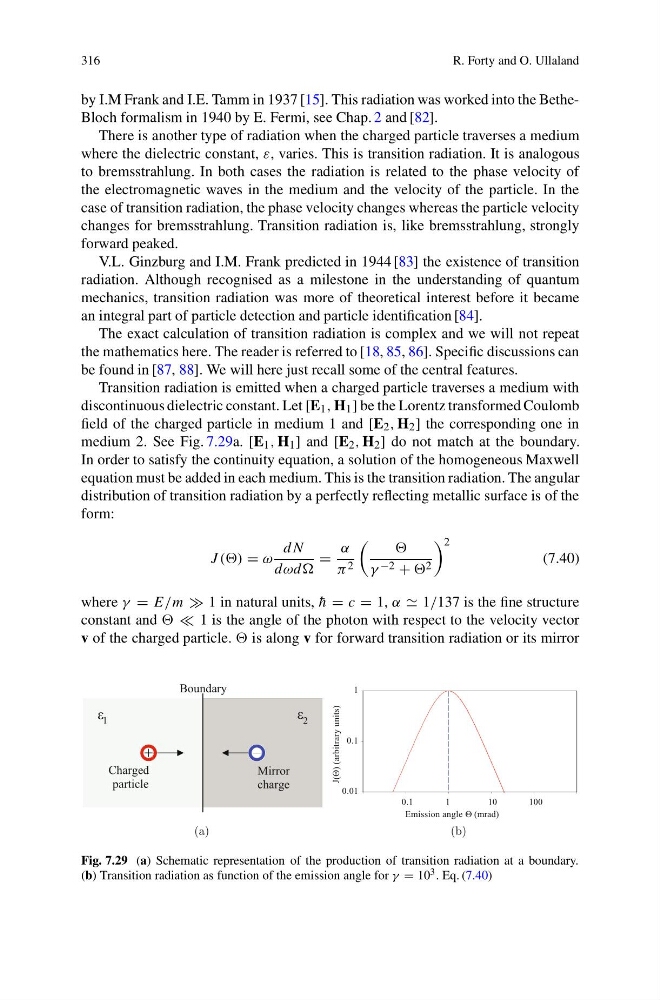
Transition radiation is emitted when a charged particle traverses a medium with
discontinuous dielectric constant. Let [E 1 , H 1 ] be the Lorentz transformed Coulomb
field of the charged particle in medium 1 and [E 2 , H 2 ] the corresponding one in
medium 2. See Fig. 7.29a. [E 1 , H 1 ] and [E 2 , H 2 ] do not match at the boundary.
In order to satisfy the continuity equation, a solution of the homogeneous Maxwell
equation must be added in each medium. This is the transition radiation. The angular
distribution of transition radiation by a perfectly reflecting metallic surface is of the
form:
J (() = ω
dN
dωdd
=
α
π 2
γ −2 + 2
2
(7.40)
where γ = E/m 1 in natural units, ¯
h = c = 1, α 1/137 is the fine structure
constant and 1 is the angle of the photon with respect to the velocity vector
v of the charged particle. is along v for forward transition radiation or its mirror
Boundary
ε
ε 1
2
Charged
particle
Mirror
charge
(a)
0.01
0.1
1
0.1
1
10
100
Emission angle Θ (mrad)
J(Θ) (arbitrary units)
(b)
Fig. 7.29 (a) Schematic representation of the production of transition radiation at a boundary.
(b) Transition radiation as function of the emission angle for γ = 10 3 . Eq. (7.40)
R. Forty and O. Ullaland
by I.M Frank and I.E. Tamm in 1937 [15]. This radiation was worked into the BetheBloch formalism in 1940 by E. Fermi, see Chap. 2 and [82].
There is another type of radiation when the charged particle traverses a medium
where the dielectric constant, ε, varies. This is transition radiation. It is analogous
to bremsstrahlung. In both cases the radiation is related to the phase velocity of
the electromagnetic waves in the medium and the velocity of the particle. In the
case of transition radiation, the phase velocity changes whereas the particle velocity
changes for bremsstrahlung. Transition radiation is, like bremsstrahlung, strongly
forward peaked.
V.L. Ginzburg and I.M. Frank predicted in 1944 [83] the existence of transition
radiation. Although recognised as a milestone in the understanding of quantum
mechanics, transition radiation was more of theoretical interest before it became
an integral part of particle detection and particle identification [84].
The exact calculation of transition radiation is complex and we will not repeat
the mathematics here. The reader is referred to [18, 85, 86]. Specific discussions can
be found in [87, 88]. We will here just recall some of the central features.
Transition radiation is emitted when a charged particle traverses a medium with
discontinuous dielectric constant. Let [E 1 , H 1 ] be the Lorentz transformed Coulomb
field of the charged particle in medium 1 and [E 2 , H 2 ] the corresponding one in
medium 2. See Fig. 7.29a. [E 1 , H 1 ] and [E 2 , H 2 ] do not match at the boundary.
In order to satisfy the continuity equation, a solution of the homogeneous Maxwell
equation must be added in each medium. This is the transition radiation. The angular
distribution of transition radiation by a perfectly reflecting metallic surface is of the
form:
J (() = ω
dN
dωdd
=
α
π 2
γ −2 + 2
2
(7.40)
where γ = E/m 1 in natural units, ¯
h = c = 1, α 1/137 is the fine structure
constant and 1 is the angle of the photon with respect to the velocity vector
v of the charged particle. is along v for forward transition radiation or its mirror
Boundary
ε
ε 1
2
Charged
particle
Mirror
charge
(a)
0.01
0.1
1
0.1
1
10
100
Emission angle Θ (mrad)
J(Θ) (arbitrary units)
(b)
Fig. 7.29 (a) Schematic representation of the production of transition radiation at a boundary.
(b) Transition radiation as function of the emission angle for γ = 10 3 . Eq. (7.40)