

312
R. Forty and O. Ullaland
Muon system
RICH-2
Magnet
RICH-1
VELO
Tracking system
Electromagnetic calorimeter
Hadronic calorimeter
(a)
(b)
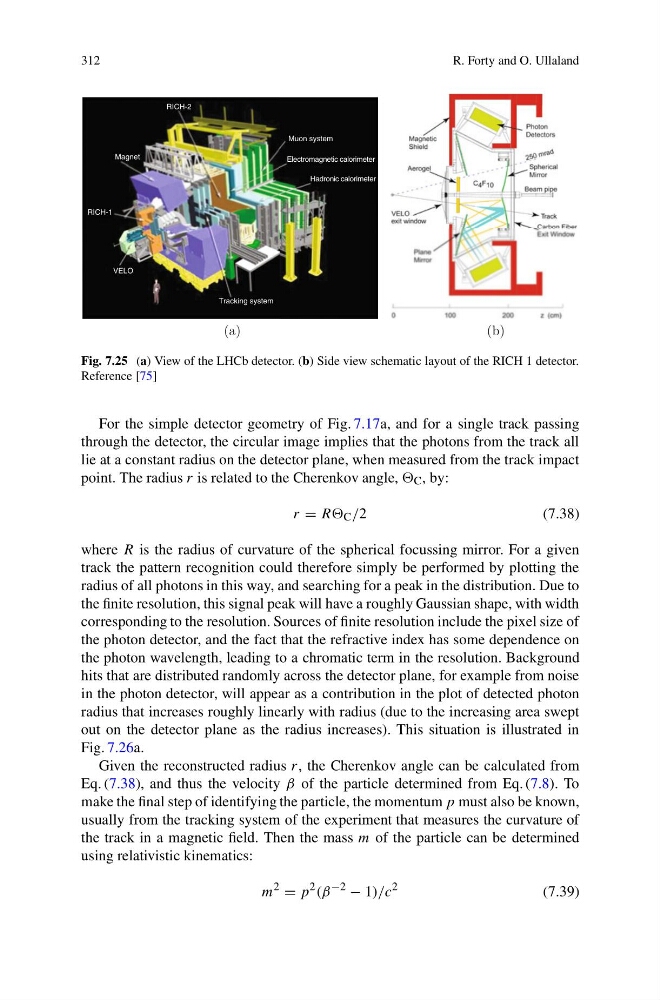
Fig. 7.25 (a) View of the LHCb detector. (b) Side view schematic layout of the RICH 1 detector.
Reference [75]
For the simple detector geometry of Fig. 7.17a, and for a single track passing
through the detector, the circular image implies that the photons from the track all
lie at a constant radius on the detector plane, when measured from the track impact
point. The radius r is related to the Cherenkov angle, C , by:
r = RR C /2
(7.38)
where R is the radius of curvature of the spherical focussing mirror. For a given
track the pattern recognition could therefore simply be performed by plotting the
radius of all photons in this way, and searching for a peak in the distribution. Due to
the finite resolution, this signal peak will have a roughly Gaussian shape, with width
corresponding to the resolution. Sources of finite resolution include the pixel size of
the photon detector, and the fact that the refractive index has some dependence on
the photon wavelength, leading to a chromatic term in the resolution. Background
hits that are distributed randomly across the detector plane, for example from noise
in the photon detector, will appear as a contribution in the plot of detected photon
radius that increases roughly linearly with radius (due to the increasing area swept
out on the detector plane as the radius increases). This situation is illustrated in
Fig. 7.26a.
Given the reconstructed radius r, the Cherenkov angle can be calculated from
Eq. (7.38), and thus the velocity β of the particle determined from Eq. (7.8). To
make the final step of identifying the particle, the momentum p must also be known,
usually from the tracking system of the experiment that measures the curvature of
the track in a magnetic field. Then the mass m of the particle can be determined
using relativistic kinematics:
m
2
= p
2 (β
−2
− 1)/c
2
(7.39)
R. Forty and O. Ullaland
Muon system
RICH-2
Magnet
RICH-1
VELO
Tracking system
Electromagnetic calorimeter
Hadronic calorimeter
(a)
(b)
Fig. 7.25 (a) View of the LHCb detector. (b) Side view schematic layout of the RICH 1 detector.
Reference [75]
For the simple detector geometry of Fig. 7.17a, and for a single track passing
through the detector, the circular image implies that the photons from the track all
lie at a constant radius on the detector plane, when measured from the track impact
point. The radius r is related to the Cherenkov angle, C , by:
r = RR C /2
(7.38)
where R is the radius of curvature of the spherical focussing mirror. For a given
track the pattern recognition could therefore simply be performed by plotting the
radius of all photons in this way, and searching for a peak in the distribution. Due to
the finite resolution, this signal peak will have a roughly Gaussian shape, with width
corresponding to the resolution. Sources of finite resolution include the pixel size of
the photon detector, and the fact that the refractive index has some dependence on
the photon wavelength, leading to a chromatic term in the resolution. Background
hits that are distributed randomly across the detector plane, for example from noise
in the photon detector, will appear as a contribution in the plot of detected photon
radius that increases roughly linearly with radius (due to the increasing area swept
out on the detector plane as the radius increases). This situation is illustrated in
Fig. 7.26a.
Given the reconstructed radius r, the Cherenkov angle can be calculated from
Eq. (7.38), and thus the velocity β of the particle determined from Eq. (7.8). To
make the final step of identifying the particle, the momentum p must also be known,
usually from the tracking system of the experiment that measures the curvature of
the track in a magnetic field. Then the mass m of the particle can be determined
using relativistic kinematics:
m
2
= p
2 (β
−2
− 1)/c
2
(7.39)