

7 Particle Detectors and Detector Systems
307
(a)
(b)
(c)
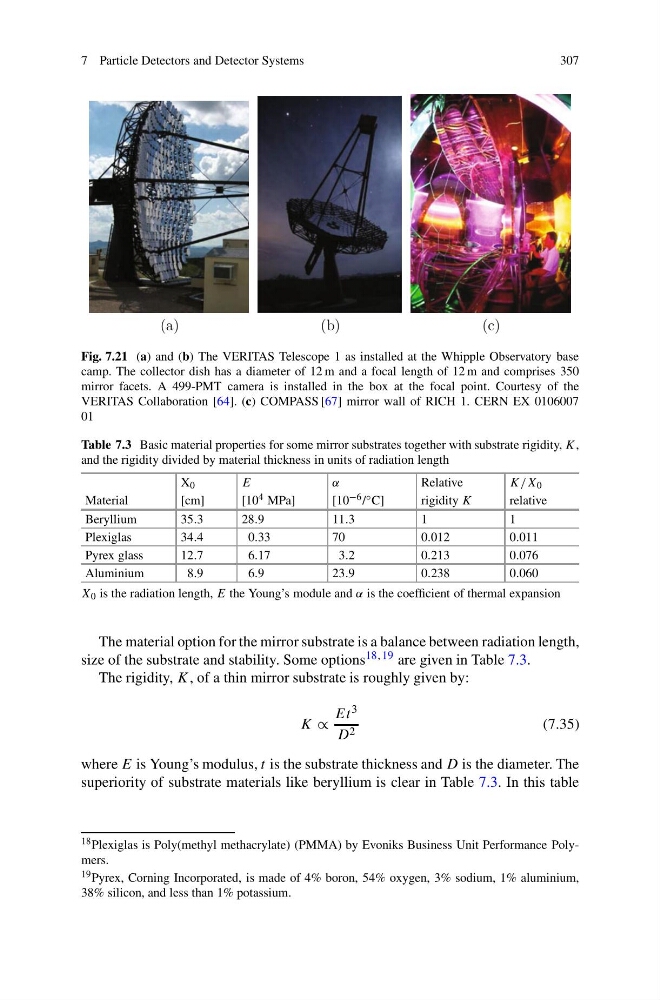
Fig. 7.21 (a) and (b) The VERITAS Telescope 1 as installed at the Whipple Observatory base
camp. The collector dish has a diameter of 12 m and a focal length of 12 m and comprises 350
mirror facets. A 499-PMT camera is installed in the box at the focal point. Courtesy of the
VERITAS Collaboration [64]. (c) COMPASS [67] mirror wall of RICH 1. CERN EX 0106007
01
Table 7.3 Basic material properties for some mirror substrates together with substrate rigidity, K,
and the rigidity divided by material thickness in units of radiation length
X 0
E
α
Relative
K/X 0
Material
[cm]
[10 4 MPa]
[10 −6 / ◦ C]
rigidity K
relative
Beryllium
35.3
28.9
11.3
1
1
Plexiglas
34.4
0.33
70
0.012
0.011
Pyrex glass
12.7
6.17
3.2
0.213
0.076
Aluminium
8.9
6.9
23.9
0.238
0.060
X 0 is the radiation length, E the Young’s module and α is the coefficient of thermal expansion
The material option for the mirror substrate is a balance between radiation length,
size of the substrate and stability. Some options 18,19 are given in Table 7.3.
The rigidity, K, of a thin mirror substrate is roughly given by:
K ∝
Et 3
D 2
(7.35)
where E is Young’s modulus, t is the substrate thickness and D is the diameter. The
superiority of substrate materials like beryllium is clear in Table 7.3. In this table
18 Plexiglas is Poly(methyl methacrylate) (PMMA) by Evoniks Business Unit Performance Polymers.
19 Pyrex, Corning Incorporated, is made of 4% boron, 54% oxygen, 3% sodium, 1% aluminium,
38% silicon, and less than 1% potassium.
307
(a)
(b)
(c)
Fig. 7.21 (a) and (b) The VERITAS Telescope 1 as installed at the Whipple Observatory base
camp. The collector dish has a diameter of 12 m and a focal length of 12 m and comprises 350
mirror facets. A 499-PMT camera is installed in the box at the focal point. Courtesy of the
VERITAS Collaboration [64]. (c) COMPASS [67] mirror wall of RICH 1. CERN EX 0106007
01
Table 7.3 Basic material properties for some mirror substrates together with substrate rigidity, K,
and the rigidity divided by material thickness in units of radiation length
X 0
E
α
Relative
K/X 0
Material
[cm]
[10 4 MPa]
[10 −6 / ◦ C]
rigidity K
relative
Beryllium
35.3
28.9
11.3
1
1
Plexiglas
34.4
0.33
70
0.012
0.011
Pyrex glass
12.7
6.17
3.2
0.213
0.076
Aluminium
8.9
6.9
23.9
0.238
0.060
X 0 is the radiation length, E the Young’s module and α is the coefficient of thermal expansion
The material option for the mirror substrate is a balance between radiation length,
size of the substrate and stability. Some options 18,19 are given in Table 7.3.
The rigidity, K, of a thin mirror substrate is roughly given by:
K ∝
Et 3
D 2
(7.35)
where E is Young’s modulus, t is the substrate thickness and D is the diameter. The
superiority of substrate materials like beryllium is clear in Table 7.3. In this table
18 Plexiglas is Poly(methyl methacrylate) (PMMA) by Evoniks Business Unit Performance Polymers.
19 Pyrex, Corning Incorporated, is made of 4% boron, 54% oxygen, 3% sodium, 1% aluminium,
38% silicon, and less than 1% potassium.