

306
R. Forty and O. Ullaland
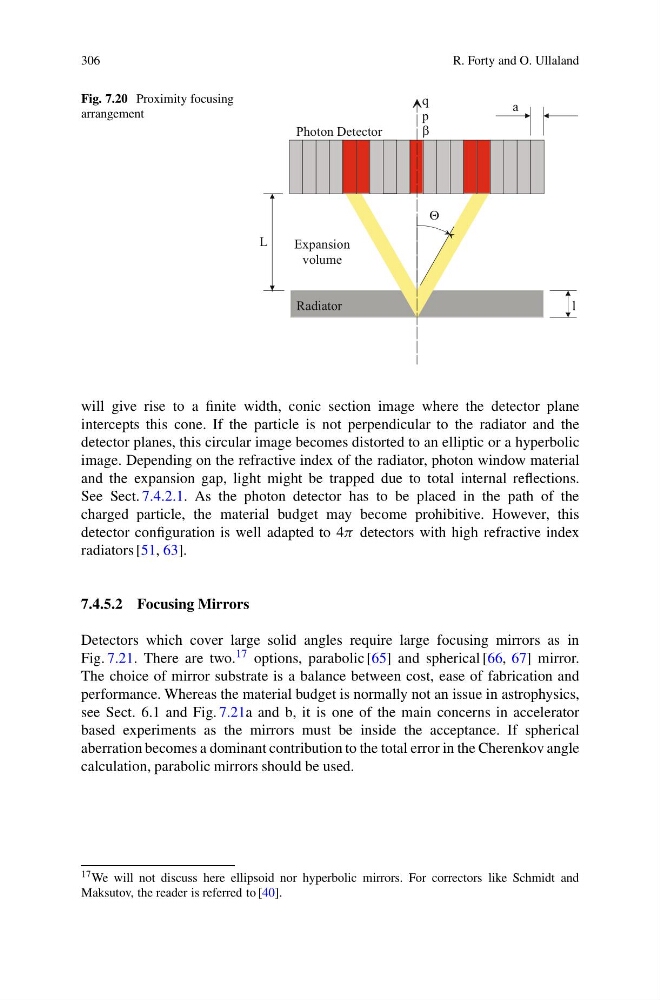
Fig. 7.20 Proximity focusing
arrangement
Radiator
Expansion
volume
Photon Detector
L
l
q
p
β
a
Θ
will give rise to a finite width, conic section image where the detector plane
intercepts this cone. If the particle is not perpendicular to the radiator and the
detector planes, this circular image becomes distorted to an elliptic or a hyperbolic
image. Depending on the refractive index of the radiator, photon window material
and the expansion gap, light might be trapped due to total internal reflections.
See Sect. 7.4.2.1. As the photon detector has to be placed in the path of the
charged particle, the material budget may become prohibitive. However, this
detector configuration is well adapted to 4π detectors with high refractive index
radiators [51, 63].
7.4.5.2 Focusing Mirrors
Detectors which cover large solid angles require large focusing mirrors as in
Fig. 7.21. There are two. 17 options, parabolic [65] and spherical [66, 67] mirror.
The choice of mirror substrate is a balance between cost, ease of fabrication and
performance. Whereas the material budget is normally not an issue in astrophysics,
see Sect. 6.1 and Fig. 7.21a and b, it is one of the main concerns in accelerator
based experiments as the mirrors must be inside the acceptance. If spherical
aberration becomes a dominant contribution to the total error in the Cherenkov angle
calculation, parabolic mirrors should be used.
17 We will not discuss here ellipsoid nor hyperbolic mirrors. For correctors like Schmidt and
Maksutov, the reader is referred to [40].
R. Forty and O. Ullaland
Fig. 7.20 Proximity focusing
arrangement
Radiator
Expansion
volume
Photon Detector
L
l
q
p
β
a
Θ
will give rise to a finite width, conic section image where the detector plane
intercepts this cone. If the particle is not perpendicular to the radiator and the
detector planes, this circular image becomes distorted to an elliptic or a hyperbolic
image. Depending on the refractive index of the radiator, photon window material
and the expansion gap, light might be trapped due to total internal reflections.
See Sect. 7.4.2.1. As the photon detector has to be placed in the path of the
charged particle, the material budget may become prohibitive. However, this
detector configuration is well adapted to 4π detectors with high refractive index
radiators [51, 63].
7.4.5.2 Focusing Mirrors
Detectors which cover large solid angles require large focusing mirrors as in
Fig. 7.21. There are two. 17 options, parabolic [65] and spherical [66, 67] mirror.
The choice of mirror substrate is a balance between cost, ease of fabrication and
performance. Whereas the material budget is normally not an issue in astrophysics,
see Sect. 6.1 and Fig. 7.21a and b, it is one of the main concerns in accelerator
based experiments as the mirrors must be inside the acceptance. If spherical
aberration becomes a dominant contribution to the total error in the Cherenkov angle
calculation, parabolic mirrors should be used.
17 We will not discuss here ellipsoid nor hyperbolic mirrors. For correctors like Schmidt and
Maksutov, the reader is referred to [40].