

7 Particle Detectors and Detector Systems
305
(a)
(b)
concentrator
field lens
photons
76
27
MAPMT
Si pixel array
(1024 elements)
Ceramic carrier
Photocathode
(–20kV)
VACUUM
Photoelectron
Electrode
Solder
bump
bonds
Binary
electronics
chip
Optical input
window
Photon
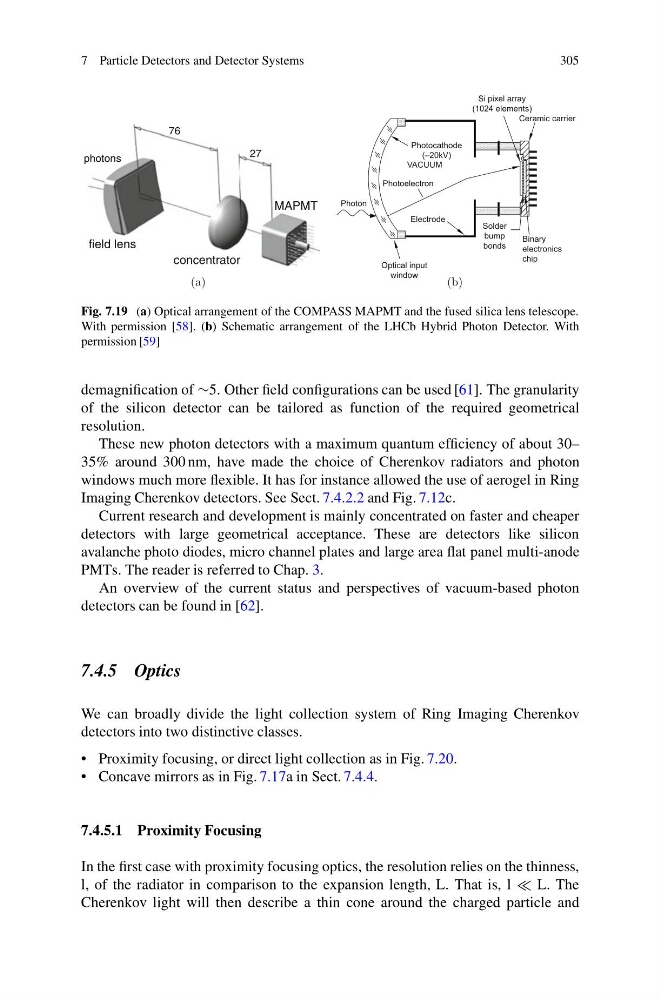
Fig. 7.19 (a) Optical arrangement of the COMPASS MAPMT and the fused silica lens telescope.
With permission [58]. (b) Schematic arrangement of the LHCb Hybrid Photon Detector. With
permission [59]
demagnification of ∼5. Other field configurations can be used [61]. The granularity
of the silicon detector can be tailored as function of the required geometrical
resolution.
These new photon detectors with a maximum quantum efficiency of about 30–
35% around 300 nm, have made the choice of Cherenkov radiators and photon
windows much more flexible. It has for instance allowed the use of aerogel in Ring
Imaging Cherenkov detectors. See Sect. 7.4.2.2 and Fig. 7.12c.
Current research and development is mainly concentrated on faster and cheaper
detectors with large geometrical acceptance. These are detectors like silicon
avalanche photo diodes, micro channel plates and large area flat panel multi-anode
PMTs. The reader is referred to Chap. 3.
An overview of the current status and perspectives of vacuum-based photon
detectors can be found in [62].
7.4.5 Optics
We can broadly divide the light collection system of Ring Imaging Cherenkov
detectors into two distinctive classes.
• Proximity focusing, or direct light collection as in Fig. 7.20.
• Concave mirrors as in Fig. 7.17a in Sect. 7.4.4.
7.4.5.1 Proximity Focusing
In the first case with proximity focusing optics, the resolution relies on the thinness,
l, of the radiator in comparison to the expansion length, L. That is, l L. The
Cherenkov light will then describe a thin cone around the charged particle and
305
(a)
(b)
concentrator
field lens
photons
76
27
MAPMT
Si pixel array
(1024 elements)
Ceramic carrier
Photocathode
(–20kV)
VACUUM
Photoelectron
Electrode
Solder
bump
bonds
Binary
electronics
chip
Optical input
window
Photon
Fig. 7.19 (a) Optical arrangement of the COMPASS MAPMT and the fused silica lens telescope.
With permission [58]. (b) Schematic arrangement of the LHCb Hybrid Photon Detector. With
permission [59]
demagnification of ∼5. Other field configurations can be used [61]. The granularity
of the silicon detector can be tailored as function of the required geometrical
resolution.
These new photon detectors with a maximum quantum efficiency of about 30–
35% around 300 nm, have made the choice of Cherenkov radiators and photon
windows much more flexible. It has for instance allowed the use of aerogel in Ring
Imaging Cherenkov detectors. See Sect. 7.4.2.2 and Fig. 7.12c.
Current research and development is mainly concentrated on faster and cheaper
detectors with large geometrical acceptance. These are detectors like silicon
avalanche photo diodes, micro channel plates and large area flat panel multi-anode
PMTs. The reader is referred to Chap. 3.
An overview of the current status and perspectives of vacuum-based photon
detectors can be found in [62].
7.4.5 Optics
We can broadly divide the light collection system of Ring Imaging Cherenkov
detectors into two distinctive classes.
• Proximity focusing, or direct light collection as in Fig. 7.20.
• Concave mirrors as in Fig. 7.17a in Sect. 7.4.4.
7.4.5.1 Proximity Focusing
In the first case with proximity focusing optics, the resolution relies on the thinness,
l, of the radiator in comparison to the expansion length, L. That is, l L. The
Cherenkov light will then describe a thin cone around the charged particle and