

298
R. Forty and O. Ullaland
(a)
( b)
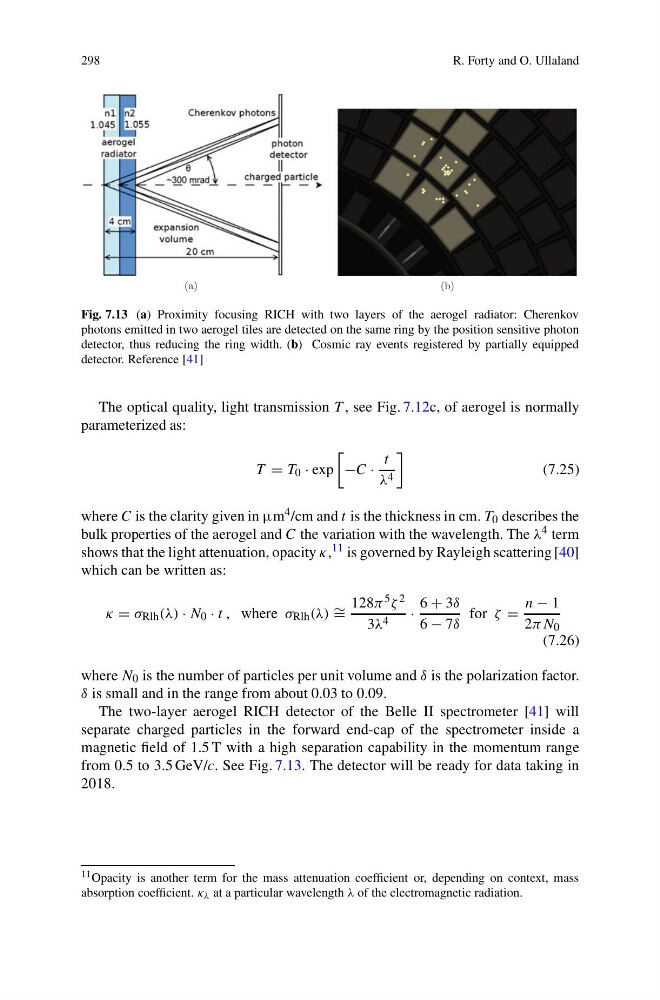
Fig. 7.13 (a) Proximity focusing RICH with two layers of the aerogel radiator: Cherenkov
photons emitted in two aerogel tiles are detected on the same ring by the position sensitive photon
detector, thus reducing the ring width. (b) Cosmic ray events registered by partially equipped
detector. Reference [41]
The optical quality, light transmission T , see Fig. 7.12c, of aerogel is normally
parameterized as:
T = T 0 · exp
−C ·
t
λ 4
(7.25)
where C is the clarity given in μm 4 /cm and t is the thickness in cm. T 0 describes the
bulk properties of the aerogel and C the variation with the wavelength. The λ 4 term
shows that the light attenuation, opacity κ, 11 is governed by Rayleigh scattering [40]
which can be written as:
κ = σ Rlh (λ) · N 0 · t , where σ Rlh (λ) ∼ =
128π 5 ζ 2
3λ 4 ·
6 + 3δ
6 − 7δ
for ζ =
n − 1
2πN 0
(7.26)
where N 0 is the number of particles per unit volume and δ is the polarization factor.
δ is small and in the range from about 0.03 to 0.09.
The two-layer aerogel RICH detector of the Belle II spectrometer [41] will
separate charged particles in the forward end-cap of the spectrometer inside a
magnetic field of 1.5 T with a high separation capability in the momentum range
from 0.5 to 3.5 GeV/c. See Fig. 7.13. The detector will be ready for data taking in
2018.
11 Opacity is another term for the mass attenuation coefficient or, depending on context, mass
absorption coefficient. κ λ at a particular wavelength λ of the electromagnetic radiation.
R. Forty and O. Ullaland
(a)
( b)
Fig. 7.13 (a) Proximity focusing RICH with two layers of the aerogel radiator: Cherenkov
photons emitted in two aerogel tiles are detected on the same ring by the position sensitive photon
detector, thus reducing the ring width. (b) Cosmic ray events registered by partially equipped
detector. Reference [41]
The optical quality, light transmission T , see Fig. 7.12c, of aerogel is normally
parameterized as:
T = T 0 · exp
−C ·
t
λ 4
(7.25)
where C is the clarity given in μm 4 /cm and t is the thickness in cm. T 0 describes the
bulk properties of the aerogel and C the variation with the wavelength. The λ 4 term
shows that the light attenuation, opacity κ, 11 is governed by Rayleigh scattering [40]
which can be written as:
κ = σ Rlh (λ) · N 0 · t , where σ Rlh (λ) ∼ =
128π 5 ζ 2
3λ 4 ·
6 + 3δ
6 − 7δ
for ζ =
n − 1
2πN 0
(7.26)
where N 0 is the number of particles per unit volume and δ is the polarization factor.
δ is small and in the range from about 0.03 to 0.09.
The two-layer aerogel RICH detector of the Belle II spectrometer [41] will
separate charged particles in the forward end-cap of the spectrometer inside a
magnetic field of 1.5 T with a high separation capability in the momentum range
from 0.5 to 3.5 GeV/c. See Fig. 7.13. The detector will be ready for data taking in
2018.
11 Opacity is another term for the mass attenuation coefficient or, depending on context, mass
absorption coefficient. κ λ at a particular wavelength λ of the electromagnetic radiation.