

7 Particle Detectors and Detector Systems
297
(a)
Wave length (nm)
300 350 400 450 500 550 600 650 700 750
Refractive Index
1.0280
1.0282
1.0284
1.0286
1.0288
1.0290
1.0292
1.0294
1.0296
(b)
Wave length (nm)
200 300 400 500 600 700 800
Transmittance (%)
0
10
20
30
40
50
60
70
80
90
100
(c)
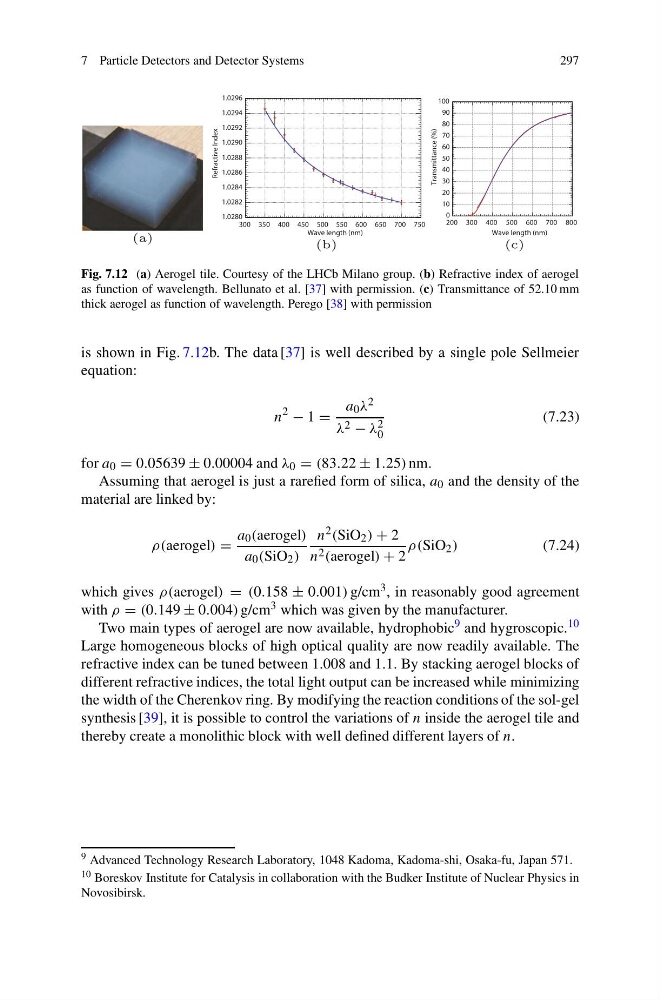
Fig. 7.12 (a) Aerogel tile. Courtesy of the LHCb Milano group. (b) Refractive index of aerogel
as function of wavelength. Bellunato et al. [37] with permission. (c) Transmittance of 52.10 mm
thick aerogel as function of wavelength. Perego [38] with permission
is shown in Fig. 7.12b. The data [37] is well described by a single pole Sellmeier
equation:
n
2
− 1 =
a 0 λ 2
λ 2 − λ 2
0
(7.23)
for a 0 = 0.05639 ± 0.00004 and λ 0 = (83.22 ± 1.25) nm.
Assuming that aerogel is just a rarefied form of silica, a 0 and the density of the
material are linked by:
ρ(aerogel) =
a 0 (aerogel)
a 0 (SiO 2 )
n 2 (SiO 2 ) + 2
n 2 (aerogel) + 2
ρ(SiO 2 )
(7.24)
which gives ρ(aerogel) = (0.158 ± 0.001) g/cm 3 , in reasonably good agreement
with ρ = (0.149 ± 0.004) g/cm 3 which was given by the manufacturer.
Two main types of aerogel are now available, hydrophobic 9 and hygroscopic. 10
Large homogeneous blocks of high optical quality are now readily available. The
refractive index can be tuned between 1.008 and 1.1. By stacking aerogel blocks of
different refractive indices, the total light output can be increased while minimizing
the width of the Cherenkov ring. By modifying the reaction conditions of the sol-gel
synthesis [39], it is possible to control the variations of n inside the aerogel tile and
thereby create a monolithic block with well defined different layers of n.
9 Advanced Technology Research Laboratory, 1048 Kadoma, Kadoma-shi, Osaka-fu, Japan 571.
10 Boreskov Institute for Catalysis in collaboration with the Budker Institute of Nuclear Physics in
Novosibirsk.
297
(a)
Wave length (nm)
300 350 400 450 500 550 600 650 700 750
Refractive Index
1.0280
1.0282
1.0284
1.0286
1.0288
1.0290
1.0292
1.0294
1.0296
(b)
Wave length (nm)
200 300 400 500 600 700 800
Transmittance (%)
0
10
20
30
40
50
60
70
80
90
100
(c)
Fig. 7.12 (a) Aerogel tile. Courtesy of the LHCb Milano group. (b) Refractive index of aerogel
as function of wavelength. Bellunato et al. [37] with permission. (c) Transmittance of 52.10 mm
thick aerogel as function of wavelength. Perego [38] with permission
is shown in Fig. 7.12b. The data [37] is well described by a single pole Sellmeier
equation:
n
2
− 1 =
a 0 λ 2
λ 2 − λ 2
0
(7.23)
for a 0 = 0.05639 ± 0.00004 and λ 0 = (83.22 ± 1.25) nm.
Assuming that aerogel is just a rarefied form of silica, a 0 and the density of the
material are linked by:
ρ(aerogel) =
a 0 (aerogel)
a 0 (SiO 2 )
n 2 (SiO 2 ) + 2
n 2 (aerogel) + 2
ρ(SiO 2 )
(7.24)
which gives ρ(aerogel) = (0.158 ± 0.001) g/cm 3 , in reasonably good agreement
with ρ = (0.149 ± 0.004) g/cm 3 which was given by the manufacturer.
Two main types of aerogel are now available, hydrophobic 9 and hygroscopic. 10
Large homogeneous blocks of high optical quality are now readily available. The
refractive index can be tuned between 1.008 and 1.1. By stacking aerogel blocks of
different refractive indices, the total light output can be increased while minimizing
the width of the Cherenkov ring. By modifying the reaction conditions of the sol-gel
synthesis [39], it is possible to control the variations of n inside the aerogel tile and
thereby create a monolithic block with well defined different layers of n.
9 Advanced Technology Research Laboratory, 1048 Kadoma, Kadoma-shi, Osaka-fu, Japan 571.
10 Boreskov Institute for Catalysis in collaboration with the Budker Institute of Nuclear Physics in
Novosibirsk.