

7 Particle Detectors and Detector Systems
295
10 mm
4 mm
Track
Radiator
γ
γ
(a)
n 1
n 2
n 3
n 3
P a r t i c l e
T r a j e c t o r y
t z
t y
Stand
off
Detector plane
(b)
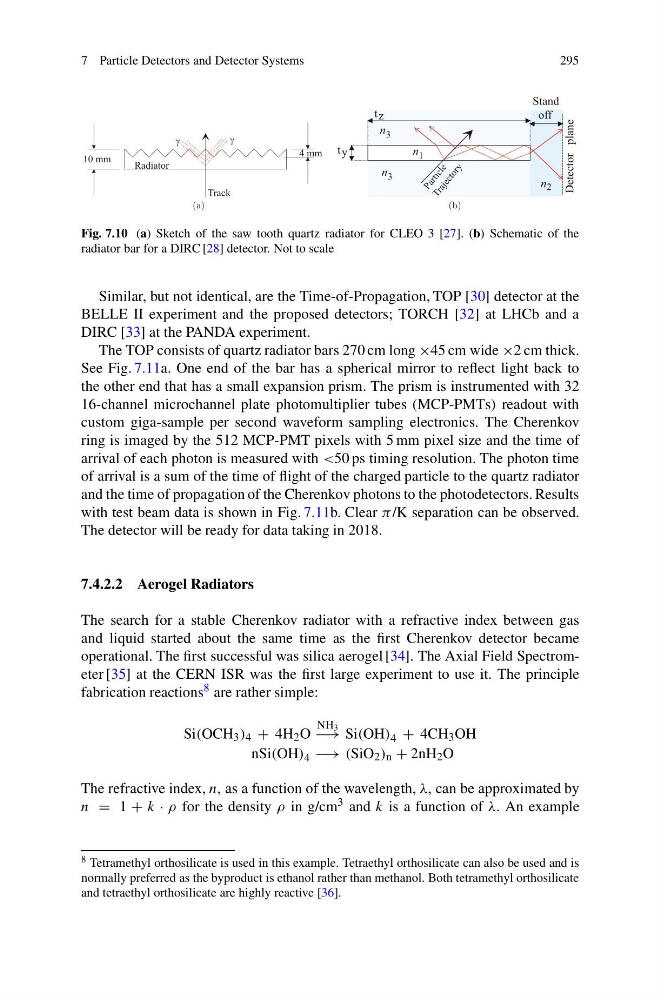
Fig. 7.10 (a) Sketch of the saw tooth quartz radiator for CLEO 3 [27]. (b) Schematic of the
radiator bar for a DIRC [28] detector. Not to scale
Similar, but not identical, are the Time-of-Propagation, TOP [30] detector at the
BELLE II experiment and the proposed detectors; TORCH [32] at LHCb and a
DIRC [33] at the PANDA experiment.
The TOP consists of quartz radiator bars 270 cm long ×45 cm wide ×2 cm thick.
See Fig. 7.11a. One end of the bar has a spherical mirror to reflect light back to
the other end that has a small expansion prism. The prism is instrumented with 32
16-channel microchannel plate photomultiplier tubes (MCP-PMTs) readout with
custom giga-sample per second waveform sampling electronics. The Cherenkov
ring is imaged by the 512 MCP-PMT pixels with 5 mm pixel size and the time of
arrival of each photon is measured with <50 ps timing resolution. The photon time
of arrival is a sum of the time of flight of the charged particle to the quartz radiator
and the time of propagation of the Cherenkov photons to the photodetectors. Results
with test beam data is shown in Fig. 7.11b. Clear π/K separation can be observed.
The detector will be ready for data taking in 2018.
7.4.2.2 Aerogel Radiators
The search for a stable Cherenkov radiator with a refractive index between gas
and liquid started about the same time as the first Cherenkov detector became
operational. The first successful was silica aerogel [34]. The Axial Field Spectrometer [35] at the CERN ISR was the first large experiment to use it. The principle
fabrication reactions 8 are rather simple:
Si(OCH 3 ) 4 + 4H 2 O
NH 3
−→ Si(OH) 4 + 4CH 3 OH
nSi(OH) 4 −→ (SiO 2 ) n + 2nH 2 O
The refractive index, n, as a function of the wavelength, λ, can be approximated by
n = 1 + k · ρ for the density ρ in g/cm 3 and k is a function of λ. An example
8 Tetramethyl orthosilicate is used in this example. Tetraethyl orthosilicate can also be used and is
normally preferred as the byproduct is ethanol rather than methanol. Both tetramethyl orthosilicate
and tetraethyl orthosilicate are highly reactive [36].
295
10 mm
4 mm
Track
Radiator
γ
γ
(a)
n 1
n 2
n 3
n 3
P a r t i c l e
T r a j e c t o r y
t z
t y
Stand
off
Detector plane
(b)
Fig. 7.10 (a) Sketch of the saw tooth quartz radiator for CLEO 3 [27]. (b) Schematic of the
radiator bar for a DIRC [28] detector. Not to scale
Similar, but not identical, are the Time-of-Propagation, TOP [30] detector at the
BELLE II experiment and the proposed detectors; TORCH [32] at LHCb and a
DIRC [33] at the PANDA experiment.
The TOP consists of quartz radiator bars 270 cm long ×45 cm wide ×2 cm thick.
See Fig. 7.11a. One end of the bar has a spherical mirror to reflect light back to
the other end that has a small expansion prism. The prism is instrumented with 32
16-channel microchannel plate photomultiplier tubes (MCP-PMTs) readout with
custom giga-sample per second waveform sampling electronics. The Cherenkov
ring is imaged by the 512 MCP-PMT pixels with 5 mm pixel size and the time of
arrival of each photon is measured with <50 ps timing resolution. The photon time
of arrival is a sum of the time of flight of the charged particle to the quartz radiator
and the time of propagation of the Cherenkov photons to the photodetectors. Results
with test beam data is shown in Fig. 7.11b. Clear π/K separation can be observed.
The detector will be ready for data taking in 2018.
7.4.2.2 Aerogel Radiators
The search for a stable Cherenkov radiator with a refractive index between gas
and liquid started about the same time as the first Cherenkov detector became
operational. The first successful was silica aerogel [34]. The Axial Field Spectrometer [35] at the CERN ISR was the first large experiment to use it. The principle
fabrication reactions 8 are rather simple:
Si(OCH 3 ) 4 + 4H 2 O
NH 3
−→ Si(OH) 4 + 4CH 3 OH
nSi(OH) 4 −→ (SiO 2 ) n + 2nH 2 O
The refractive index, n, as a function of the wavelength, λ, can be approximated by
n = 1 + k · ρ for the density ρ in g/cm 3 and k is a function of λ. An example
8 Tetramethyl orthosilicate is used in this example. Tetraethyl orthosilicate can also be used and is
normally preferred as the byproduct is ethanol rather than methanol. Both tetramethyl orthosilicate
and tetraethyl orthosilicate are highly reactive [36].