

294
R. Forty and O. Ullaland
1.0
1.5
2.0
2.5
200
300
400
500
Wave length (nm)
Refractive index n
Fused quartz
CaFl
LiFl
ZnS
magnesium oxide
(a)
0
50
100
100
200
500
1000
Wave length (nm)
Transmission (%)
LiF
CaF
MgF2
KU1
KV
Fused quartz:
(b)
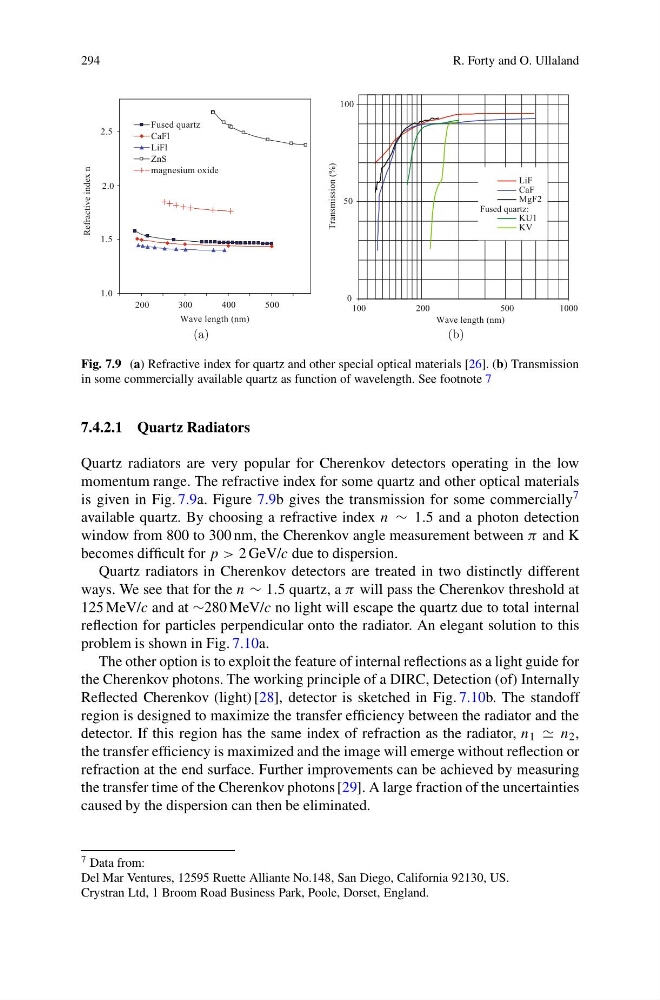
Fig. 7.9 (a) Refractive index for quartz and other special optical materials [26]. (b) Transmission
in some commercially available quartz as function of wavelength. See footnote 7
7.4.2.1 Quartz Radiators
Quartz radiators are very popular for Cherenkov detectors operating in the low
momentum range. The refractive index for some quartz and other optical materials
is given in Fig. 7.9a. Figure 7.9b gives the transmission for some commercially 7
available quartz. By choosing a refractive index n ∼ 1.5 and a photon detection
window from 800 to 300 nm, the Cherenkov angle measurement between π and K
becomes difficult for p > 2 GeV/c due to dispersion.
Quartz radiators in Cherenkov detectors are treated in two distinctly different
ways. We see that for the n ∼ 1.5 quartz, a π will pass the Cherenkov threshold at
125 MeV/c and at ∼280 MeV/c no light will escape the quartz due to total internal
reflection for particles perpendicular onto the radiator. An elegant solution to this
problem is shown in Fig. 7.10a.
The other option is to exploit the feature of internal reflections as a light guide for
the Cherenkov photons. The working principle of a DIRC, Detection (of) Internally
Reflected Cherenkov (light) [28], detector is sketched in Fig. 7.10b. The standoff
region is designed to maximize the transfer efficiency between the radiator and the
detector. If this region has the same index of refraction as the radiator, n 1 n 2 ,
the transfer efficiency is maximized and the image will emerge without reflection or
refraction at the end surface. Further improvements can be achieved by measuring
the transfer time of the Cherenkov photons [29]. A large fraction of the uncertainties
caused by the dispersion can then be eliminated.
7 Data from:
Del Mar Ventures, 12595 Ruette Alliante No.148, San Diego, California 92130, US.
Crystran Ltd, 1 Broom Road Business Park, Poole, Dorset, England.
R. Forty and O. Ullaland
1.0
1.5
2.0
2.5
200
300
400
500
Wave length (nm)
Refractive index n
Fused quartz
CaFl
LiFl
ZnS
magnesium oxide
(a)
0
50
100
100
200
500
1000
Wave length (nm)
Transmission (%)
LiF
CaF
MgF2
KU1
KV
Fused quartz:
(b)
Fig. 7.9 (a) Refractive index for quartz and other special optical materials [26]. (b) Transmission
in some commercially available quartz as function of wavelength. See footnote 7
7.4.2.1 Quartz Radiators
Quartz radiators are very popular for Cherenkov detectors operating in the low
momentum range. The refractive index for some quartz and other optical materials
is given in Fig. 7.9a. Figure 7.9b gives the transmission for some commercially 7
available quartz. By choosing a refractive index n ∼ 1.5 and a photon detection
window from 800 to 300 nm, the Cherenkov angle measurement between π and K
becomes difficult for p > 2 GeV/c due to dispersion.
Quartz radiators in Cherenkov detectors are treated in two distinctly different
ways. We see that for the n ∼ 1.5 quartz, a π will pass the Cherenkov threshold at
125 MeV/c and at ∼280 MeV/c no light will escape the quartz due to total internal
reflection for particles perpendicular onto the radiator. An elegant solution to this
problem is shown in Fig. 7.10a.
The other option is to exploit the feature of internal reflections as a light guide for
the Cherenkov photons. The working principle of a DIRC, Detection (of) Internally
Reflected Cherenkov (light) [28], detector is sketched in Fig. 7.10b. The standoff
region is designed to maximize the transfer efficiency between the radiator and the
detector. If this region has the same index of refraction as the radiator, n 1 n 2 ,
the transfer efficiency is maximized and the image will emerge without reflection or
refraction at the end surface. Further improvements can be achieved by measuring
the transfer time of the Cherenkov photons [29]. A large fraction of the uncertainties
caused by the dispersion can then be eliminated.
7 Data from:
Del Mar Ventures, 12595 Ruette Alliante No.148, San Diego, California 92130, US.
Crystran Ltd, 1 Broom Road Business Park, Poole, Dorset, England.