

292
R. Forty and O. Ullaland
250
300
350
400
450
500
200
300
400
500
600
700
Wave length (nm)
Refractive index (n-1)10
6
CO 2
O 2
N 2
Argon
Air
(a)
1
10
100
1000
10000
0
5
10
15
20
25
Photon energy (eV)
Relative dispersion
He
Ne
Ar
Kr
Xe
CF
CO
1000
500
250
125
100
75
Wave length (nm)
2
4
(b)
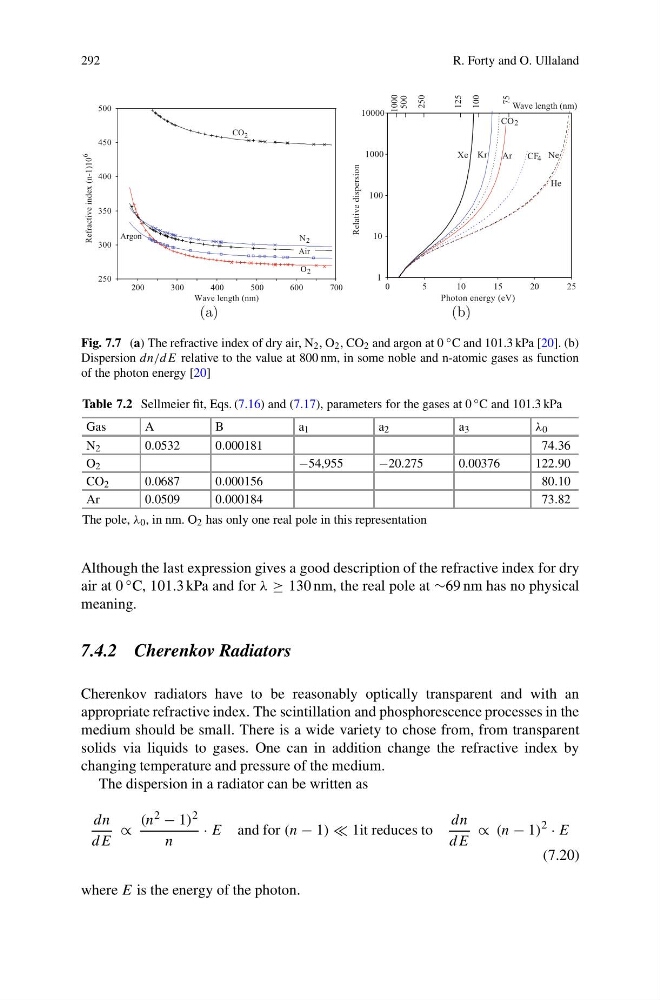
Fig. 7.7 (a) The refractive index of dry air, N 2 , O 2 , CO 2 and argon at 0 ◦ C and 101.3 kPa [20]. (b)
Dispersion dn/dE relative to the value at 800 nm, in some noble and n-atomic gases as function
of the photon energy [20]
Table 7.2 Sellmeier fit, Eqs. (7.16) and (7.17), parameters for the gases at 0 ◦ C and 101.3 kPa
Gas
A
B
a 1
a 2
a 3
λ 0
N 2
0.0532
0.000181
74.36
O 2
−54,955
−20.275
0.00376
122.90
CO 2
0.0687
0.000156
80.10
Ar
0.0509
0.000184
73.82
The pole, λ 0 , in nm. O 2 has only one real pole in this representation
Although the last expression gives a good description of the refractive index for dry
air at 0 ◦ C, 101.3 kPa and for λ ≥ 130 nm, the real pole at ∼69 nm has no physical
meaning.
7.4.2 Cherenkov Radiators
Cherenkov radiators have to be reasonably optically transparent and with an
appropriate refractive index. The scintillation and phosphorescence processes in the
medium should be small. There is a wide variety to chose from, from transparent
solids via liquids to gases. One can in addition change the refractive index by
changing temperature and pressure of the medium.
The dispersion in a radiator can be written as
dn
dE
∝
(n 2 − 1) 2
n
· E and for (n − 1) 1it reduces to
dn
dE
∝ (n − 1)
2
· E
(7.20)
where E is the energy of the photon.
R. Forty and O. Ullaland
250
300
350
400
450
500
200
300
400
500
600
700
Wave length (nm)
Refractive index (n-1)10
6
CO 2
O 2
N 2
Argon
Air
(a)
1
10
100
1000
10000
0
5
10
15
20
25
Photon energy (eV)
Relative dispersion
He
Ne
Ar
Kr
Xe
CF
CO
1000
500
250
125
100
75
Wave length (nm)
2
4
(b)
Fig. 7.7 (a) The refractive index of dry air, N 2 , O 2 , CO 2 and argon at 0 ◦ C and 101.3 kPa [20]. (b)
Dispersion dn/dE relative to the value at 800 nm, in some noble and n-atomic gases as function
of the photon energy [20]
Table 7.2 Sellmeier fit, Eqs. (7.16) and (7.17), parameters for the gases at 0 ◦ C and 101.3 kPa
Gas
A
B
a 1
a 2
a 3
λ 0
N 2
0.0532
0.000181
74.36
O 2
−54,955
−20.275
0.00376
122.90
CO 2
0.0687
0.000156
80.10
Ar
0.0509
0.000184
73.82
The pole, λ 0 , in nm. O 2 has only one real pole in this representation
Although the last expression gives a good description of the refractive index for dry
air at 0 ◦ C, 101.3 kPa and for λ ≥ 130 nm, the real pole at ∼69 nm has no physical
meaning.
7.4.2 Cherenkov Radiators
Cherenkov radiators have to be reasonably optically transparent and with an
appropriate refractive index. The scintillation and phosphorescence processes in the
medium should be small. There is a wide variety to chose from, from transparent
solids via liquids to gases. One can in addition change the refractive index by
changing temperature and pressure of the medium.
The dispersion in a radiator can be written as
dn
dE
∝
(n 2 − 1) 2
n
· E and for (n − 1) 1it reduces to
dn
dE
∝ (n − 1)
2
· E
(7.20)
where E is the energy of the photon.