

290
R. Forty and O. Ullaland
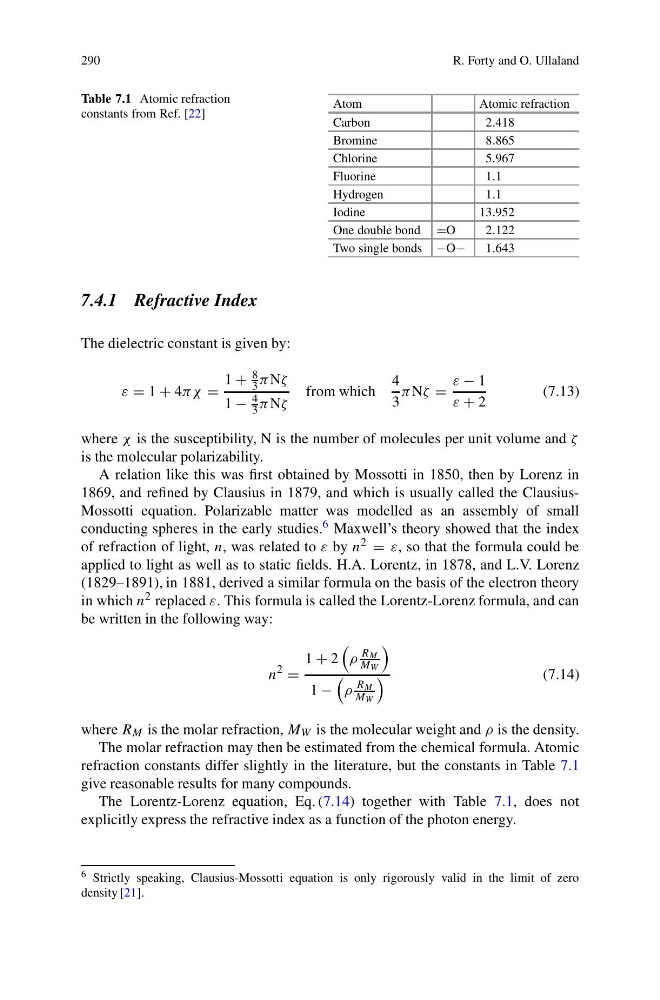
Table 7.1 Atomic refraction
constants from Ref. [22]
Atom
Atomic refraction
Carbon
2.418
Bromine
8.865
Chlorine
5.967
Fluorine
1.1
Hydrogen
1.1
Iodine
13.952
One double bond =O
2.122
Two single bonds −O−
1.643
7.4.1 Refractive Index
The dielectric constant is given by:
ε = 1 + 4πχ =
1 +
8
3 πNζ
1 −
4
3 πNζ
from which
4
3
πNζ =
ε − 1
ε + 2
(7.13)
where χ is the susceptibility, N is the number of molecules per unit volume and ζ
is the molecular polarizability.
A relation like this was first obtained by Mossotti in 1850, then by Lorenz in
1869, and refined by Clausius in 1879, and which is usually called the ClausiusMossotti equation. Polarizable matter was modelled as an assembly of small
conducting spheres in the early studies. 6 Maxwell’s theory showed that the index
of refraction of light, n, was related to ε by n 2 = ε, so that the formula could be
applied to light as well as to static fields. H.A. Lorentz, in 1878, and L.V. Lorenz
(1829–1891), in 1881, derived a similar formula on the basis of the electron theory
in which n 2 replaced ε. This formula is called the Lorentz-Lorenz formula, and can
be written in the following way:
n
2
=
1 + 2
ρ
R M
M W
1 −
ρ
R M
M W
(7.14)
where R M is the molar refraction, M W is the molecular weight and ρ is the density.
The molar refraction may then be estimated from the chemical formula. Atomic
refraction constants differ slightly in the literature, but the constants in Table 7.1
give reasonable results for many compounds.
The Lorentz-Lorenz equation, Eq. (7.14) together with Table 7.1, does not
explicitly express the refractive index as a function of the photon energy.
6 Strictly speaking, Clausius-Mossotti equation is only rigorously valid in the limit of zero
density [21].
R. Forty and O. Ullaland
Table 7.1 Atomic refraction
constants from Ref. [22]
Atom
Atomic refraction
Carbon
2.418
Bromine
8.865
Chlorine
5.967
Fluorine
1.1
Hydrogen
1.1
Iodine
13.952
One double bond =O
2.122
Two single bonds −O−
1.643
7.4.1 Refractive Index
The dielectric constant is given by:
ε = 1 + 4πχ =
1 +
8
3 πNζ
1 −
4
3 πNζ
from which
4
3
πNζ =
ε − 1
ε + 2
(7.13)
where χ is the susceptibility, N is the number of molecules per unit volume and ζ
is the molecular polarizability.
A relation like this was first obtained by Mossotti in 1850, then by Lorenz in
1869, and refined by Clausius in 1879, and which is usually called the ClausiusMossotti equation. Polarizable matter was modelled as an assembly of small
conducting spheres in the early studies. 6 Maxwell’s theory showed that the index
of refraction of light, n, was related to ε by n 2 = ε, so that the formula could be
applied to light as well as to static fields. H.A. Lorentz, in 1878, and L.V. Lorenz
(1829–1891), in 1881, derived a similar formula on the basis of the electron theory
in which n 2 replaced ε. This formula is called the Lorentz-Lorenz formula, and can
be written in the following way:
n
2
=
1 + 2
ρ
R M
M W
1 −
ρ
R M
M W
(7.14)
where R M is the molar refraction, M W is the molecular weight and ρ is the density.
The molar refraction may then be estimated from the chemical formula. Atomic
refraction constants differ slightly in the literature, but the constants in Table 7.1
give reasonable results for many compounds.
The Lorentz-Lorenz equation, Eq. (7.14) together with Table 7.1, does not
explicitly express the refractive index as a function of the photon energy.
6 Strictly speaking, Clausius-Mossotti equation is only rigorously valid in the limit of zero
density [21].