

7 Particle Detectors and Detector Systems
289
We see from the above that Cherenkov radiation is characterized by:
• Cherenkov radiation is a prompt signal.
• The existence of a threshold 5 in β min = n −1
• The Cherenkov angle is depending on β.
• The number of Cherenkov photons emitted is depending on β.
• The number of photons emitted is depending on the square of the charge of the
particle.
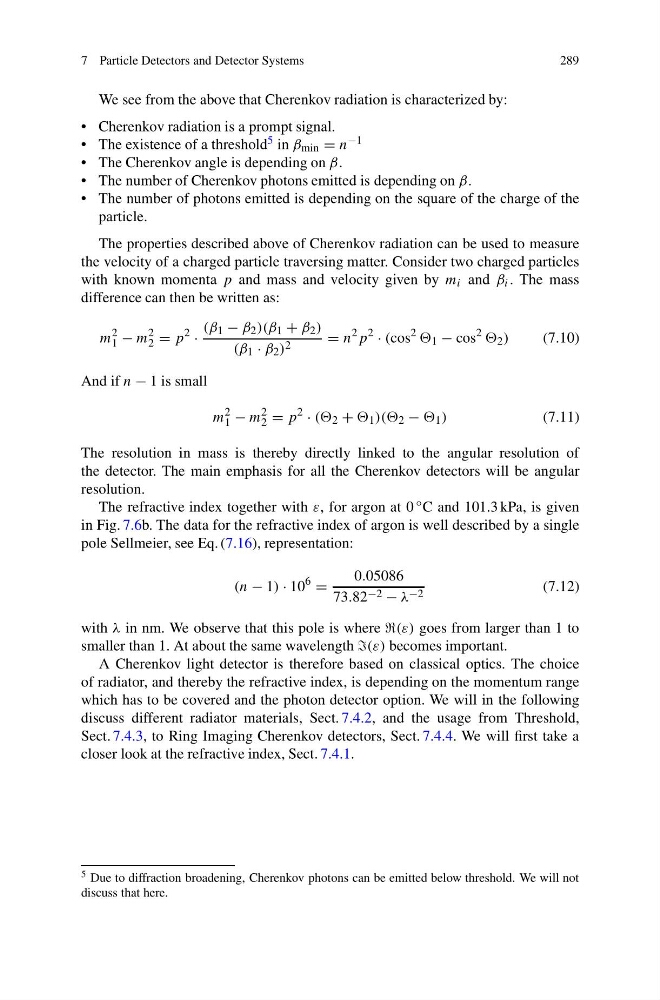
The properties described above of Cherenkov radiation can be used to measure
the velocity of a charged particle traversing matter. Consider two charged particles
with known momenta p and mass and velocity given by m i and β i . The mass
difference can then be written as:
m
2
1 − m
2
2 = p
2
·
(β 1 − β 2 )(β 1 + β 2 )
(β 1 · β 2 ) 2
= n
2 p
2
· (cos
2 1 − cos
2 2 )
(7.10)
And if n − 1 is small
m
2
1 − m
2
2 = p
2
· (( 2 + 1 )(( 2 − 1 )
(7.11)
The resolution in mass is thereby directly linked to the angular resolution of
the detector. The main emphasis for all the Cherenkov detectors will be angular
resolution.
The refractive index together with ε, for argon at 0 ◦ C and 101.3 kPa, is given
in Fig. 7.6b. The data for the refractive index of argon is well described by a single
pole Sellmeier, see Eq. (7.16), representation:
(n − 1) · 10
6
=
0.05086
73.82 −2 − λ −2
(7.12)
with λ in nm. We observe that this pole is where (ε) goes from larger than 1 to
smaller than 1. At about the same wavelength (ε) becomes important.
A Cherenkov light detector is therefore based on classical optics. The choice
of radiator, and thereby the refractive index, is depending on the momentum range
which has to be covered and the photon detector option. We will in the following
discuss different radiator materials, Sect. 7.4.2, and the usage from Threshold,
Sect. 7.4.3, to Ring Imaging Cherenkov detectors, Sect. 7.4.4. We will first take a
closer look at the refractive index, Sect. 7.4.1.
5 Due to diffraction broadening, Cherenkov photons can be emitted below threshold. We will not
discuss that here.
289
We see from the above that Cherenkov radiation is characterized by:
• Cherenkov radiation is a prompt signal.
• The existence of a threshold 5 in β min = n −1
• The Cherenkov angle is depending on β.
• The number of Cherenkov photons emitted is depending on β.
• The number of photons emitted is depending on the square of the charge of the
particle.
The properties described above of Cherenkov radiation can be used to measure
the velocity of a charged particle traversing matter. Consider two charged particles
with known momenta p and mass and velocity given by m i and β i . The mass
difference can then be written as:
m
2
1 − m
2
2 = p
2
·
(β 1 − β 2 )(β 1 + β 2 )
(β 1 · β 2 ) 2
= n
2 p
2
· (cos
2 1 − cos
2 2 )
(7.10)
And if n − 1 is small
m
2
1 − m
2
2 = p
2
· (( 2 + 1 )(( 2 − 1 )
(7.11)
The resolution in mass is thereby directly linked to the angular resolution of
the detector. The main emphasis for all the Cherenkov detectors will be angular
resolution.
The refractive index together with ε, for argon at 0 ◦ C and 101.3 kPa, is given
in Fig. 7.6b. The data for the refractive index of argon is well described by a single
pole Sellmeier, see Eq. (7.16), representation:
(n − 1) · 10
6
=
0.05086
73.82 −2 − λ −2
(7.12)
with λ in nm. We observe that this pole is where (ε) goes from larger than 1 to
smaller than 1. At about the same wavelength (ε) becomes important.
A Cherenkov light detector is therefore based on classical optics. The choice
of radiator, and thereby the refractive index, is depending on the momentum range
which has to be covered and the photon detector option. We will in the following
discuss different radiator materials, Sect. 7.4.2, and the usage from Threshold,
Sect. 7.4.3, to Ring Imaging Cherenkov detectors, Sect. 7.4.4. We will first take a
closer look at the refractive index, Sect. 7.4.1.
5 Due to diffraction broadening, Cherenkov photons can be emitted below threshold. We will not
discuss that here.