

288
R. Forty and O. Ullaland
7.4 Cherenkov Radiation
The theory of Cherenkov radiation is discussed in Chap. 2. Further reading can be
found in references [15–18]. We will here just recall some of the main features. The
condition for emission of a Cherenkov photon is given by
cos C =
1
β ·
√
ε(λ)
=
1
β · n(λ)
(7.8)
and the number of emitted photons by
d 2 N
dL dλ
= 2παZ
2 sin
2 C
λ 2 ,
(7.9)
where C is the angle of the emitted photon relative to the particle trajectory, ε
is the dielectric constant as function of the photon wavelength λ, L is the radiator
length, α ∼ 1/137 is the fine structure constant, β is the particle velocity relative
to the speed of light in vacuum, β = v/c = pc/E, and Z is the charge of the
particle in units of electron charges. The refractive index, n, is given as n 2 = ε. The
relationship between the photon wavelength and its angular frequency, ω, is given
by λ(nm) ∼ 1240/ ¯
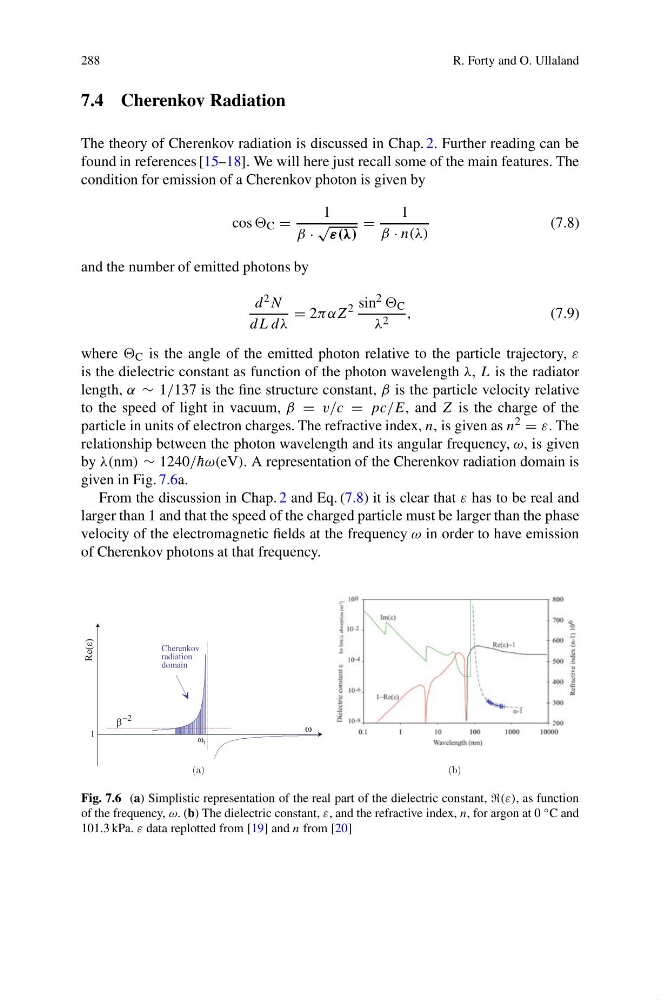
hω(eV). A representation of the Cherenkov radiation domain is
given in Fig. 7.6a.
From the discussion in Chap. 2 and Eq. (7.8) it is clear that ε has to be real and
larger than 1 and that the speed of the charged particle must be larger than the phase
velocity of the electromagnetic fields at the frequency ω in order to have emission
of Cherenkov photons at that frequency.
1
Cherenkov
radiation
domain
β
−2
ω
ω t
Re(ε)
(a)
(b)
Fig. 7.6 (a) Simplistic representation of the real part of the dielectric constant, (ε), as function
of the frequency, ω. (b) The dielectric constant, ε, and the refractive index, n, for argon at 0 ◦ C and
101.3 kPa. ε data replotted from [19] and n from [20]
R. Forty and O. Ullaland
7.4 Cherenkov Radiation
The theory of Cherenkov radiation is discussed in Chap. 2. Further reading can be
found in references [15–18]. We will here just recall some of the main features. The
condition for emission of a Cherenkov photon is given by
cos C =
1
β ·
√
ε(λ)
=
1
β · n(λ)
(7.8)
and the number of emitted photons by
d 2 N
dL dλ
= 2παZ
2 sin
2 C
λ 2 ,
(7.9)
where C is the angle of the emitted photon relative to the particle trajectory, ε
is the dielectric constant as function of the photon wavelength λ, L is the radiator
length, α ∼ 1/137 is the fine structure constant, β is the particle velocity relative
to the speed of light in vacuum, β = v/c = pc/E, and Z is the charge of the
particle in units of electron charges. The refractive index, n, is given as n 2 = ε. The
relationship between the photon wavelength and its angular frequency, ω, is given
by λ(nm) ∼ 1240/ ¯
hω(eV). A representation of the Cherenkov radiation domain is
given in Fig. 7.6a.
From the discussion in Chap. 2 and Eq. (7.8) it is clear that ε has to be real and
larger than 1 and that the speed of the charged particle must be larger than the phase
velocity of the electromagnetic fields at the frequency ω in order to have emission
of Cherenkov photons at that frequency.
1
Cherenkov
radiation
domain
β
−2
ω
ω t
Re(ε)
(a)
(b)
Fig. 7.6 (a) Simplistic representation of the real part of the dielectric constant, (ε), as function
of the frequency, ω. (b) The dielectric constant, ε, and the refractive index, n, for argon at 0 ◦ C and
101.3 kPa. ε data replotted from [19] and n from [20]