

7 Particle Detectors and Detector Systems
287
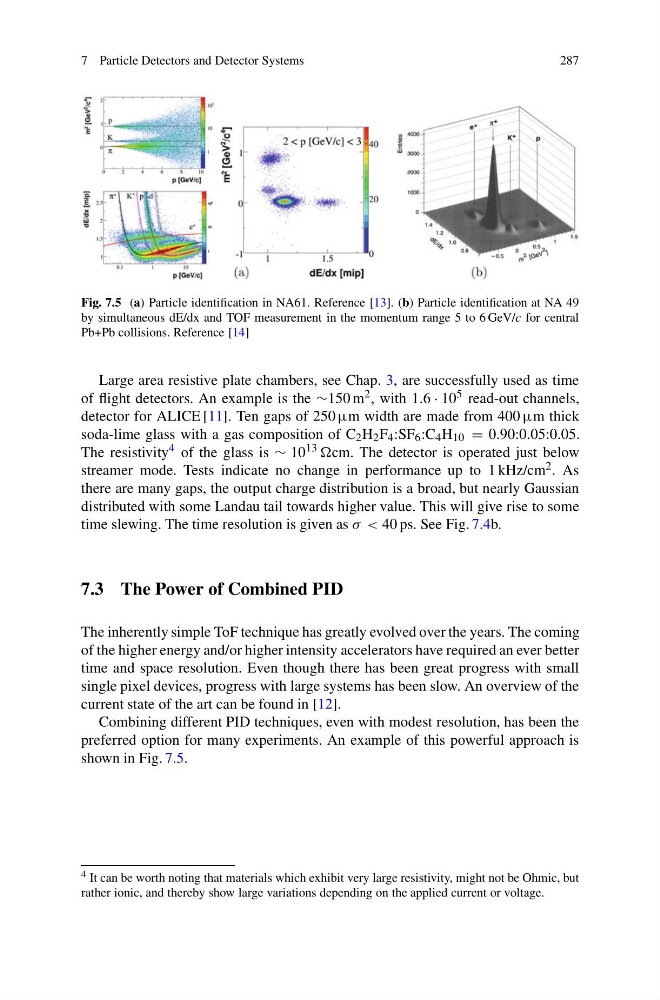
Fig. 7.5 (a) Particle identification in NA61. Reference [13]. (b) Particle identification at NA 49
by simultaneous dE/dx and TOF measurement in the momentum range 5 to 6 GeV/c for central
Pb+Pb collisions. Reference [14]
Large area resistive plate chambers, see Chap. 3, are successfully used as time
of flight detectors. An example is the ∼150 m 2 , with 1.6 · 10 5 read-out channels,
detector for ALICE [11]. Ten gaps of 250 μm width are made from 400 μm thick
soda-lime glass with a gas composition of C 2 H 2 F 4 :SF 6 :C 4 H 10 = 0.90:0.05:0.05.
The resistivity 4 of the glass is ∼ 10 13 cm. The detector is operated just below
streamer mode. Tests indicate no change in performance up to 1 kHz/cm 2 . As
there are many gaps, the output charge distribution is a broad, but nearly Gaussian
distributed with some Landau tail towards higher value. This will give rise to some
time slewing. The time resolution is given as σ < 40 ps. See Fig. 7.4b.
7.3 The Power of Combined PID
The inherently simple ToF technique has greatly evolved over the years. The coming
of the higher energy and/or higher intensity accelerators have required an ever better
time and space resolution. Even though there has been great progress with small
single pixel devices, progress with large systems has been slow. An overview of the
current state of the art can be found in [12].
Combining different PID techniques, even with modest resolution, has been the
preferred option for many experiments. An example of this powerful approach is
shown in Fig. 7.5.
4 It can be worth noting that materials which exhibit very large resistivity, might not be Ohmic, but
rather ionic, and thereby show large variations depending on the applied current or voltage.
287
Fig. 7.5 (a) Particle identification in NA61. Reference [13]. (b) Particle identification at NA 49
by simultaneous dE/dx and TOF measurement in the momentum range 5 to 6 GeV/c for central
Pb+Pb collisions. Reference [14]
Large area resistive plate chambers, see Chap. 3, are successfully used as time
of flight detectors. An example is the ∼150 m 2 , with 1.6 · 10 5 read-out channels,
detector for ALICE [11]. Ten gaps of 250 μm width are made from 400 μm thick
soda-lime glass with a gas composition of C 2 H 2 F 4 :SF 6 :C 4 H 10 = 0.90:0.05:0.05.
The resistivity 4 of the glass is ∼ 10 13 cm. The detector is operated just below
streamer mode. Tests indicate no change in performance up to 1 kHz/cm 2 . As
there are many gaps, the output charge distribution is a broad, but nearly Gaussian
distributed with some Landau tail towards higher value. This will give rise to some
time slewing. The time resolution is given as σ < 40 ps. See Fig. 7.4b.
7.3 The Power of Combined PID
The inherently simple ToF technique has greatly evolved over the years. The coming
of the higher energy and/or higher intensity accelerators have required an ever better
time and space resolution. Even though there has been great progress with small
single pixel devices, progress with large systems has been slow. An overview of the
current state of the art can be found in [12].
Combining different PID techniques, even with modest resolution, has been the
preferred option for many experiments. An example of this powerful approach is
shown in Fig. 7.5.
4 It can be worth noting that materials which exhibit very large resistivity, might not be Ohmic, but
rather ionic, and thereby show large variations depending on the applied current or voltage.