

6 Calorimetry
241
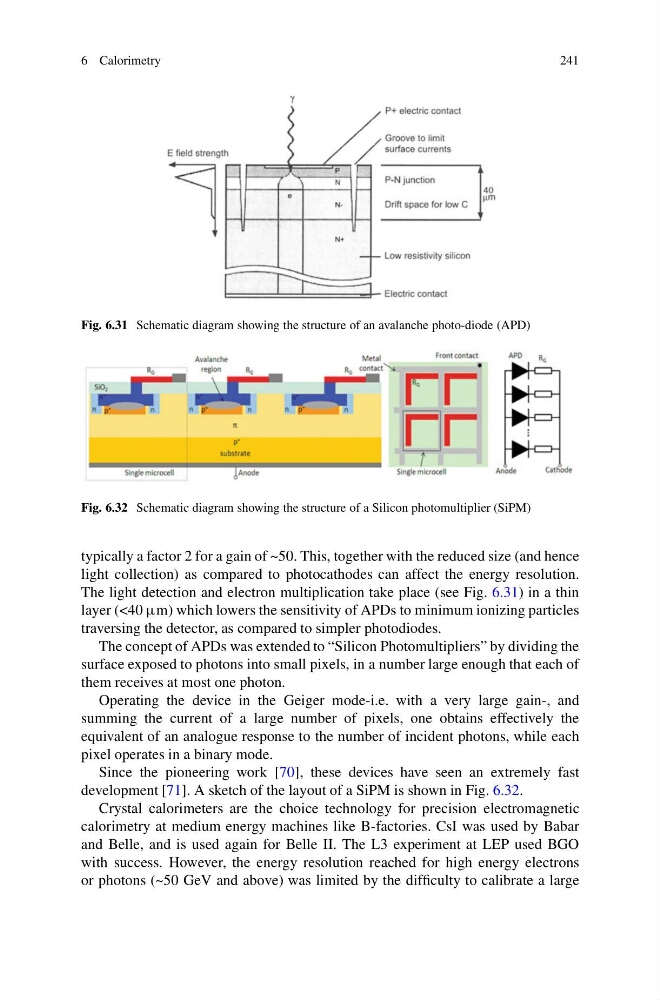
Fig. 6.31 Schematic diagram showing the structure of an avalanche photo-diode (APD)
Fig. 6.32 Schematic diagram showing the structure of a Silicon photomultiplier (SiPM)
typically a factor 2 for a gain of ~50. This, together with the reduced size (and hence
light collection) as compared to photocathodes can affect the energy resolution.
The light detection and electron multiplication take place (see Fig. 6.31) in a thin
layer (<40 μm) which lowers the sensitivity of APDs to minimum ionizing particles
traversing the detector, as compared to simpler photodiodes.
The concept of APDs was extended to “Silicon Photomultipliers” by dividing the
surface exposed to photons into small pixels, in a number large enough that each of
them receives at most one photon.
Operating the device in the Geiger mode-i.e. with a very large gain-, and
summing the current of a large number of pixels, one obtains effectively the
equivalent of an analogue response to the number of incident photons, while each
pixel operates in a binary mode.
Since the pioneering work [70], these devices have seen an extremely fast
development [71]. A sketch of the layout of a SiPM is shown in Fig. 6.32.
Crystal calorimeters are the choice technology for precision electromagnetic
calorimetry at medium energy machines like B-factories. CsI was used by Babar
and Belle, and is used again for Belle II. The L3 experiment at LEP used BGO
with success. However, the energy resolution reached for high energy electrons
or photons (~50 GeV and above) was limited by the difficulty to calibrate a large
241
Fig. 6.31 Schematic diagram showing the structure of an avalanche photo-diode (APD)
Fig. 6.32 Schematic diagram showing the structure of a Silicon photomultiplier (SiPM)
typically a factor 2 for a gain of ~50. This, together with the reduced size (and hence
light collection) as compared to photocathodes can affect the energy resolution.
The light detection and electron multiplication take place (see Fig. 6.31) in a thin
layer (<40 μm) which lowers the sensitivity of APDs to minimum ionizing particles
traversing the detector, as compared to simpler photodiodes.
The concept of APDs was extended to “Silicon Photomultipliers” by dividing the
surface exposed to photons into small pixels, in a number large enough that each of
them receives at most one photon.
Operating the device in the Geiger mode-i.e. with a very large gain-, and
summing the current of a large number of pixels, one obtains effectively the
equivalent of an analogue response to the number of incident photons, while each
pixel operates in a binary mode.
Since the pioneering work [70], these devices have seen an extremely fast
development [71]. A sketch of the layout of a SiPM is shown in Fig. 6.32.
Crystal calorimeters are the choice technology for precision electromagnetic
calorimetry at medium energy machines like B-factories. CsI was used by Babar
and Belle, and is used again for Belle II. The L3 experiment at LEP used BGO
with success. However, the energy resolution reached for high energy electrons
or photons (~50 GeV and above) was limited by the difficulty to calibrate a large