

242
C. W. Fabjan and D. Fournier
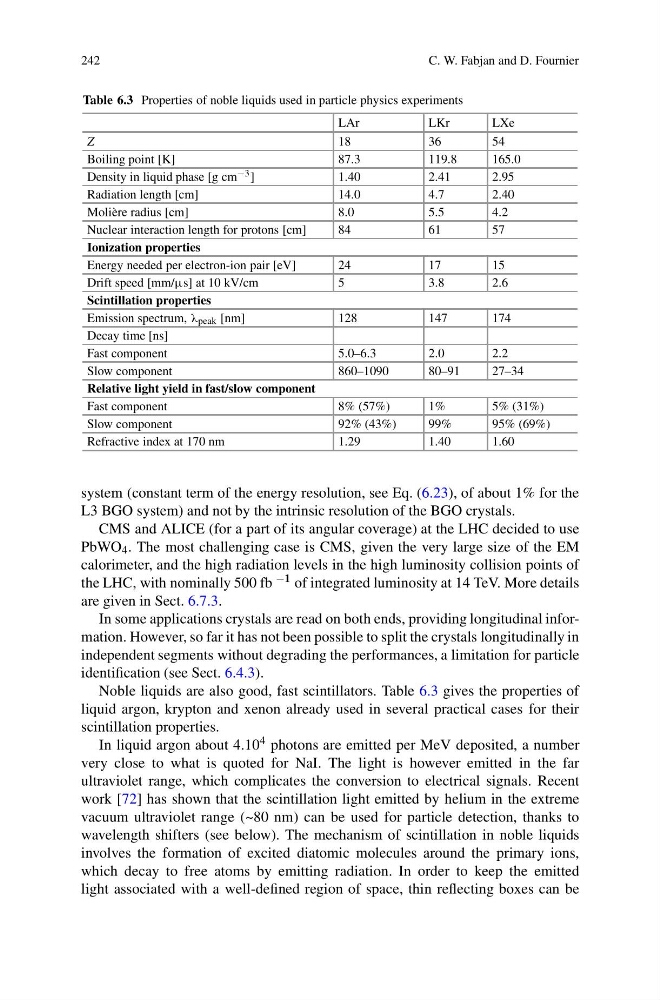
Table 6.3 Properties of noble liquids used in particle physics experiments
LAr
LKr
LXe
Z
18
36
54
Boiling point [K]
87.3
119.8
165.0
Density in liquid phase [g cm −3 ]
1.40
2.41
2.95
Radiation length [cm]
14.0
4.7
2.40
Molière radius [cm]
8.0
5.5
4.2
Nuclear interaction length for protons [cm]
84
61
57
Ionization properties
Energy needed per electron-ion pair [eV]
24
17
15
Drift speed [mm/μs] at 10 kV/cm
5
3.8
2.6
Scintillation properties
Emission spectrum, λ peak [nm]
128
147
174
Decay time [ns]
Fast component
5.0–6.3
2.0
2.2
Slow component
860–1090
80–91
27–34
Relative light yield in fast/slow component
Fast component
8% (57%)
1%
5% (31%)
Slow component
92% (43%)
99%
95% (69%)
Refractive index at 170 nm
1.29
1.40
1.60
system (constant term of the energy resolution, see Eq. (6.23), of about 1% for the
L3 BGO system) and not by the intrinsic resolution of the BGO crystals.
CMS and ALICE (for a part of its angular coverage) at the LHC decided to use
PbWO 4 . The most challenging case is CMS, given the very large size of the EM
calorimeter, and the high radiation levels in the high luminosity collision points of
the LHC, with nominally 500 fb −1 of integrated luminosity at 14 TeV. More details
are given in Sect. 6.7.3.
In some applications crystals are read on both ends, providing longitudinal information. However, so far it has not been possible to split the crystals longitudinally in
independent segments without degrading the performances, a limitation for particle
identification (see Sect. 6.4.3).
Noble liquids are also good, fast scintillators. Table 6.3 gives the properties of
liquid argon, krypton and xenon already used in several practical cases for their
scintillation properties.
In liquid argon about 4.10 4 photons are emitted per MeV deposited, a number
very close to what is quoted for NaI. The light is however emitted in the far
ultraviolet range, which complicates the conversion to electrical signals. Recent
work [72] has shown that the scintillation light emitted by helium in the extreme
vacuum ultraviolet range (~80 nm) can be used for particle detection, thanks to
wavelength shifters (see below). The mechanism of scintillation in noble liquids
involves the formation of excited diatomic molecules around the primary ions,
which decay to free atoms by emitting radiation. In order to keep the emitted
light associated with a well-defined region of space, thin reflecting boxes can be
C. W. Fabjan and D. Fournier
Table 6.3 Properties of noble liquids used in particle physics experiments
LAr
LKr
LXe
Z
18
36
54
Boiling point [K]
87.3
119.8
165.0
Density in liquid phase [g cm −3 ]
1.40
2.41
2.95
Radiation length [cm]
14.0
4.7
2.40
Molière radius [cm]
8.0
5.5
4.2
Nuclear interaction length for protons [cm]
84
61
57
Ionization properties
Energy needed per electron-ion pair [eV]
24
17
15
Drift speed [mm/μs] at 10 kV/cm
5
3.8
2.6
Scintillation properties
Emission spectrum, λ peak [nm]
128
147
174
Decay time [ns]
Fast component
5.0–6.3
2.0
2.2
Slow component
860–1090
80–91
27–34
Relative light yield in fast/slow component
Fast component
8% (57%)
1%
5% (31%)
Slow component
92% (43%)
99%
95% (69%)
Refractive index at 170 nm
1.29
1.40
1.60
system (constant term of the energy resolution, see Eq. (6.23), of about 1% for the
L3 BGO system) and not by the intrinsic resolution of the BGO crystals.
CMS and ALICE (for a part of its angular coverage) at the LHC decided to use
PbWO 4 . The most challenging case is CMS, given the very large size of the EM
calorimeter, and the high radiation levels in the high luminosity collision points of
the LHC, with nominally 500 fb −1 of integrated luminosity at 14 TeV. More details
are given in Sect. 6.7.3.
In some applications crystals are read on both ends, providing longitudinal information. However, so far it has not been possible to split the crystals longitudinally in
independent segments without degrading the performances, a limitation for particle
identification (see Sect. 6.4.3).
Noble liquids are also good, fast scintillators. Table 6.3 gives the properties of
liquid argon, krypton and xenon already used in several practical cases for their
scintillation properties.
In liquid argon about 4.10 4 photons are emitted per MeV deposited, a number
very close to what is quoted for NaI. The light is however emitted in the far
ultraviolet range, which complicates the conversion to electrical signals. Recent
work [72] has shown that the scintillation light emitted by helium in the extreme
vacuum ultraviolet range (~80 nm) can be used for particle detection, thanks to
wavelength shifters (see below). The mechanism of scintillation in noble liquids
involves the formation of excited diatomic molecules around the primary ions,
which decay to free atoms by emitting radiation. In order to keep the emitted
light associated with a well-defined region of space, thin reflecting boxes can be