

240
C. W. Fabjan and D. Fournier
Table 6.2 Properties of scintillating crystals applied in particle physics experiments
NAI(Tl) CsI(Tl) CsI
BaF 2 CeF 3 BGO PbWO 4 LYSO
Density [g cm −3 ]
3.67
4.51
4.51 4.89 6.16 7.13 8.3
7.1
Radiation length [cm]
2.59
1.85
1.85 2.06 1.68 1.12 0.89
1.16
Molière radius [cm]
4.8
3.5
3.5
3.4
2.6
2.3
2.0
2.07
Interaction length [cm]
41.4
37.0
37.0 29.9 26.2 21.8 18.0
20.3
dE/dx)mip [MeV cm −1 ]
4.79
5.61
5.61 6.37 8.0
8.92 9.4
9.2
Refractive index [at λ peak ] 1.85
1.79
1.95 1.50 1.62 2.15 2.2
1.8
Hygroscopicity
Yes
Slight Slight No
No
No
No
No
Emission spectrum, λ peak
Slow component [nm]
410
560
420
300 340 480 510
Fast component [nm]
310
220 300
510
420
Light yield rel. to NaI
Slow component
100
45
5.6
21
6.6
9
0.3
Fast component
2.3
2.7
2.0
0.4
75
Decay time [ns]
Slow component
230
1300
35
630 30
300 50
Fast component
6
0.9
9
10
35
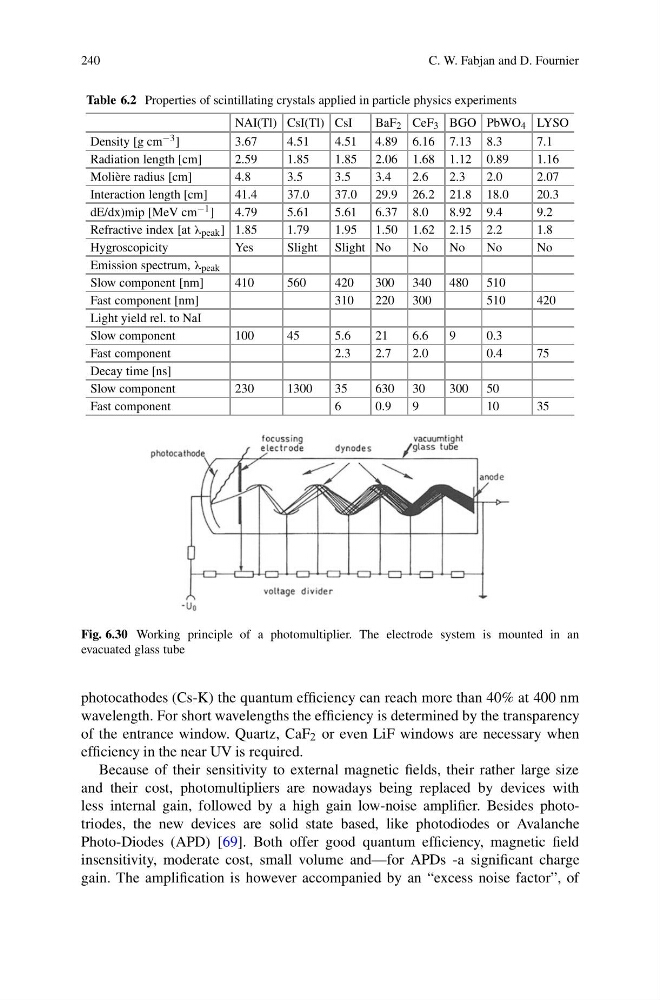
Fig. 6.30 Working principle of a photomultiplier. The electrode system is mounted in an
evacuated glass tube
photocathodes (Cs-K) the quantum efficiency can reach more than 40% at 400 nm
wavelength. For short wavelengths the efficiency is determined by the transparency
of the entrance window. Quartz, CaF 2 or even LiF windows are necessary when
efficiency in the near UV is required.
Because of their sensitivity to external magnetic fields, their rather large size
and their cost, photomultipliers are nowadays being replaced by devices with
less internal gain, followed by a high gain low-noise amplifier. Besides phototriodes, the new devices are solid state based, like photodiodes or Avalanche
Photo-Diodes (APD) [69]. Both offer good quantum efficiency, magnetic field
insensitivity, moderate cost, small volume and—for APDs -a significant charge
gain. The amplification is however accompanied by an “excess noise factor”, of
C. W. Fabjan and D. Fournier
Table 6.2 Properties of scintillating crystals applied in particle physics experiments
NAI(Tl) CsI(Tl) CsI
BaF 2 CeF 3 BGO PbWO 4 LYSO
Density [g cm −3 ]
3.67
4.51
4.51 4.89 6.16 7.13 8.3
7.1
Radiation length [cm]
2.59
1.85
1.85 2.06 1.68 1.12 0.89
1.16
Molière radius [cm]
4.8
3.5
3.5
3.4
2.6
2.3
2.0
2.07
Interaction length [cm]
41.4
37.0
37.0 29.9 26.2 21.8 18.0
20.3
dE/dx)mip [MeV cm −1 ]
4.79
5.61
5.61 6.37 8.0
8.92 9.4
9.2
Refractive index [at λ peak ] 1.85
1.79
1.95 1.50 1.62 2.15 2.2
1.8
Hygroscopicity
Yes
Slight Slight No
No
No
No
No
Emission spectrum, λ peak
Slow component [nm]
410
560
420
300 340 480 510
Fast component [nm]
310
220 300
510
420
Light yield rel. to NaI
Slow component
100
45
5.6
21
6.6
9
0.3
Fast component
2.3
2.7
2.0
0.4
75
Decay time [ns]
Slow component
230
1300
35
630 30
300 50
Fast component
6
0.9
9
10
35
Fig. 6.30 Working principle of a photomultiplier. The electrode system is mounted in an
evacuated glass tube
photocathodes (Cs-K) the quantum efficiency can reach more than 40% at 400 nm
wavelength. For short wavelengths the efficiency is determined by the transparency
of the entrance window. Quartz, CaF 2 or even LiF windows are necessary when
efficiency in the near UV is required.
Because of their sensitivity to external magnetic fields, their rather large size
and their cost, photomultipliers are nowadays being replaced by devices with
less internal gain, followed by a high gain low-noise amplifier. Besides phototriodes, the new devices are solid state based, like photodiodes or Avalanche
Photo-Diodes (APD) [69]. Both offer good quantum efficiency, magnetic field
insensitivity, moderate cost, small volume and—for APDs -a significant charge
gain. The amplification is however accompanied by an “excess noise factor”, of