

232
C. W. Fabjan and D. Fournier
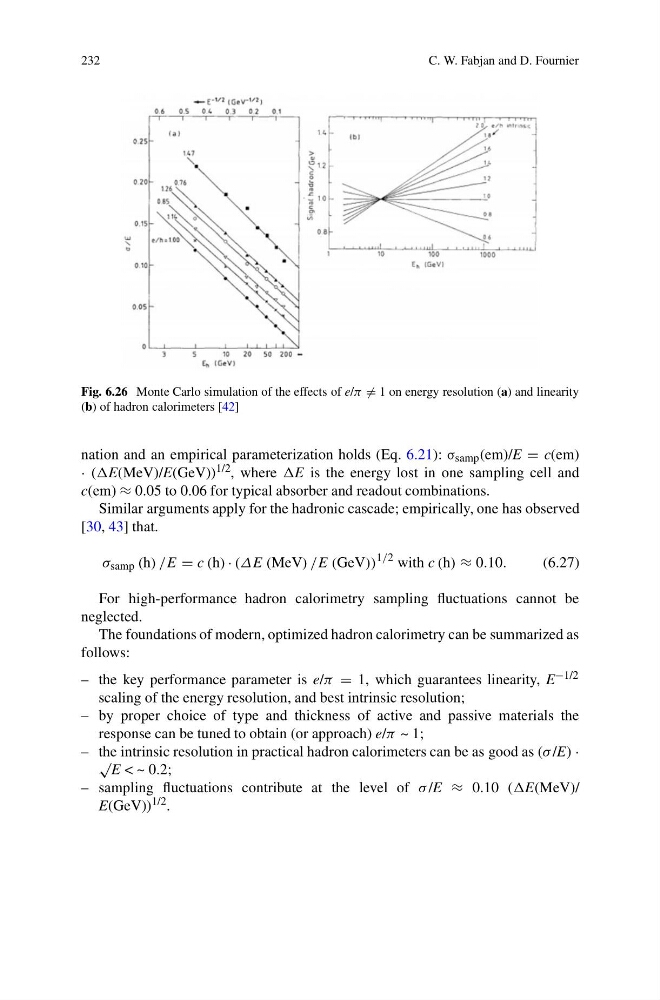
Fig. 6.26 Monte Carlo simulation of the effects of e/π = 1 on energy resolution (a) and linearity
(b) of hadron calorimeters [42]
nation and an empirical parameterization holds (Eq. 6.21): σ samp (em)/E = c(em)
· ( 1/2 , where is the energy lost in one sampling cell and
c(em) ≈ 0.05 to 0.06 for typical absorber and readout combinations.
Similar arguments apply for the hadronic cascade; empirically, one has observed
[30, 43] that.
σ samp (h) /E = c (h) · (ΔE (MeV) /E (GeV))
1/2 with c (h) ≈ 0.10.
(6.27)
For high-performance hadron calorimetry sampling fluctuations cannot be
neglected.
The foundations of modern, optimized hadron calorimetry can be summarized as
follows:
– the key performance parameter is e/π = 1, which guarantees linearity, E −1/2
scaling of the energy resolution, and best intrinsic resolution;
– by proper choice of type and thickness of active and passive materials the
response can be tuned to obtain (or approach) e/π ~ 1;
– the intrinsic resolution in practical hadron calorimeters can be as good as (σ /E) ·
√ E < ~ 0.2;
– sampling fluctuations contribute at the level of σ /E ≈ 0.10 (
E(GeV)) 1/2 .
C. W. Fabjan and D. Fournier
Fig. 6.26 Monte Carlo simulation of the effects of e/π = 1 on energy resolution (a) and linearity
(b) of hadron calorimeters [42]
nation and an empirical parameterization holds (Eq. 6.21): σ samp (em)/E = c(em)
· ( 1/2 , where is the energy lost in one sampling cell and
c(em) ≈ 0.05 to 0.06 for typical absorber and readout combinations.
Similar arguments apply for the hadronic cascade; empirically, one has observed
[30, 43] that.
σ samp (h) /E = c (h) · (ΔE (MeV) /E (GeV))
1/2 with c (h) ≈ 0.10.
(6.27)
For high-performance hadron calorimetry sampling fluctuations cannot be
neglected.
The foundations of modern, optimized hadron calorimetry can be summarized as
follows:
– the key performance parameter is e/π = 1, which guarantees linearity, E −1/2
scaling of the energy resolution, and best intrinsic resolution;
– by proper choice of type and thickness of active and passive materials the
response can be tuned to obtain (or approach) e/π ~ 1;
– the intrinsic resolution in practical hadron calorimeters can be as good as (σ /E) ·
√ E < ~ 0.2;
– sampling fluctuations contribute at the level of σ /E ≈ 0.10 (
E(GeV)) 1/2 .