

6 Calorimetry
231
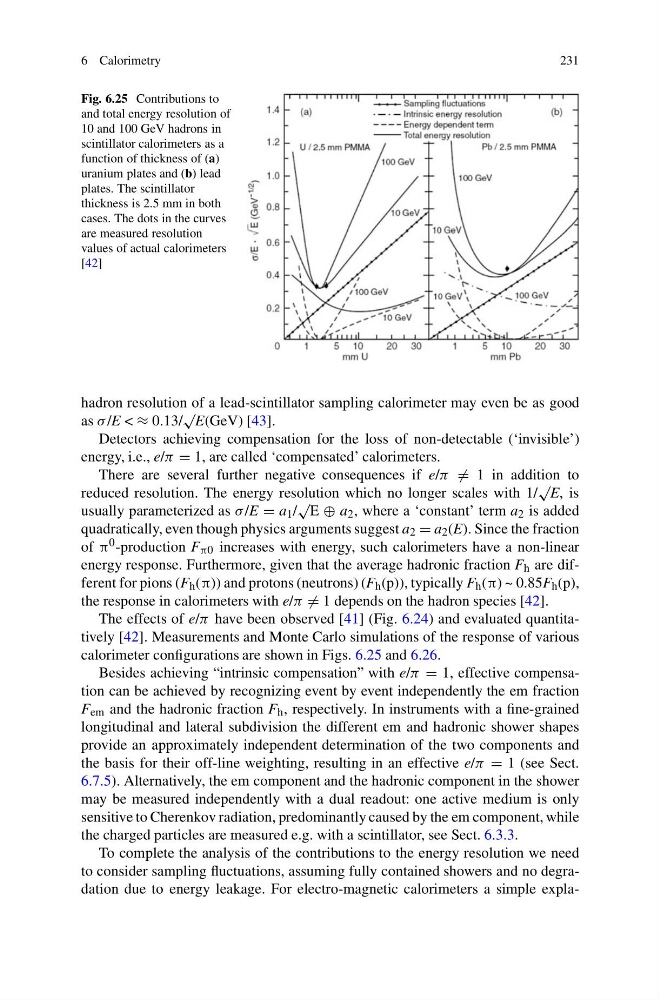
Fig. 6.25 Contributions to
and total energy resolution of
10 and 100 GeV hadrons in
scintillator calorimeters as a
function of thickness of (a)
uranium plates and (b) lead
plates. The scintillator
thickness is 2.5 mm in both
cases. The dots in the curves
are measured resolution
values of actual calorimeters
[42]
hadron resolution of a lead-scintillator sampling calorimeter may even be as good
as σ /E < ≈ 0.13/
√
E(GeV) [43].
Detectors achieving compensation for the loss of non-detectable (‘invisible’)
energy, i.e., e/π = 1, are called ‘compensated’ calorimeters.
There are several further negative consequences if e/π = 1 in addition to
reduced resolution. The energy resolution which no longer scales with 1/
√
E, is
usually parameterized as σ /E = a 1 /
√ E ⊕ a 2 , where a ‘constant’ term a 2 is added
quadratically, even though physics arguments suggest a 2 = a 2 (E). Since the fraction
of π 0 -production F π0 increases with energy, such calorimeters have a non-linear
energy response. Furthermore, given that the average hadronic fraction F h are different for pions (F h (π)) and protons (neutrons) (F h (p)), typically F h (π) ~ 0.85F h (p),
the response in calorimeters with e/π = 1 depends on the hadron species [42].
The effects of e/π have been observed [41] (Fig. 6.24) and evaluated quantitatively [42]. Measurements and Monte Carlo simulations of the response of various
calorimeter configurations are shown in Figs. 6.25 and 6.26.
Besides achieving “intrinsic compensation” with e/π = 1, effective compensation can be achieved by recognizing event by event independently the em fraction
F em and the hadronic fraction F h , respectively. In instruments with a fine-grained
longitudinal and lateral subdivision the different em and hadronic shower shapes
provide an approximately independent determination of the two components and
the basis for their off-line weighting, resulting in an effective e/π = 1 (see Sect.
6.7.5). Alternatively, the em component and the hadronic component in the shower
may be measured independently with a dual readout: one active medium is only
sensitive to Cherenkov radiation, predominantly caused by the em component, while
the charged particles are measured e.g. with a scintillator, see Sect. 6.3.3.
To complete the analysis of the contributions to the energy resolution we need
to consider sampling fluctuations, assuming fully contained showers and no degradation due to energy leakage. For electro-magnetic calorimeters a simple expla-
231
Fig. 6.25 Contributions to
and total energy resolution of
10 and 100 GeV hadrons in
scintillator calorimeters as a
function of thickness of (a)
uranium plates and (b) lead
plates. The scintillator
thickness is 2.5 mm in both
cases. The dots in the curves
are measured resolution
values of actual calorimeters
[42]
hadron resolution of a lead-scintillator sampling calorimeter may even be as good
as σ /E < ≈ 0.13/
√
E(GeV) [43].
Detectors achieving compensation for the loss of non-detectable (‘invisible’)
energy, i.e., e/π = 1, are called ‘compensated’ calorimeters.
There are several further negative consequences if e/π = 1 in addition to
reduced resolution. The energy resolution which no longer scales with 1/
√
E, is
usually parameterized as σ /E = a 1 /
√ E ⊕ a 2 , where a ‘constant’ term a 2 is added
quadratically, even though physics arguments suggest a 2 = a 2 (E). Since the fraction
of π 0 -production F π0 increases with energy, such calorimeters have a non-linear
energy response. Furthermore, given that the average hadronic fraction F h are different for pions (F h (π)) and protons (neutrons) (F h (p)), typically F h (π) ~ 0.85F h (p),
the response in calorimeters with e/π = 1 depends on the hadron species [42].
The effects of e/π have been observed [41] (Fig. 6.24) and evaluated quantitatively [42]. Measurements and Monte Carlo simulations of the response of various
calorimeter configurations are shown in Figs. 6.25 and 6.26.
Besides achieving “intrinsic compensation” with e/π = 1, effective compensation can be achieved by recognizing event by event independently the em fraction
F em and the hadronic fraction F h , respectively. In instruments with a fine-grained
longitudinal and lateral subdivision the different em and hadronic shower shapes
provide an approximately independent determination of the two components and
the basis for their off-line weighting, resulting in an effective e/π = 1 (see Sect.
6.7.5). Alternatively, the em component and the hadronic component in the shower
may be measured independently with a dual readout: one active medium is only
sensitive to Cherenkov radiation, predominantly caused by the em component, while
the charged particles are measured e.g. with a scintillator, see Sect. 6.3.3.
To complete the analysis of the contributions to the energy resolution we need
to consider sampling fluctuations, assuming fully contained showers and no degradation due to energy leakage. For electro-magnetic calorimeters a simple expla-