

230
C. W. Fabjan and D. Fournier
This difference in neutron response between high-Z absorbers and hydrogencontaining readout materials has an important consequence. Consider the contributions of n/mip as a function of the sampling fraction f S . The mip signal will be
inversely proportional to the thickness of the absorber plates, whereas the signal
from proton recoils will not be affected by changing f S : the n/mip signal will increase
with decreasing f S . Changing the sampling fraction allows to alter, to ‘tune’ e/π.
Tuning of the ratio R d = passive material [mm]/active material [mm] is a powerful
tool for acting on e/π [41]. This approach works well for high-Z absorbers with a
relatively large fission cross section, accompanied by multiple neutron emission.
Optimized ratios tend to imply for practical scintillator thicknesses rather thick
absorbers with concomitant significant sampling fluctuations and reduced signals.
How tightly are the various fluctuating contributions to the invisible energy
correlated with the average behaviour, as measured by e/π? A quantitative
answer needs rather complete shower and signal simulations and confirmation by
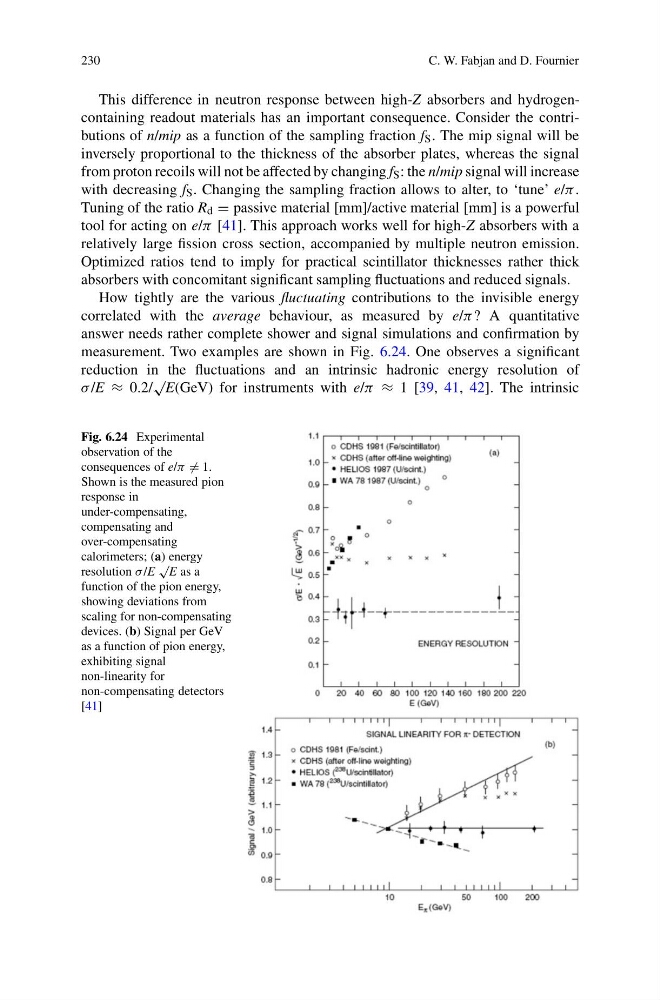
measurement. Two examples are shown in Fig. 6.24. One observes a significant
reduction in the fluctuations and an intrinsic hadronic energy resolution of
σ /E ≈ 0.2/
√
E(GeV) for instruments with e/π ≈ 1 [39, 41, 42]. The intrinsic
Fig. 6.24 Experimental
observation of the
consequences of e/π = 1.
Shown is the measured pion
response in
under-compensating,
compensating and
over-compensating
calorimeters; (a) energy
resolution σ /E
√
E as a
function of the pion energy,
showing deviations from
scaling for non-compensating
devices. (b) Signal per GeV
as a function of pion energy,
exhibiting signal
non-linearity for
non-compensating detectors
[41]
C. W. Fabjan and D. Fournier
This difference in neutron response between high-Z absorbers and hydrogencontaining readout materials has an important consequence. Consider the contributions of n/mip as a function of the sampling fraction f S . The mip signal will be
inversely proportional to the thickness of the absorber plates, whereas the signal
from proton recoils will not be affected by changing f S : the n/mip signal will increase
with decreasing f S . Changing the sampling fraction allows to alter, to ‘tune’ e/π.
Tuning of the ratio R d = passive material [mm]/active material [mm] is a powerful
tool for acting on e/π [41]. This approach works well for high-Z absorbers with a
relatively large fission cross section, accompanied by multiple neutron emission.
Optimized ratios tend to imply for practical scintillator thicknesses rather thick
absorbers with concomitant significant sampling fluctuations and reduced signals.
How tightly are the various fluctuating contributions to the invisible energy
correlated with the average behaviour, as measured by e/π? A quantitative
answer needs rather complete shower and signal simulations and confirmation by
measurement. Two examples are shown in Fig. 6.24. One observes a significant
reduction in the fluctuations and an intrinsic hadronic energy resolution of
σ /E ≈ 0.2/
√
E(GeV) for instruments with e/π ≈ 1 [39, 41, 42]. The intrinsic
Fig. 6.24 Experimental
observation of the
consequences of e/π = 1.
Shown is the measured pion
response in
under-compensating,
compensating and
over-compensating
calorimeters; (a) energy
resolution σ /E
√
E as a
function of the pion energy,
showing deviations from
scaling for non-compensating
devices. (b) Signal per GeV
as a function of pion energy,
exhibiting signal
non-linearity for
non-compensating detectors
[41]