

6 Calorimetry
229
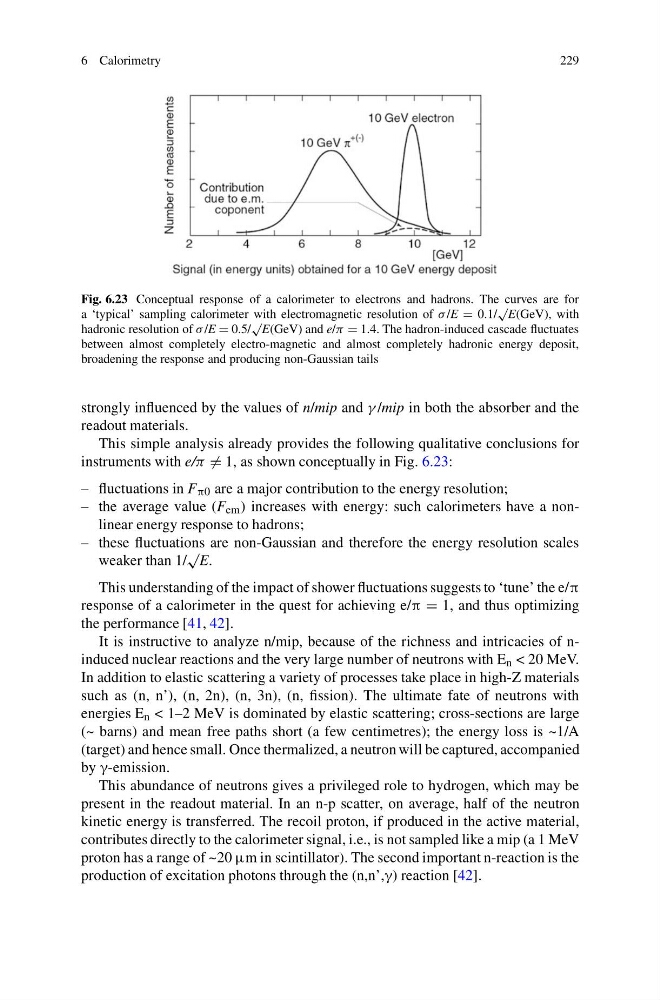
Fig. 6.23 Conceptual response of a calorimeter to electrons and hadrons. The curves are for
a ‘typical’ sampling calorimeter with electromagnetic resolution of σ /E = 0.1/
√
E(GeV), with
hadronic resolution of σ /E = 0.5/
√ E(GeV) and e/π = 1.4. The hadron-induced cascade fluctuates
between almost completely electro-magnetic and almost completely hadronic energy deposit,
broadening the response and producing non-Gaussian tails
strongly influenced by the values of n/mip and γ /mip in both the absorber and the
readout materials.
This simple analysis already provides the following qualitative conclusions for
instruments with e/π = 1, as shown conceptually in Fig. 6.23:
– fluctuations in F π0 are a major contribution to the energy resolution;
– the average value (F em ) increases with energy: such calorimeters have a nonlinear energy response to hadrons;
– these fluctuations are non-Gaussian and therefore the energy resolution scales
weaker than 1/
√
E.
This understanding of the impact of shower fluctuations suggests to ‘tune’ the e/π
response of a calorimeter in the quest for achieving e/π = 1, and thus optimizing
the performance [41, 42].
It is instructive to analyze n/mip, because of the richness and intricacies of ninduced nuclear reactions and the very large number of neutrons with E n < 20 MeV.
In addition to elastic scattering a variety of processes take place in high-Z materials
such as (n, n’), (n, 2n), (n, 3n), (n, fission). The ultimate fate of neutrons with
energies E n < 1–2 MeV is dominated by elastic scattering; cross-sections are large
(~ barns) and mean free paths short (a few centimetres); the energy loss is ~1/A
(target) and hence small. Once thermalized, a neutron will be captured, accompanied
by γ-emission.
This abundance of neutrons gives a privileged role to hydrogen, which may be
present in the readout material. In an n-p scatter, on average, half of the neutron
kinetic energy is transferred. The recoil proton, if produced in the active material,
contributes directly to the calorimeter signal, i.e., is not sampled like a mip (a 1 MeV
proton has a range of ~20 μm in scintillator). The second important n-reaction is the
production of excitation photons through the (n,n’,γ) reaction [42].
229
Fig. 6.23 Conceptual response of a calorimeter to electrons and hadrons. The curves are for
a ‘typical’ sampling calorimeter with electromagnetic resolution of σ /E = 0.1/
√
E(GeV), with
hadronic resolution of σ /E = 0.5/
√ E(GeV) and e/π = 1.4. The hadron-induced cascade fluctuates
between almost completely electro-magnetic and almost completely hadronic energy deposit,
broadening the response and producing non-Gaussian tails
strongly influenced by the values of n/mip and γ /mip in both the absorber and the
readout materials.
This simple analysis already provides the following qualitative conclusions for
instruments with e/π = 1, as shown conceptually in Fig. 6.23:
– fluctuations in F π0 are a major contribution to the energy resolution;
– the average value (F em ) increases with energy: such calorimeters have a nonlinear energy response to hadrons;
– these fluctuations are non-Gaussian and therefore the energy resolution scales
weaker than 1/
√
E.
This understanding of the impact of shower fluctuations suggests to ‘tune’ the e/π
response of a calorimeter in the quest for achieving e/π = 1, and thus optimizing
the performance [41, 42].
It is instructive to analyze n/mip, because of the richness and intricacies of ninduced nuclear reactions and the very large number of neutrons with E n < 20 MeV.
In addition to elastic scattering a variety of processes take place in high-Z materials
such as (n, n’), (n, 2n), (n, 3n), (n, fission). The ultimate fate of neutrons with
energies E n < 1–2 MeV is dominated by elastic scattering; cross-sections are large
(~ barns) and mean free paths short (a few centimetres); the energy loss is ~1/A
(target) and hence small. Once thermalized, a neutron will be captured, accompanied
by γ-emission.
This abundance of neutrons gives a privileged role to hydrogen, which may be
present in the readout material. In an n-p scatter, on average, half of the neutron
kinetic energy is transferred. The recoil proton, if produced in the active material,
contributes directly to the calorimeter signal, i.e., is not sampled like a mip (a 1 MeV
proton has a range of ~20 μm in scintillator). The second important n-reaction is the
production of excitation photons through the (n,n’,γ) reaction [42].