

228
C. W. Fabjan and D. Fournier
6.2.7 Energy Resolution of Hadron Calorimeters
The average properties of the hadronic cascade are a reflection of the intrinsic eventby-event fluctuations which determine the energy resolution. Most importantly,
fluctuations in the hadronic component are correlated with the number of spallation
neutrons and (delayed) nuclear photons and hence with the energy consumed
to overcome the binding energy; these particles from the nuclear reactions will
contribute differently (in general less) to the measurable signal.
Let η e be the efficiency for observing a signal E e vis (visible energy) from
an electromagnetic shower, i.e., E e vis = η e E(em); let η h be the corresponding
efficiency for purely hadronic energy to give a measurable signal in an instrument.
Decomposing a hadron-induced shower into the em fraction F em and a purely
hadronic part F h the measured, ‘visible’ energy E π vis for a pion-induced shower
is.
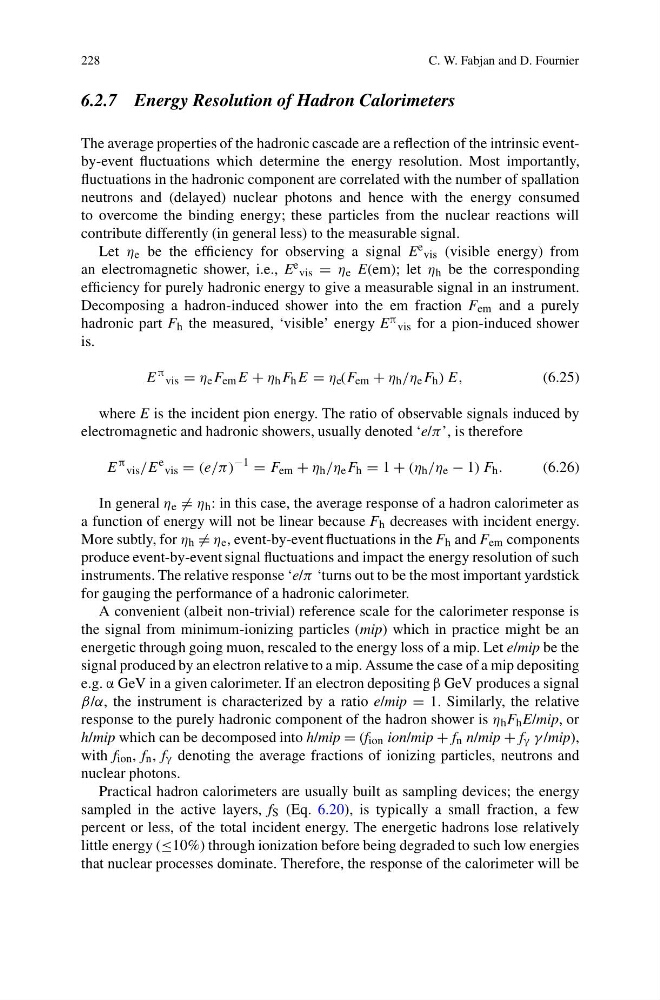
E
π
vis = η e F em E + η h F h E = η e (F em + η h /η e F h ) E,
(6.25)
where E is the incident pion energy. The ratio of observable signals induced by
electromagnetic and hadronic showers, usually denoted ‘e/π’, is therefore
E
π
vis /E
e
vis = (e/π)
−1
= F em + η h /η e F h = 1 + (η h /η e − 1) F h .
(6.26)
In general η e = η h : in this case, the average response of a hadron calorimeter as
a function of energy will not be linear because F h decreases with incident energy.
More subtly, for η h = η e , event-by-event fluctuations in the F h and F em components
produce event-by-event signal fluctuations and impact the energy resolution of such
instruments. The relative response ‘e/π ‘turns out to be the most important yardstick
for gauging the performance of a hadronic calorimeter.
A convenient (albeit non-trivial) reference scale for the calorimeter response is
the signal from minimum-ionizing particles (mip) which in practice might be an
energetic through going muon, rescaled to the energy loss of a mip. Let e/mip be the
signal produced by an electron relative to a mip. Assume the case of a mip depositing
e.g. α GeV in a given calorimeter. If an electron depositing β GeV produces a signal
β/α, the instrument is characterized by a ratio e/mip = 1. Similarly, the relative
response to the purely hadronic component of the hadron shower is η h F h E/mip, or
h/mip which can be decomposed into h/mip = (f ion ion/mip + f n n/mip + f γ γ /mip),
with f ion , f n , f γ denoting the average fractions of ionizing particles, neutrons and
nuclear photons.
Practical hadron calorimeters are usually built as sampling devices; the energy
sampled in the active layers, f S (Eq. 6.20), is typically a small fraction, a few
percent or less, of the total incident energy. The energetic hadrons lose relatively
little energy (≤10%) through ionization before being degraded to such low energies
that nuclear processes dominate. Therefore, the response of the calorimeter will be
C. W. Fabjan and D. Fournier
6.2.7 Energy Resolution of Hadron Calorimeters
The average properties of the hadronic cascade are a reflection of the intrinsic eventby-event fluctuations which determine the energy resolution. Most importantly,
fluctuations in the hadronic component are correlated with the number of spallation
neutrons and (delayed) nuclear photons and hence with the energy consumed
to overcome the binding energy; these particles from the nuclear reactions will
contribute differently (in general less) to the measurable signal.
Let η e be the efficiency for observing a signal E e vis (visible energy) from
an electromagnetic shower, i.e., E e vis = η e E(em); let η h be the corresponding
efficiency for purely hadronic energy to give a measurable signal in an instrument.
Decomposing a hadron-induced shower into the em fraction F em and a purely
hadronic part F h the measured, ‘visible’ energy E π vis for a pion-induced shower
is.
E
π
vis = η e F em E + η h F h E = η e (F em + η h /η e F h ) E,
(6.25)
where E is the incident pion energy. The ratio of observable signals induced by
electromagnetic and hadronic showers, usually denoted ‘e/π’, is therefore
E
π
vis /E
e
vis = (e/π)
−1
= F em + η h /η e F h = 1 + (η h /η e − 1) F h .
(6.26)
In general η e = η h : in this case, the average response of a hadron calorimeter as
a function of energy will not be linear because F h decreases with incident energy.
More subtly, for η h = η e , event-by-event fluctuations in the F h and F em components
produce event-by-event signal fluctuations and impact the energy resolution of such
instruments. The relative response ‘e/π ‘turns out to be the most important yardstick
for gauging the performance of a hadronic calorimeter.
A convenient (albeit non-trivial) reference scale for the calorimeter response is
the signal from minimum-ionizing particles (mip) which in practice might be an
energetic through going muon, rescaled to the energy loss of a mip. Let e/mip be the
signal produced by an electron relative to a mip. Assume the case of a mip depositing
e.g. α GeV in a given calorimeter. If an electron depositing β GeV produces a signal
β/α, the instrument is characterized by a ratio e/mip = 1. Similarly, the relative
response to the purely hadronic component of the hadron shower is η h F h E/mip, or
h/mip which can be decomposed into h/mip = (f ion ion/mip + f n n/mip + f γ γ /mip),
with f ion , f n , f γ denoting the average fractions of ionizing particles, neutrons and
nuclear photons.
Practical hadron calorimeters are usually built as sampling devices; the energy
sampled in the active layers, f S (Eq. 6.20), is typically a small fraction, a few
percent or less, of the total incident energy. The energetic hadrons lose relatively
little energy (≤10%) through ionization before being degraded to such low energies
that nuclear processes dominate. Therefore, the response of the calorimeter will be