

6 Calorimetry
233
6.2.8 Muons in a Dense Material
The velocity dependence of the average energy loss by collisions of singly charged
particles (muons, pions, protons, . . . ) with electrons of the traversed medium differs
slightly from formula (6.1) and is given by:
−
dE
dx
= k
Z
A
1
β 2
ln
2m e c 2 γ 2 β 2
I
− β
2
−
δ
2
MeV/
g/cm
−2
(6.28)
where δ ≈ ln(γ) accounts for screening effects at high energy. As a function
of energy of the incident particle the most probable value shows a slow increase
(relativistic rise) followed by a plateau whose value depends on the density of the
material. The energy loss reaches a minimum for γ β ~ 3, corresponding to muon
energies of few hundred MeV.
At a given energy, the energy loss distribution of −dE/dx in a slab of material has
an asymmetric distribution around its most probable value, usually referred to as the
“Landau-Vavilov” distribution [44, 45]. The muon energy loss in dense materials
has been extensively studied [46]. Both, the absolute energy loss and the straggling
function agree with measurements at the percent level [47] up to several hundred
GeV.
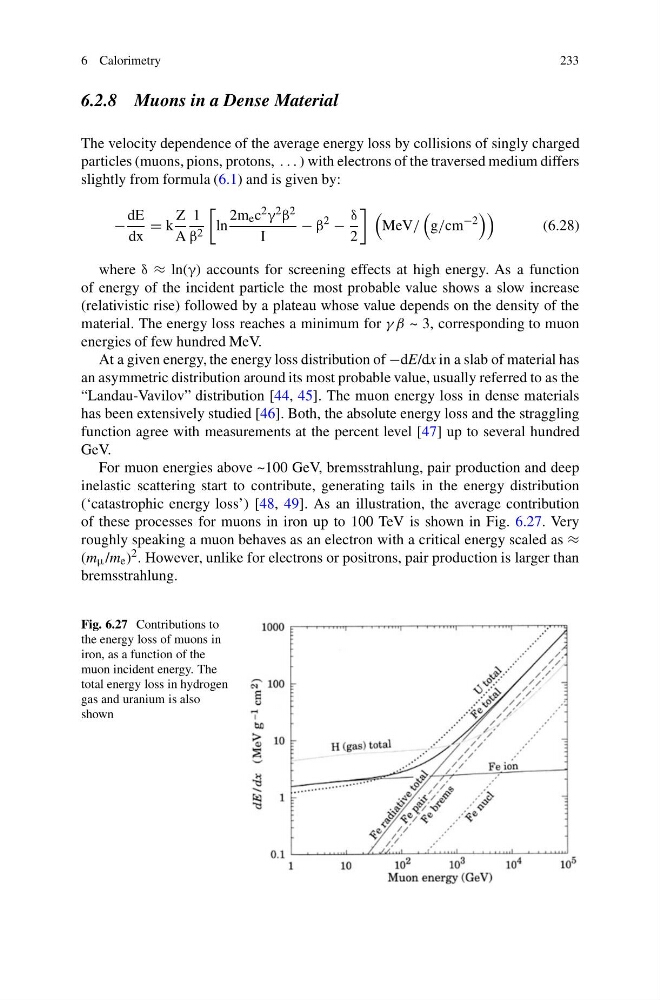
For muon energies above ~100 GeV, bremsstrahlung, pair production and deep
inelastic scattering start to contribute, generating tails in the energy distribution
(‘catastrophic energy loss’) [48, 49]. As an illustration, the average contribution
of these processes for muons in iron up to 100 TeV is shown in Fig. 6.27. Very
roughly speaking a muon behaves as an electron with a critical energy scaled as ≈
(m μ /m e ) 2 . However, unlike for electrons or positrons, pair production is larger than
bremsstrahlung.
Fig. 6.27 Contributions to
the energy loss of muons in
iron, as a function of the
muon incident energy. The
total energy loss in hydrogen
gas and uranium is also
shown
233
6.2.8 Muons in a Dense Material
The velocity dependence of the average energy loss by collisions of singly charged
particles (muons, pions, protons, . . . ) with electrons of the traversed medium differs
slightly from formula (6.1) and is given by:
−
dE
dx
= k
Z
A
1
β 2
ln
2m e c 2 γ 2 β 2
I
− β
2
−
δ
2
MeV/
g/cm
−2
(6.28)
where δ ≈ ln(γ) accounts for screening effects at high energy. As a function
of energy of the incident particle the most probable value shows a slow increase
(relativistic rise) followed by a plateau whose value depends on the density of the
material. The energy loss reaches a minimum for γ β ~ 3, corresponding to muon
energies of few hundred MeV.
At a given energy, the energy loss distribution of −dE/dx in a slab of material has
an asymmetric distribution around its most probable value, usually referred to as the
“Landau-Vavilov” distribution [44, 45]. The muon energy loss in dense materials
has been extensively studied [46]. Both, the absolute energy loss and the straggling
function agree with measurements at the percent level [47] up to several hundred
GeV.
For muon energies above ~100 GeV, bremsstrahlung, pair production and deep
inelastic scattering start to contribute, generating tails in the energy distribution
(‘catastrophic energy loss’) [48, 49]. As an illustration, the average contribution
of these processes for muons in iron up to 100 TeV is shown in Fig. 6.27. Very
roughly speaking a muon behaves as an electron with a critical energy scaled as ≈
(m μ /m e ) 2 . However, unlike for electrons or positrons, pair production is larger than
bremsstrahlung.
Fig. 6.27 Contributions to
the energy loss of muons in
iron, as a function of the
muon incident energy. The
total energy loss in hydrogen
gas and uranium is also
shown