

214
C. W. Fabjan and D. Fournier
100
10
0
3
6
9
12
Depth [X 0 ]
15
e
+
e
–
Energydeposit[MeV/X
0 ]
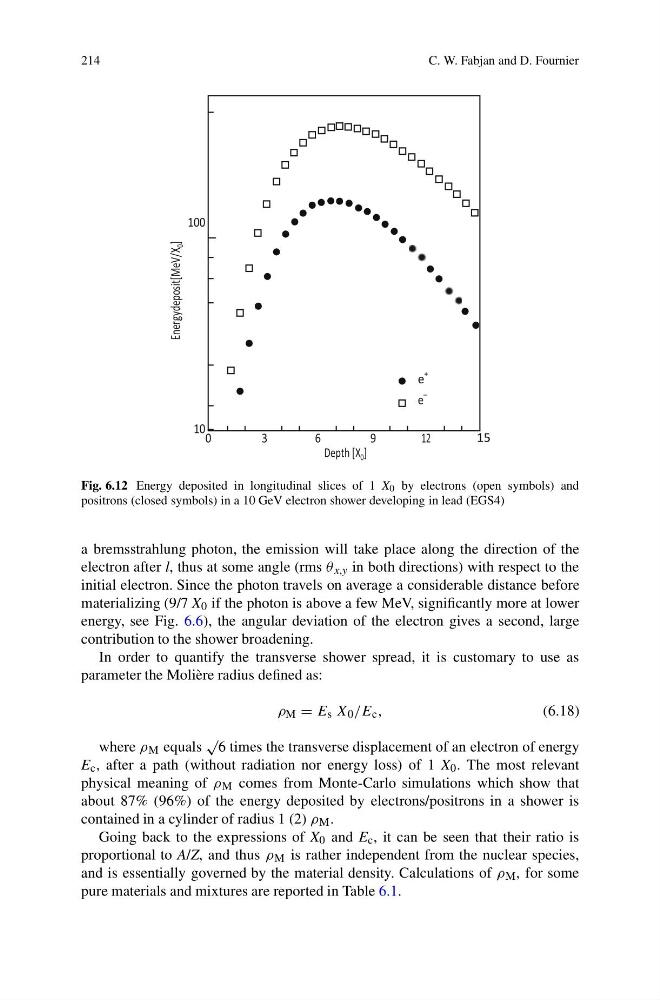
Fig. 6.12 Energy deposited in longitudinal slices of 1 X 0 by electrons (open symbols) and
positrons (closed symbols) in a 10 GeV electron shower developing in lead (EGS4)
a bremsstrahlung photon, the emission will take place along the direction of the
electron after l, thus at some angle (rms θ x,y in both directions) with respect to the
initial electron. Since the photon travels on average a considerable distance before
materializing (9/7 X 0 if the photon is above a few MeV, significantly more at lower
energy, see Fig. 6.6), the angular deviation of the electron gives a second, large
contribution to the shower broadening.
In order to quantify the transverse shower spread, it is customary to use as
parameter the Molière radius defined as:
ρ M = E s X 0 /E c ,
(6.18)
where ρ M equals
√
6 times the transverse displacement of an electron of energy
E c , after a path (without radiation nor energy loss) of 1 X 0 . The most relevant
physical meaning of ρ M comes from Monte-Carlo simulations which show that
about 87% (96%) of the energy deposited by electrons/positrons in a shower is
contained in a cylinder of radius 1 (2) ρ M .
Going back to the expressions of X 0 and E c , it can be seen that their ratio is
proportional to A/Z, and thus ρ M is rather independent from the nuclear species,
and is essentially governed by the material density. Calculations of ρ M , for some
pure materials and mixtures are reported in Table 6.1.
C. W. Fabjan and D. Fournier
100
10
0
3
6
9
12
Depth [X 0 ]
15
e
+
e
–
Energydeposit[MeV/X
0 ]
Fig. 6.12 Energy deposited in longitudinal slices of 1 X 0 by electrons (open symbols) and
positrons (closed symbols) in a 10 GeV electron shower developing in lead (EGS4)
a bremsstrahlung photon, the emission will take place along the direction of the
electron after l, thus at some angle (rms θ x,y in both directions) with respect to the
initial electron. Since the photon travels on average a considerable distance before
materializing (9/7 X 0 if the photon is above a few MeV, significantly more at lower
energy, see Fig. 6.6), the angular deviation of the electron gives a second, large
contribution to the shower broadening.
In order to quantify the transverse shower spread, it is customary to use as
parameter the Molière radius defined as:
ρ M = E s X 0 /E c ,
(6.18)
where ρ M equals
√
6 times the transverse displacement of an electron of energy
E c , after a path (without radiation nor energy loss) of 1 X 0 . The most relevant
physical meaning of ρ M comes from Monte-Carlo simulations which show that
about 87% (96%) of the energy deposited by electrons/positrons in a shower is
contained in a cylinder of radius 1 (2) ρ M .
Going back to the expressions of X 0 and E c , it can be seen that their ratio is
proportional to A/Z, and thus ρ M is rather independent from the nuclear species,
and is essentially governed by the material density. Calculations of ρ M , for some
pure materials and mixtures are reported in Table 6.1.