

6 Calorimetry
213
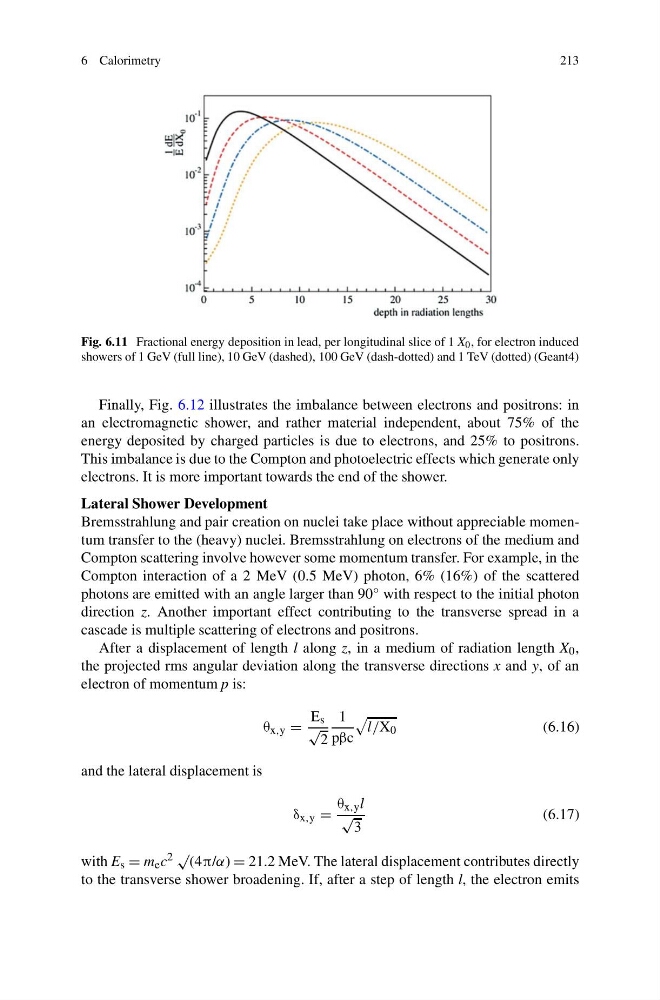
Fig. 6.11 Fractional energy deposition in lead, per longitudinal slice of 1 X 0 , for electron induced
showers of 1 GeV (full line), 10 GeV (dashed), 100 GeV (dash-dotted) and 1 TeV (dotted) (Geant4)
Finally, Fig. 6.12 illustrates the imbalance between electrons and positrons: in
an electromagnetic shower, and rather material independent, about 75% of the
energy deposited by charged particles is due to electrons, and 25% to positrons.
This imbalance is due to the Compton and photoelectric effects which generate only
electrons. It is more important towards the end of the shower.
Lateral Shower Development
Bremsstrahlung and pair creation on nuclei take place without appreciable momentum transfer to the (heavy) nuclei. Bremsstrahlung on electrons of the medium and
Compton scattering involve however some momentum transfer. For example, in the
Compton interaction of a 2 MeV (0.5 MeV) photon, 6% (16%) of the scattered
photons are emitted with an angle larger than 90 ◦ with respect to the initial photon
direction z. Another important effect contributing to the transverse spread in a
cascade is multiple scattering of electrons and positrons.
After a displacement of length l along z, in a medium of radiation length X 0 ,
the projected rms angular deviation along the transverse directions x and y, of an
electron of momentum p is:
θ x,y =
E s
√
2
1
pβc
l/X 0
(6.16)
and the lateral displacement is
δ x,y =
θ x,y l
√
3
(6.17)
with E s = m e c 2 √
(4π/α) = 21.2 MeV. The lateral displacement contributes directly
to the transverse shower broadening. If, after a step of length l, the electron emits
213
Fig. 6.11 Fractional energy deposition in lead, per longitudinal slice of 1 X 0 , for electron induced
showers of 1 GeV (full line), 10 GeV (dashed), 100 GeV (dash-dotted) and 1 TeV (dotted) (Geant4)
Finally, Fig. 6.12 illustrates the imbalance between electrons and positrons: in
an electromagnetic shower, and rather material independent, about 75% of the
energy deposited by charged particles is due to electrons, and 25% to positrons.
This imbalance is due to the Compton and photoelectric effects which generate only
electrons. It is more important towards the end of the shower.
Lateral Shower Development
Bremsstrahlung and pair creation on nuclei take place without appreciable momentum transfer to the (heavy) nuclei. Bremsstrahlung on electrons of the medium and
Compton scattering involve however some momentum transfer. For example, in the
Compton interaction of a 2 MeV (0.5 MeV) photon, 6% (16%) of the scattered
photons are emitted with an angle larger than 90 ◦ with respect to the initial photon
direction z. Another important effect contributing to the transverse spread in a
cascade is multiple scattering of electrons and positrons.
After a displacement of length l along z, in a medium of radiation length X 0 ,
the projected rms angular deviation along the transverse directions x and y, of an
electron of momentum p is:
θ x,y =
E s
√
2
1
pβc
l/X 0
(6.16)
and the lateral displacement is
δ x,y =
θ x,y l
√
3
(6.17)
with E s = m e c 2 √
(4π/α) = 21.2 MeV. The lateral displacement contributes directly
to the transverse shower broadening. If, after a step of length l, the electron emits