

6 Calorimetry
215
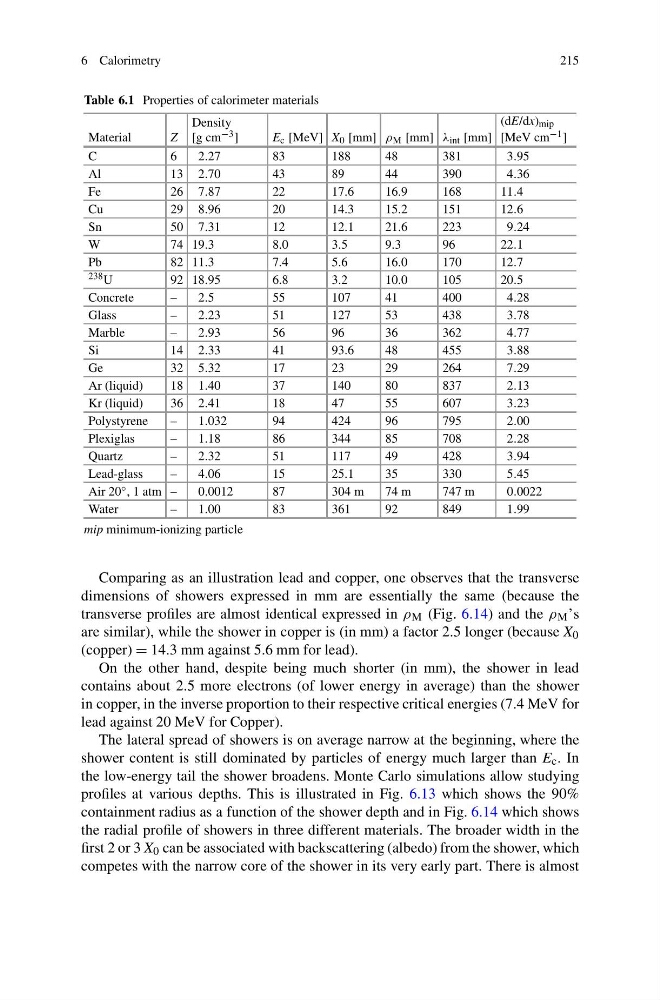
Table 6.1 Properties of calorimeter materials
Material
Z
Density
[g cm −3 ]
E c [MeV] X 0 [mm] ρ M [mm] λ int [mm]
(dE/dx) mip
[MeV cm −1 ]
C
6
2.27
83
188
48
381
3.95
Al
13 2.70
43
89
44
390
4.36
Fe
26 7.87
22
17.6
16.9
168
11.4
Cu
29 8.96
20
14.3
15.2
151
12.6
Sn
50 7.31
12
12.1
21.6
223
9.24
W
74 19.3
8.0
3.5
9.3
96
22.1
Pb
82 11.3
7.4
5.6
16.0
170
12.7
238 U
92 18.95
6.8
3.2
10.0
105
20.5
Concrete
–
2.5
55
107
41
400
4.28
Glass
–
2.23
51
127
53
438
3.78
Marble
–
2.93
56
96
36
362
4.77
Si
14 2.33
41
93.6
48
455
3.88
Ge
32 5.32
17
23
29
264
7.29
Ar (liquid)
18 1.40
37
140
80
837
2.13
Kr (liquid)
36 2.41
18
47
55
607
3.23
Polystyrene
–
1.032
94
424
96
795
2.00
Plexiglas
–
1.18
86
344
85
708
2.28
Quartz
–
2.32
51
117
49
428
3.94
Lead-glass
–
4.06
15
25.1
35
330
5.45
Air 20 ◦ , 1 atm –
0.0012
87
304 m
74 m
747 m
0.0022
Water
–
1.00
83
361
92
849
1.99
mip minimum-ionizing particle
Comparing as an illustration lead and copper, one observes that the transverse
dimensions of showers expressed in mm are essentially the same (because the
transverse profiles are almost identical expressed in ρ M (Fig. 6.14) and the ρ M ’s
are similar), while the shower in copper is (in mm) a factor 2.5 longer (because X 0
(copper) = 14.3 mm against 5.6 mm for lead).
On the other hand, despite being much shorter (in mm), the shower in lead
contains about 2.5 more electrons (of lower energy in average) than the shower
in copper, in the inverse proportion to their respective critical energies (7.4 MeV for
lead against 20 MeV for Copper).
The lateral spread of showers is on average narrow at the beginning, where the
shower content is still dominated by particles of energy much larger than E c . In
the low-energy tail the shower broadens. Monte Carlo simulations allow studying
profiles at various depths. This is illustrated in Fig. 6.13 which shows the 90%
containment radius as a function of the shower depth and in Fig. 6.14 which shows
the radial profile of showers in three different materials. The broader width in the
first 2 or 3 X 0 can be associated with backscattering (albedo) from the shower, which
competes with the narrow core of the shower in its very early part. There is almost
215
Table 6.1 Properties of calorimeter materials
Material
Z
Density
[g cm −3 ]
E c [MeV] X 0 [mm] ρ M [mm] λ int [mm]
(dE/dx) mip
[MeV cm −1 ]
C
6
2.27
83
188
48
381
3.95
Al
13 2.70
43
89
44
390
4.36
Fe
26 7.87
22
17.6
16.9
168
11.4
Cu
29 8.96
20
14.3
15.2
151
12.6
Sn
50 7.31
12
12.1
21.6
223
9.24
W
74 19.3
8.0
3.5
9.3
96
22.1
Pb
82 11.3
7.4
5.6
16.0
170
12.7
238 U
92 18.95
6.8
3.2
10.0
105
20.5
Concrete
–
2.5
55
107
41
400
4.28
Glass
–
2.23
51
127
53
438
3.78
Marble
–
2.93
56
96
36
362
4.77
Si
14 2.33
41
93.6
48
455
3.88
Ge
32 5.32
17
23
29
264
7.29
Ar (liquid)
18 1.40
37
140
80
837
2.13
Kr (liquid)
36 2.41
18
47
55
607
3.23
Polystyrene
–
1.032
94
424
96
795
2.00
Plexiglas
–
1.18
86
344
85
708
2.28
Quartz
–
2.32
51
117
49
428
3.94
Lead-glass
–
4.06
15
25.1
35
330
5.45
Air 20 ◦ , 1 atm –
0.0012
87
304 m
74 m
747 m
0.0022
Water
–
1.00
83
361
92
849
1.99
mip minimum-ionizing particle
Comparing as an illustration lead and copper, one observes that the transverse
dimensions of showers expressed in mm are essentially the same (because the
transverse profiles are almost identical expressed in ρ M (Fig. 6.14) and the ρ M ’s
are similar), while the shower in copper is (in mm) a factor 2.5 longer (because X 0
(copper) = 14.3 mm against 5.6 mm for lead).
On the other hand, despite being much shorter (in mm), the shower in lead
contains about 2.5 more electrons (of lower energy in average) than the shower
in copper, in the inverse proportion to their respective critical energies (7.4 MeV for
lead against 20 MeV for Copper).
The lateral spread of showers is on average narrow at the beginning, where the
shower content is still dominated by particles of energy much larger than E c . In
the low-energy tail the shower broadens. Monte Carlo simulations allow studying
profiles at various depths. This is illustrated in Fig. 6.13 which shows the 90%
containment radius as a function of the shower depth and in Fig. 6.14 which shows
the radial profile of showers in three different materials. The broader width in the
first 2 or 3 X 0 can be associated with backscattering (albedo) from the shower, which
competes with the narrow core of the shower in its very early part. There is almost