

206
C. W. Fabjan and D. Fournier
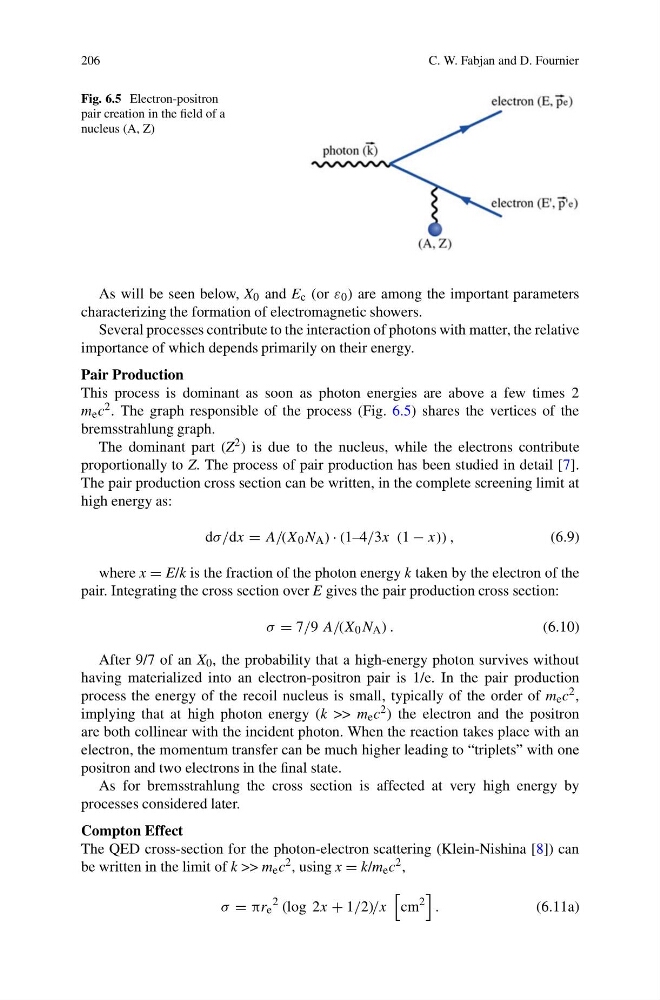
Fig. 6.5 Electron-positron
pair creation in the field of a
nucleus (A, Z)
As will be seen below, X 0 and E c (or ε 0 ) are among the important parameters
characterizing the formation of electromagnetic showers.
Several processes contribute to the interaction of photons with matter, the relative
importance of which depends primarily on their energy.
Pair Production
This process is dominant as soon as photon energies are above a few times 2
m e c 2 . The graph responsible of the process (Fig. 6.5) shares the vertices of the
bremsstrahlung graph.
The dominant part (Z 2 ) is due to the nucleus, while the electrons contribute
proportionally to Z. The process of pair production has been studied in detail [7].
The pair production cross section can be written, in the complete screening limit at
high energy as:
dσ/dx = A/(X 0 N A ) · (1–4/3x (1 − x)) ,
(6.9)
where x = E/k is the fraction of the photon energy k taken by the electron of the
pair. Integrating the cross section over E gives the pair production cross section:
σ = 7/9 A/(X 0 N A ) .
(6.10)
After 9/7 of an X 0 , the probability that a high-energy photon survives without
having materialized into an electron-positron pair is 1/e. In the pair production
process the energy of the recoil nucleus is small, typically of the order of m e c 2 ,
implying that at high photon energy (k >> m e c 2 ) the electron and the positron
are both collinear with the incident photon. When the reaction takes place with an
electron, the momentum transfer can be much higher leading to “triplets” with one
positron and two electrons in the final state.
As for bremsstrahlung the cross section is affected at very high energy by
processes considered later.
Compton Effect
The QED cross-section for the photon-electron scattering (Klein-Nishina [8]) can
be written in the limit of k >> m e c 2 , using x = k/m e c 2 ,
σ = πr e
2 (log 2x + 1/2)/x
cm
2
.
(6.11a)
C. W. Fabjan and D. Fournier
Fig. 6.5 Electron-positron
pair creation in the field of a
nucleus (A, Z)
As will be seen below, X 0 and E c (or ε 0 ) are among the important parameters
characterizing the formation of electromagnetic showers.
Several processes contribute to the interaction of photons with matter, the relative
importance of which depends primarily on their energy.
Pair Production
This process is dominant as soon as photon energies are above a few times 2
m e c 2 . The graph responsible of the process (Fig. 6.5) shares the vertices of the
bremsstrahlung graph.
The dominant part (Z 2 ) is due to the nucleus, while the electrons contribute
proportionally to Z. The process of pair production has been studied in detail [7].
The pair production cross section can be written, in the complete screening limit at
high energy as:
dσ/dx = A/(X 0 N A ) · (1–4/3x (1 − x)) ,
(6.9)
where x = E/k is the fraction of the photon energy k taken by the electron of the
pair. Integrating the cross section over E gives the pair production cross section:
σ = 7/9 A/(X 0 N A ) .
(6.10)
After 9/7 of an X 0 , the probability that a high-energy photon survives without
having materialized into an electron-positron pair is 1/e. In the pair production
process the energy of the recoil nucleus is small, typically of the order of m e c 2 ,
implying that at high photon energy (k >> m e c 2 ) the electron and the positron
are both collinear with the incident photon. When the reaction takes place with an
electron, the momentum transfer can be much higher leading to “triplets” with one
positron and two electrons in the final state.
As for bremsstrahlung the cross section is affected at very high energy by
processes considered later.
Compton Effect
The QED cross-section for the photon-electron scattering (Klein-Nishina [8]) can
be written in the limit of k >> m e c 2 , using x = k/m e c 2 ,
σ = πr e
2 (log 2x + 1/2)/x
cm
2
.
(6.11a)