

6 Calorimetry
205
The Z 2 term reflects the fact that the bremsstrahlung results from a coupling of
the initial electron to the electromagnetic field of the nucleus, somewhat screened by
the electrons (log term), and augmented by a direct contribution from the electrons
(Z 2 replaced by Z (Z + 1)).
The radiation length of a compound, or mixture, can be calculated using:
1/X 0 = Σ w j /X j
(6.6)
where the w j are the fractions by weight of the nuclear species j of the mixture or
of the compound.
The spectrum of photons with energy k radiated by an electron of energy E
traversing a thin slab of material (expressed as a function of y = k/E) has the
characteristic “bremsstrahlung” spectrum:
dσ/dk = A/ (X 0 N A k) ·
4/3–4/3y + y
2
.
(6.7)
At very high energies a number of effects, considered at the end of this
subsection, modify the spectrum.
Another important quantity, the critical energy can be introduced examining Fig.
6.2. The critical energy E c for electrons (or positrons) in a given medium is defined
as the energy at which energy loss by radiation in a thin slab equals the energy loss
by ionization. A slightly different definition ε 0 , introduced by Rossi, results from
considering the relative energy loss as fully independent of energy (see Fig. 6.2).
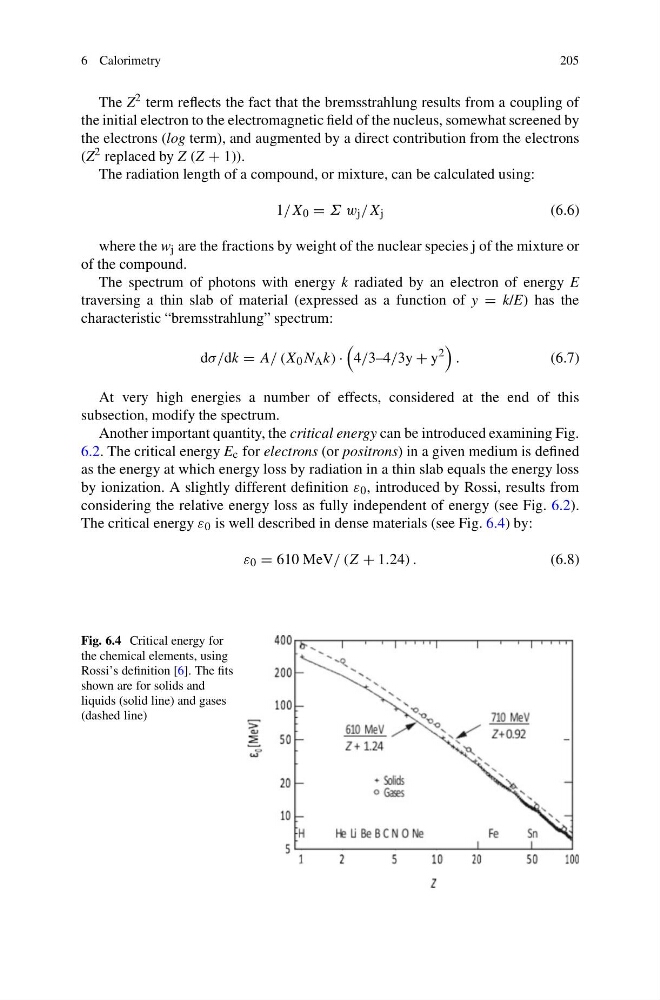
The critical energy ε 0 is well described in dense materials (see Fig. 6.4) by:
ε 0 = 610 MeV/ (Z + 1.24) .
(6.8)
Fig. 6.4 Critical energy for
the chemical elements, using
Rossi’s definition [6]. The fits
shown are for solids and
liquids (solid line) and gases
(dashed line)
205
The Z 2 term reflects the fact that the bremsstrahlung results from a coupling of
the initial electron to the electromagnetic field of the nucleus, somewhat screened by
the electrons (log term), and augmented by a direct contribution from the electrons
(Z 2 replaced by Z (Z + 1)).
The radiation length of a compound, or mixture, can be calculated using:
1/X 0 = Σ w j /X j
(6.6)
where the w j are the fractions by weight of the nuclear species j of the mixture or
of the compound.
The spectrum of photons with energy k radiated by an electron of energy E
traversing a thin slab of material (expressed as a function of y = k/E) has the
characteristic “bremsstrahlung” spectrum:
dσ/dk = A/ (X 0 N A k) ·
4/3–4/3y + y
2
.
(6.7)
At very high energies a number of effects, considered at the end of this
subsection, modify the spectrum.
Another important quantity, the critical energy can be introduced examining Fig.
6.2. The critical energy E c for electrons (or positrons) in a given medium is defined
as the energy at which energy loss by radiation in a thin slab equals the energy loss
by ionization. A slightly different definition ε 0 , introduced by Rossi, results from
considering the relative energy loss as fully independent of energy (see Fig. 6.2).
The critical energy ε 0 is well described in dense materials (see Fig. 6.4) by:
ε 0 = 610 MeV/ (Z + 1.24) .
(6.8)
Fig. 6.4 Critical energy for
the chemical elements, using
Rossi’s definition [6]. The fits
shown are for solids and
liquids (solid line) and gases
(dashed line)