

204
C. W. Fabjan and D. Fournier
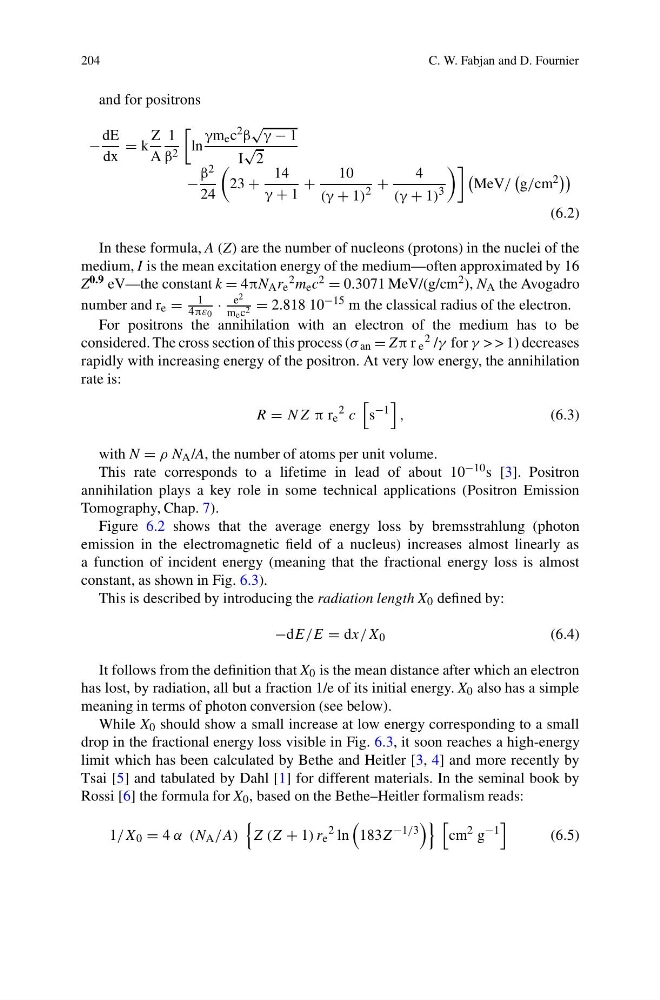
and for positrons
−
dE
dx
= k
Z
A
1
β 2
ln
γm e c 2 β
√
γ − 1
I
√
2
−
β 2
24
23 +
14
γ + 1
+
10
(γ + 1)
2
+
4
(γ + 1)
3
MeV/
g/cm 2
(6.2)
In these formula, A (Z) are the number of nucleons (protons) in the nuclei of the
medium, I is the mean excitation energy of the medium—often approximated by 16
Z 0.9 eV—the constant k = 4πN A r e
2 m e c 2 = 0.3071 MeV/(g/cm 2 ), N A the Avogadro
number and r e =
1
4πε 0
·
e 2
m e c 2 = 2.818 10 −15 m the classical radius of the electron.
For positrons the annihilation with an electron of the medium has to be
considered. The cross section of this process (σ an = Zπ r e
2 /γ for γ > > 1) decreases
rapidly with increasing energy of the positron. At very low energy, the annihilation
rate is:
R = NZ π r e
2 c
s
−1
,
(6.3)
with N = ρ N A /A, the number of atoms per unit volume.
This rate corresponds to a lifetime in lead of about 10 −10 s [3]. Positron
annihilation plays a key role in some technical applications (Positron Emission
Tomography, Chap. 7).
Figure 6.2 shows that the average energy loss by bremsstrahlung (photon
emission in the electromagnetic field of a nucleus) increases almost linearly as
a function of incident energy (meaning that the fractional energy loss is almost
constant, as shown in Fig. 6.3).
This is described by introducing the radiation length X 0 defined by:
−dE/E = dx/X 0
(6.4)
It follows from the definition that X 0 is the mean distance after which an electron
has lost, by radiation, all but a fraction 1/e of its initial energy. X 0 also has a simple
meaning in terms of photon conversion (see below).
While X 0 should show a small increase at low energy corresponding to a small
drop in the fractional energy loss visible in Fig. 6.3, it soon reaches a high-energy
limit which has been calculated by Bethe and Heitler [3, 4] and more recently by
Tsai [5] and tabulated by Dahl [1] for different materials. In the seminal book by
Rossi [6] the formula for X 0 , based on the Bethe–Heitler formalism reads:
1/X 0 = 4 α (N A /A)
Z (Z + 1) r e
2 ln
183Z
−1/3
cm
2 g
−1
(6.5)
C. W. Fabjan and D. Fournier
and for positrons
−
dE
dx
= k
Z
A
1
β 2
ln
γm e c 2 β
√
γ − 1
I
√
2
−
β 2
24
23 +
14
γ + 1
+
10
(γ + 1)
2
+
4
(γ + 1)
3
MeV/
g/cm 2
(6.2)
In these formula, A (Z) are the number of nucleons (protons) in the nuclei of the
medium, I is the mean excitation energy of the medium—often approximated by 16
Z 0.9 eV—the constant k = 4πN A r e
2 m e c 2 = 0.3071 MeV/(g/cm 2 ), N A the Avogadro
number and r e =
1
4πε 0
·
e 2
m e c 2 = 2.818 10 −15 m the classical radius of the electron.
For positrons the annihilation with an electron of the medium has to be
considered. The cross section of this process (σ an = Zπ r e
2 /γ for γ > > 1) decreases
rapidly with increasing energy of the positron. At very low energy, the annihilation
rate is:
R = NZ π r e
2 c
s
−1
,
(6.3)
with N = ρ N A /A, the number of atoms per unit volume.
This rate corresponds to a lifetime in lead of about 10 −10 s [3]. Positron
annihilation plays a key role in some technical applications (Positron Emission
Tomography, Chap. 7).
Figure 6.2 shows that the average energy loss by bremsstrahlung (photon
emission in the electromagnetic field of a nucleus) increases almost linearly as
a function of incident energy (meaning that the fractional energy loss is almost
constant, as shown in Fig. 6.3).
This is described by introducing the radiation length X 0 defined by:
−dE/E = dx/X 0
(6.4)
It follows from the definition that X 0 is the mean distance after which an electron
has lost, by radiation, all but a fraction 1/e of its initial energy. X 0 also has a simple
meaning in terms of photon conversion (see below).
While X 0 should show a small increase at low energy corresponding to a small
drop in the fractional energy loss visible in Fig. 6.3, it soon reaches a high-energy
limit which has been calculated by Bethe and Heitler [3, 4] and more recently by
Tsai [5] and tabulated by Dahl [1] for different materials. In the seminal book by
Rossi [6] the formula for X 0 , based on the Bethe–Heitler formalism reads:
1/X 0 = 4 α (N A /A)
Z (Z + 1) r e
2 ln
183Z
−1/3
cm
2 g
−1
(6.5)