

6 Calorimetry
203
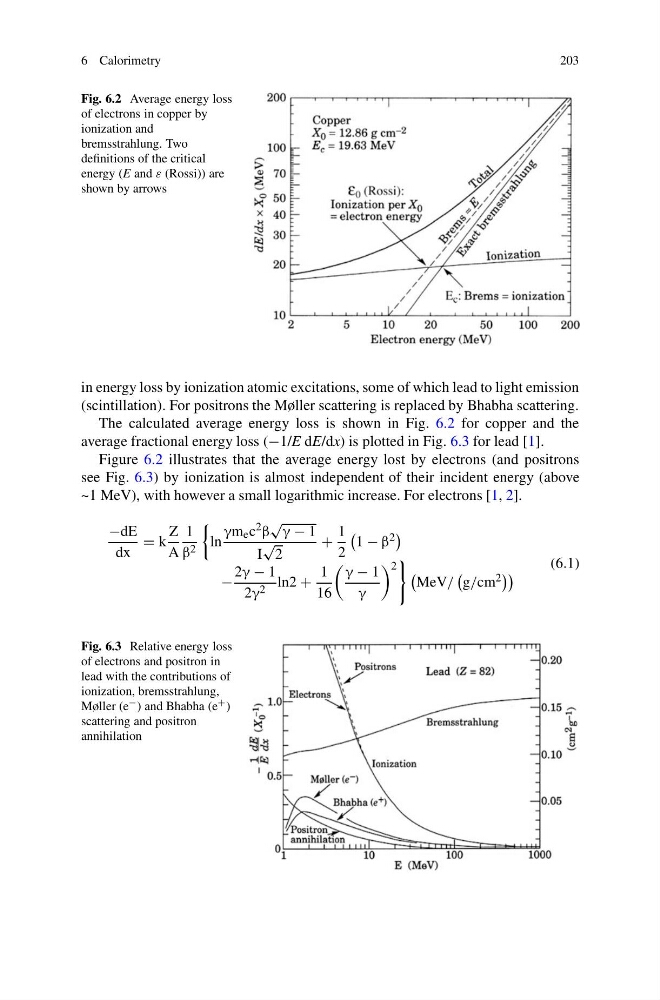
Fig. 6.2 Average energy loss
of electrons in copper by
ionization and
bremsstrahlung. Two
definitions of the critical
energy (E and ε (Rossi)) are
shown by arrows
in energy loss by ionization atomic excitations, some of which lead to light emission
(scintillation). For positrons the Møller scattering is replaced by Bhabha scattering.
The calculated average energy loss is shown in Fig. 6.2 for copper and the
average fractional energy loss (−1/E dE/dx) is plotted in Fig. 6.3 for lead [1].
Figure 6.2 illustrates that the average energy lost by electrons (and positrons
see Fig. 6.3) by ionization is almost independent of their incident energy (above
~1 MeV), with however a small logarithmic increase. For electrons [1, 2].
−dE
dx
= k
Z
A
1
β 2
ln
γm e c 2 β
√
γ − 1
I
√
2
+
1
2
1 − β 2
−
2γ − 1
2γ 2 ln2 +
1
16
γ − 1
γ
2
MeV/
g/cm 2
(6.1)
Fig. 6.3 Relative energy loss
of electrons and positron in
lead with the contributions of
ionization, bremsstrahlung,
Møller (e − ) and Bhabha (e + )
scattering and positron
annihilation
203
Fig. 6.2 Average energy loss
of electrons in copper by
ionization and
bremsstrahlung. Two
definitions of the critical
energy (E and ε (Rossi)) are
shown by arrows
in energy loss by ionization atomic excitations, some of which lead to light emission
(scintillation). For positrons the Møller scattering is replaced by Bhabha scattering.
The calculated average energy loss is shown in Fig. 6.2 for copper and the
average fractional energy loss (−1/E dE/dx) is plotted in Fig. 6.3 for lead [1].
Figure 6.2 illustrates that the average energy lost by electrons (and positrons
see Fig. 6.3) by ionization is almost independent of their incident energy (above
~1 MeV), with however a small logarithmic increase. For electrons [1, 2].
−dE
dx
= k
Z
A
1
β 2
ln
γm e c 2 β
√
γ − 1
I
√
2
+
1
2
1 − β 2
−
2γ − 1
2γ 2 ln2 +
1
16
γ − 1
γ
2
MeV/
g/cm 2
(6.1)
Fig. 6.3 Relative energy loss
of electrons and positron in
lead with the contributions of
ionization, bremsstrahlung,
Møller (e − ) and Bhabha (e + )
scattering and positron
annihilation