

202
C. W. Fabjan and D. Fournier
Only electromagnetic and strong interactions contribute to calorimetric signals,
the weak (and gravitational) interaction being much too small to contribute. Particles
with only weak (or gravitational interaction) will escape direct calorimetric detection. An exception are the neutrino detectors discussed in Sect. 6.4: statistically,
when a very large number of neutrinos cross a detector, a tiny fraction of them
will interact (weakly) with matter and will lead to particle production which can be
measured by different methods, including calorimetry.
The measurement of the energy of a particle is the primary goal of calorimetry.
In addition, several other important quantities can be extracted, such as impact
position and timing, particle direction and identification. These issues are considered
in Sects. 6.4–6.6, before addressing specific examples in Sect. 6.7.
In Sect. 6.2 the fundamentals of calorimetry are presented, followed by a
discussion of signal formation obtained from the energy deposition (Sect. 6.3).
In recent years, calorimetry in the ATLAS and CMS detectors at the LHC played
an essential role in the discovery of the Higgs boson, announced in July 2012.
6.2 Calorimetry: Fundamental Phenomena
Given the large differences between electromagnetic interactions and strong interactions, the following subsections start with electrons and photons, which have only
electromagnetic interactions (see however the end of this section), before addressing
the case of particles with strong interactions, also called hadrons. The case of muons
is considered in a separate subsection.
6.2.1 Interactions of Electrons and Photons with Matter
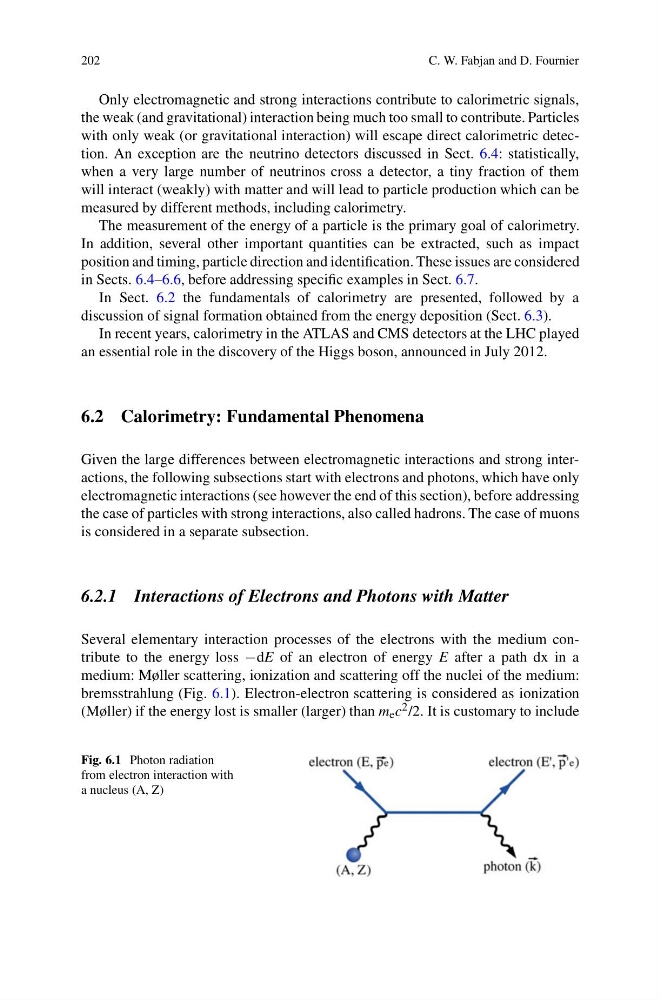
Several elementary interaction processes of the electrons with the medium contribute to the energy loss −dE of an electron of energy E after a path dx in a
medium: Møller scattering, ionization and scattering off the nuclei of the medium:
bremsstrahlung (Fig. 6.1). Electron-electron scattering is considered as ionization
(Møller) if the energy lost is smaller (larger) than m e c 2 /2. It is customary to include
Fig. 6.1 Photon radiation
from electron interaction with
a nucleus (A, Z)
C. W. Fabjan and D. Fournier
Only electromagnetic and strong interactions contribute to calorimetric signals,
the weak (and gravitational) interaction being much too small to contribute. Particles
with only weak (or gravitational interaction) will escape direct calorimetric detection. An exception are the neutrino detectors discussed in Sect. 6.4: statistically,
when a very large number of neutrinos cross a detector, a tiny fraction of them
will interact (weakly) with matter and will lead to particle production which can be
measured by different methods, including calorimetry.
The measurement of the energy of a particle is the primary goal of calorimetry.
In addition, several other important quantities can be extracted, such as impact
position and timing, particle direction and identification. These issues are considered
in Sects. 6.4–6.6, before addressing specific examples in Sect. 6.7.
In Sect. 6.2 the fundamentals of calorimetry are presented, followed by a
discussion of signal formation obtained from the energy deposition (Sect. 6.3).
In recent years, calorimetry in the ATLAS and CMS detectors at the LHC played
an essential role in the discovery of the Higgs boson, announced in July 2012.
6.2 Calorimetry: Fundamental Phenomena
Given the large differences between electromagnetic interactions and strong interactions, the following subsections start with electrons and photons, which have only
electromagnetic interactions (see however the end of this section), before addressing
the case of particles with strong interactions, also called hadrons. The case of muons
is considered in a separate subsection.
6.2.1 Interactions of Electrons and Photons with Matter
Several elementary interaction processes of the electrons with the medium contribute to the energy loss −dE of an electron of energy E after a path dx in a
medium: Møller scattering, ionization and scattering off the nuclei of the medium:
bremsstrahlung (Fig. 6.1). Electron-electron scattering is considered as ionization
(Møller) if the energy lost is smaller (larger) than m e c 2 /2. It is customary to include
Fig. 6.1 Photon radiation
from electron interaction with
a nucleus (A, Z)