

6 Calorimetry
207
The related probability for Compton scattering after the traversal of a material
slab of thickness dt and mass per unit volume ρ is:
φ = σρ N A Z/A dt.
(6.11b)
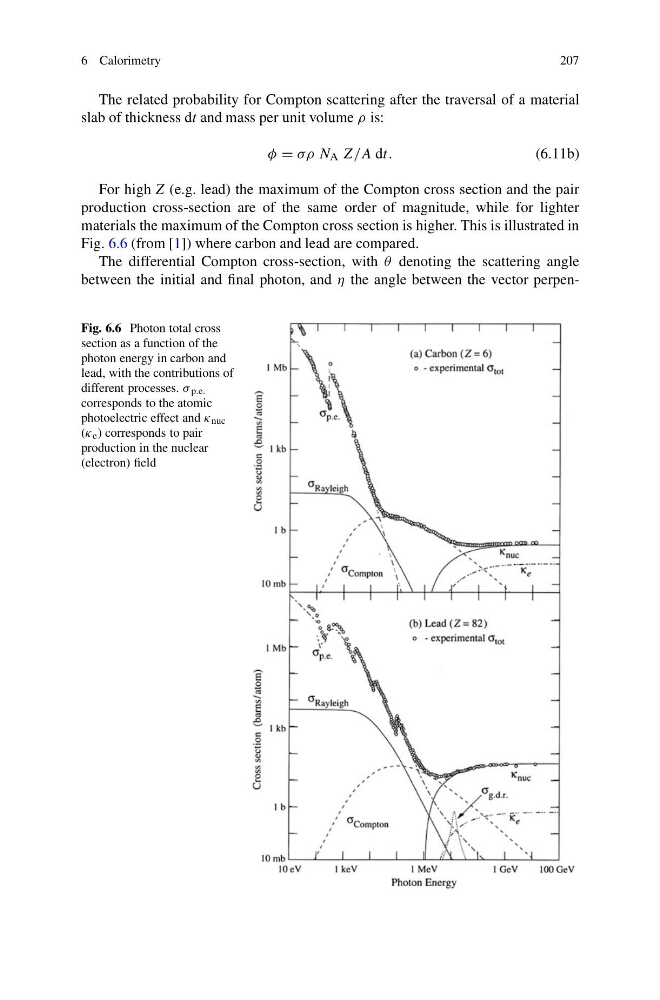
For high Z (e.g. lead) the maximum of the Compton cross section and the pair
production cross-section are of the same order of magnitude, while for lighter
materials the maximum of the Compton cross section is higher. This is illustrated in
Fig. 6.6 (from [1]) where carbon and lead are compared.
The differential Compton cross-section, with θ denoting the scattering angle
between the initial and final photon, and η the angle between the vector perpenFig. 6.6 Photon total cross
section as a function of the
photon energy in carbon and
lead, with the contributions of
different processes. σ p.e.
corresponds to the atomic
photoelectric effect and κ nuc
(κ e ) corresponds to pair
production in the nuclear
(electron) field
207
The related probability for Compton scattering after the traversal of a material
slab of thickness dt and mass per unit volume ρ is:
φ = σρ N A Z/A dt.
(6.11b)
For high Z (e.g. lead) the maximum of the Compton cross section and the pair
production cross-section are of the same order of magnitude, while for lighter
materials the maximum of the Compton cross section is higher. This is illustrated in
Fig. 6.6 (from [1]) where carbon and lead are compared.
The differential Compton cross-section, with θ denoting the scattering angle
between the initial and final photon, and η the angle between the vector perpenFig. 6.6 Photon total cross
section as a function of the
photon energy in carbon and
lead, with the contributions of
different processes. σ p.e.
corresponds to the atomic
photoelectric effect and κ nuc
(κ e ) corresponds to pair
production in the nuclear
(electron) field