

5 Solid State Detectors
187
electronics. The measurement of the primary ionization without gain avoids any
effect of gain variation or amplification noise, and thus leads to stable operation in
spectroscopic measurements. However, high speed and very low noise requirements,
detection of single photons, compensation for charge losses due to radiation
damage or timing accuracies of the order of tens of picoseconds, make an intrinsic
amplification of the detectors desirable.
A rather old and well known device is the avalanche diode, with several different
operating modes. In the last two decades arrays of avalanche diodes operated in
the Geiger mode (SiPMs—Silicon Photo Multipliers) have become photo-detectors
of choice for many applications, and more recently tracking detectors with gain
(LGAD—Low Gain Avalanche Detectors) are developed with the aim to combine
precision position with precision timing in the harsh radiation environment of the
high-luminosity LHC at CERN.
5.11.1 Avalanche Diode
An avalanche diode has a region with a field of sufficient strength to cause charge
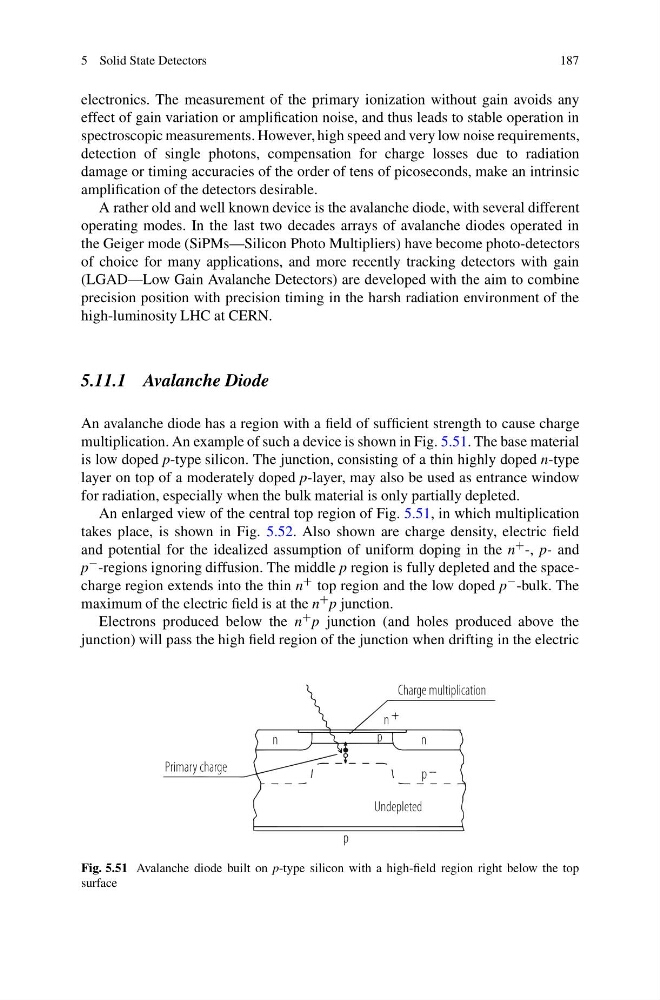
multiplication. An example of such a device is shown in Fig. 5.51. The base material
is low doped p-type silicon. The junction, consisting of a thin highly doped n-type
layer on top of a moderately doped p-layer, may also be used as entrance window
for radiation, especially when the bulk material is only partially depleted.
An enlarged view of the central top region of Fig. 5.51, in which multiplication
takes place, is shown in Fig. 5.52. Also shown are charge density, electric field
and potential for the idealized assumption of uniform doping in the n + -, p- and
p − -regions ignoring diffusion. The middle p region is fully depleted and the spacecharge region extends into the thin n + top region and the low doped p − -bulk. The
maximum of the electric field is at the n + p junction.
Electrons produced below the n + p junction (and holes produced above the
junction) will pass the high field region of the junction when drifting in the electric
Fig. 5.51 Avalanche diode built on p-type silicon with a high-field region right below the top
surface
187
electronics. The measurement of the primary ionization without gain avoids any
effect of gain variation or amplification noise, and thus leads to stable operation in
spectroscopic measurements. However, high speed and very low noise requirements,
detection of single photons, compensation for charge losses due to radiation
damage or timing accuracies of the order of tens of picoseconds, make an intrinsic
amplification of the detectors desirable.
A rather old and well known device is the avalanche diode, with several different
operating modes. In the last two decades arrays of avalanche diodes operated in
the Geiger mode (SiPMs—Silicon Photo Multipliers) have become photo-detectors
of choice for many applications, and more recently tracking detectors with gain
(LGAD—Low Gain Avalanche Detectors) are developed with the aim to combine
precision position with precision timing in the harsh radiation environment of the
high-luminosity LHC at CERN.
5.11.1 Avalanche Diode
An avalanche diode has a region with a field of sufficient strength to cause charge
multiplication. An example of such a device is shown in Fig. 5.51. The base material
is low doped p-type silicon. The junction, consisting of a thin highly doped n-type
layer on top of a moderately doped p-layer, may also be used as entrance window
for radiation, especially when the bulk material is only partially depleted.
An enlarged view of the central top region of Fig. 5.51, in which multiplication
takes place, is shown in Fig. 5.52. Also shown are charge density, electric field
and potential for the idealized assumption of uniform doping in the n + -, p- and
p − -regions ignoring diffusion. The middle p region is fully depleted and the spacecharge region extends into the thin n + top region and the low doped p − -bulk. The
maximum of the electric field is at the n + p junction.
Electrons produced below the n + p junction (and holes produced above the
junction) will pass the high field region of the junction when drifting in the electric
Fig. 5.51 Avalanche diode built on p-type silicon with a high-field region right below the top
surface