

188
G. Lutz and R. Klanner
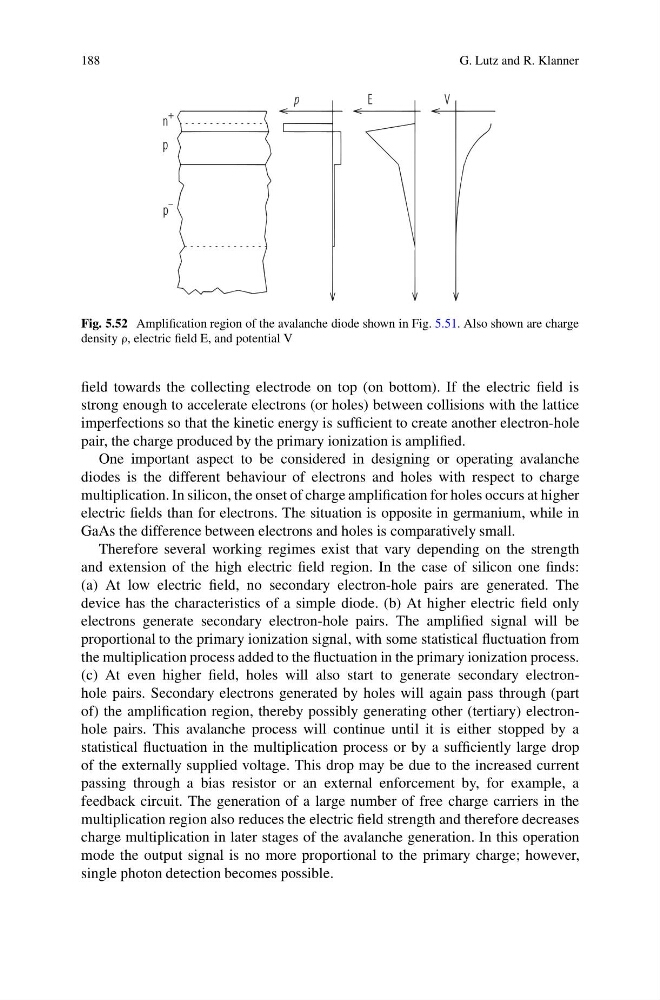
Fig. 5.52 Amplification region of the avalanche diode shown in Fig. 5.51. Also shown are charge
density ρ, electric field E, and potential V
field towards the collecting electrode on top (on bottom). If the electric field is
strong enough to accelerate electrons (or holes) between collisions with the lattice
imperfections so that the kinetic energy is sufficient to create another electron-hole
pair, the charge produced by the primary ionization is amplified.
One important aspect to be considered in designing or operating avalanche
diodes is the different behaviour of electrons and holes with respect to charge
multiplication. In silicon, the onset of charge amplification for holes occurs at higher
electric fields than for electrons. The situation is opposite in germanium, while in
GaAs the difference between electrons and holes is comparatively small.
Therefore several working regimes exist that vary depending on the strength
and extension of the high electric field region. In the case of silicon one finds:
(a) At low electric field, no secondary electron-hole pairs are generated. The
device has the characteristics of a simple diode. (b) At higher electric field only
electrons generate secondary electron-hole pairs. The amplified signal will be
proportional to the primary ionization signal, with some statistical fluctuation from
the multiplication process added to the fluctuation in the primary ionization process.
(c) At even higher field, holes will also start to generate secondary electronhole pairs. Secondary electrons generated by holes will again pass through (part
of) the amplification region, thereby possibly generating other (tertiary) electronhole pairs. This avalanche process will continue until it is either stopped by a
statistical fluctuation in the multiplication process or by a sufficiently large drop
of the externally supplied voltage. This drop may be due to the increased current
passing through a bias resistor or an external enforcement by, for example, a
feedback circuit. The generation of a large number of free charge carriers in the
multiplication region also reduces the electric field strength and therefore decreases
charge multiplication in later stages of the avalanche generation. In this operation
mode the output signal is no more proportional to the primary charge; however,
single photon detection becomes possible.
G. Lutz and R. Klanner
Fig. 5.52 Amplification region of the avalanche diode shown in Fig. 5.51. Also shown are charge
density ρ, electric field E, and potential V
field towards the collecting electrode on top (on bottom). If the electric field is
strong enough to accelerate electrons (or holes) between collisions with the lattice
imperfections so that the kinetic energy is sufficient to create another electron-hole
pair, the charge produced by the primary ionization is amplified.
One important aspect to be considered in designing or operating avalanche
diodes is the different behaviour of electrons and holes with respect to charge
multiplication. In silicon, the onset of charge amplification for holes occurs at higher
electric fields than for electrons. The situation is opposite in germanium, while in
GaAs the difference between electrons and holes is comparatively small.
Therefore several working regimes exist that vary depending on the strength
and extension of the high electric field region. In the case of silicon one finds:
(a) At low electric field, no secondary electron-hole pairs are generated. The
device has the characteristics of a simple diode. (b) At higher electric field only
electrons generate secondary electron-hole pairs. The amplified signal will be
proportional to the primary ionization signal, with some statistical fluctuation from
the multiplication process added to the fluctuation in the primary ionization process.
(c) At even higher field, holes will also start to generate secondary electronhole pairs. Secondary electrons generated by holes will again pass through (part
of) the amplification region, thereby possibly generating other (tertiary) electronhole pairs. This avalanche process will continue until it is either stopped by a
statistical fluctuation in the multiplication process or by a sufficiently large drop
of the externally supplied voltage. This drop may be due to the increased current
passing through a bias resistor or an external enforcement by, for example, a
feedback circuit. The generation of a large number of free charge carriers in the
multiplication region also reduces the electric field strength and therefore decreases
charge multiplication in later stages of the avalanche generation. In this operation
mode the output signal is no more proportional to the primary charge; however,
single photon detection becomes possible.