

5 Solid State Detectors
175
5.10.1 Hybrid Pixel Detectors
Hybrid pixel detectors are used at the Large Hadron Collider (LHC) as the tracking
detectors closest to the beam, where the track densities is highest and the radiation
exposure most severe. They also became a standard detector for X-ray imaging, in
particular at accelerator driven X-ray sources. In their simplest form they consist of
a detector wafer with a two dimensional diode array and separate electronics wafers
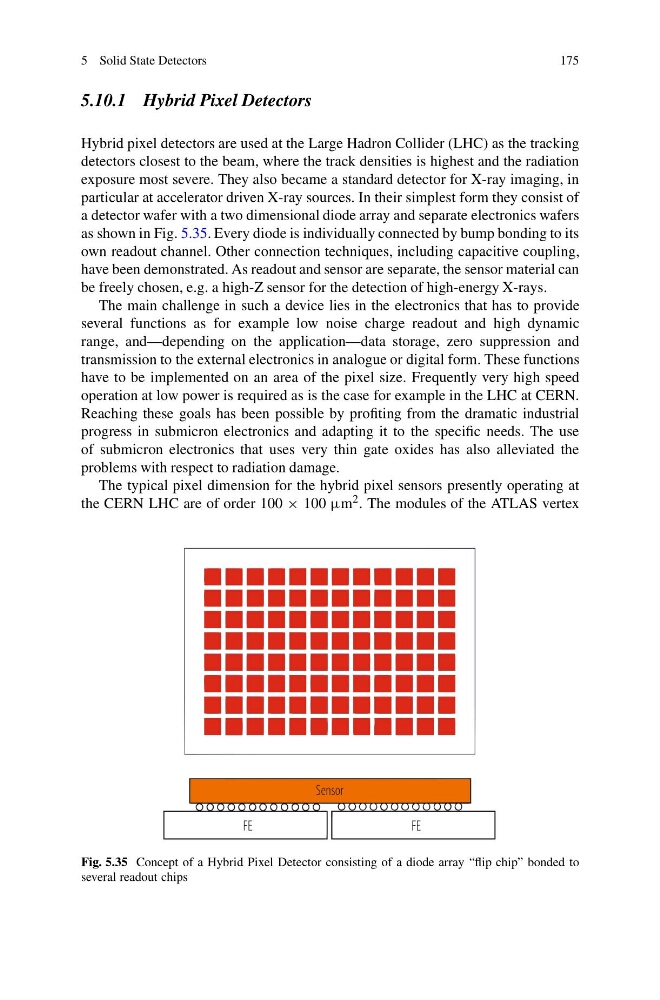
as shown in Fig. 5.35. Every diode is individually connected by bump bonding to its
own readout channel. Other connection techniques, including capacitive coupling,
have been demonstrated. As readout and sensor are separate, the sensor material can
be freely chosen, e.g. a high-Z sensor for the detection of high-energy X-rays.
The main challenge in such a device lies in the electronics that has to provide
several functions as for example low noise charge readout and high dynamic
range, and—depending on the application—data storage, zero suppression and
transmission to the external electronics in analogue or digital form. These functions
have to be implemented on an area of the pixel size. Frequently very high speed
operation at low power is required as is the case for example in the LHC at CERN.
Reaching these goals has been possible by profiting from the dramatic industrial
progress in submicron electronics and adapting it to the specific needs. The use
of submicron electronics that uses very thin gate oxides has also alleviated the
problems with respect to radiation damage.
The typical pixel dimension for the hybrid pixel sensors presently operating at
the CERN LHC are of order 100 × 100 μm 2 . The modules of the ATLAS vertex
Fig. 5.35 Concept of a Hybrid Pixel Detector consisting of a diode array “flip chip” bonded to
several readout chips
175
5.10.1 Hybrid Pixel Detectors
Hybrid pixel detectors are used at the Large Hadron Collider (LHC) as the tracking
detectors closest to the beam, where the track densities is highest and the radiation
exposure most severe. They also became a standard detector for X-ray imaging, in
particular at accelerator driven X-ray sources. In their simplest form they consist of
a detector wafer with a two dimensional diode array and separate electronics wafers
as shown in Fig. 5.35. Every diode is individually connected by bump bonding to its
own readout channel. Other connection techniques, including capacitive coupling,
have been demonstrated. As readout and sensor are separate, the sensor material can
be freely chosen, e.g. a high-Z sensor for the detection of high-energy X-rays.
The main challenge in such a device lies in the electronics that has to provide
several functions as for example low noise charge readout and high dynamic
range, and—depending on the application—data storage, zero suppression and
transmission to the external electronics in analogue or digital form. These functions
have to be implemented on an area of the pixel size. Frequently very high speed
operation at low power is required as is the case for example in the LHC at CERN.
Reaching these goals has been possible by profiting from the dramatic industrial
progress in submicron electronics and adapting it to the specific needs. The use
of submicron electronics that uses very thin gate oxides has also alleviated the
problems with respect to radiation damage.
The typical pixel dimension for the hybrid pixel sensors presently operating at
the CERN LHC are of order 100 × 100 μm 2 . The modules of the ATLAS vertex
Fig. 5.35 Concept of a Hybrid Pixel Detector consisting of a diode array “flip chip” bonded to
several readout chips